

Pakistan chief justice seeks stronger Muslim world ties, unveils AI guidelines for courts

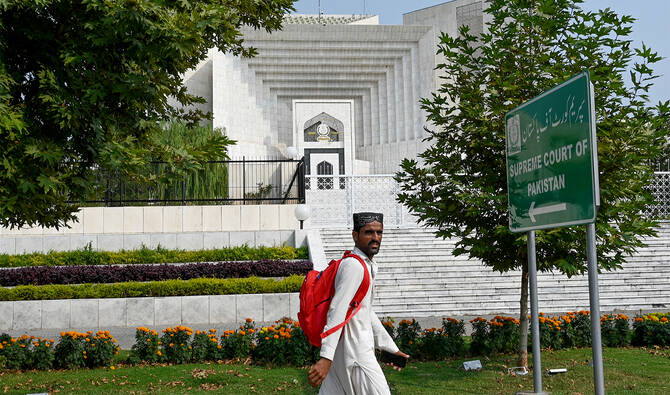
In this photograph taken on October 23, 2024, a man walks past the Pakistan's Supreme Court building in Islamabad. (AFP/File)
Short Url
Updated 08 September 2025
Follow

Pakistan chief justice seeks stronger Muslim world ties, unveils AI guidelines for courts

  • Efforts underway to expand Supreme Court’s collaboration with Saudi Arabia’s Muslim World League, says Justice Yahya Afridi
  • Says a ‘Charter on Ethical Use of AI’ being finalized by the Supreme Court to ensure technology supports judicial efficiency

ISLAMABAD: Pakistan’s Chief Justice Yahya Afridi on Monday said the Supreme Court was expanding partnerships with judicial bodies in Muslim countries and finalizing an ethics charter on artificial intelligence to improve court efficiency.

Justice Afridi was speaking at the Judicial Conference in Islamabad, which is held to mark the beginning of the judicial year. The ceremony was attended by senior judges of the country and members of bar councils to highlight the judiciary’s performance and initiatives. 

The Pakistani judge said that in an interconnected world, it is not possible to strengthen judicial institutions in isolation. He mentioned that the top court had prepared a memorandum of understanding (MoU) with the Supreme People’s Court of China, while a draft MoU with the Constitutional Court of Türkiye is also under review. 

“This Court is also engaged in cooperative exchanges with the Supreme Courts of Bangladesh, Iran, Azerbaijan, and Denmark, and efforts are underway to expand collaboration with the Muslim World League of Saudi Arabia,” Justice Afridi said. 

The Pakistani judge hoped these partnerships would lead to the strengthening of the Supreme Court’s institutional capacity and bring global best practices into Pakistan’s judicial system.

Justice Afridi also spoke about technological reforms taken by the court to improve its efficiency and transform its functions. He said the Supreme Court has introduced digital case filings through which case files are transferred electronically. 

He said the top court has also introduced e-notices, supported by WhatsApp, SMS, and email alerts, and upgraded the digital infrastructure in Islamabad and at the branch registries to facilitate online hearings. It added that the top court has also extended video link services to the country’s high courts. 

Justice Afridi said Model Civil and Criminal Courts are continuing to function with time-bound trials, while mediation facilities were expanded across the provinces and metropolitan family courts to provide speedy justice. 

“In parallel, a Charter on the Ethical Use of AI is being finalized to ensure technology supports judicial efficiency without replacing human discretion,” he said. 

The judge noted that exactly a year ago on Sept. 8, 2024, the number of pending cases with the top court had reached 60,635 while during the year, 20,811 new cases were instituted while 22,863 cases were decided by the Supreme Court. 

“I must add, however, that the backlog could have been reduced even further, had many of our judges not been engaged in larger Constitutional Benches which demand extended hearings,” Justice Afridi said. 


Customs seize narcotics, smuggled goods, vehicles worth $4.9 million in southwest Pakistan

Updated 16 December 2025
Follow

Customs seize narcotics, smuggled goods, vehicles worth $4.9 million in southwest Pakistan

  • Customs seize 22.14 kg narcotics, consignments of smuggled betel nuts, Hino trucks, auto parts, says FBR
  • Smuggled goods enter Pakistan’s Balochistan province from neighboring countries Iran and Afghanistan

ISLAMABAD: Pakistan Customs seized narcotics, smuggled goods and vehicles worth a total of Rs1.38 billion [$4.92 million] in the southwestern Balochistan province on Tuesday, the Federal Board of Revenue (FBR) said in a statement. 

Customs Enforcement Quetta seized and recovered 22.14 kilograms of narcotics and consignments of smuggled goods comprising betel nuts, Indian medicines, Chinese salt, auto parts, a ROCO vehicle and three Hino trucks in two separate operations, the FBR said. All items cost an estimated Rs1.38 billion, it added. 

Smuggled items make their way into Pakistan through southwestern Balochistan province, which borders Iran and Afghanistan. 

“These operations are part of the collectorate’s intensified enforcement drive aimed at curbing smuggling and dismantling illegal trade networks,” the FBR said. 

“All the seized narcotics, goods and vehicles have been taken into custody, and legal proceedings under the Customs Act 1969 have been formally initiated.”

In the first operation, customs officials intercepted three containers during routine checking at FEU Zariat Cross (ZC) area. The containers were being transported from Quetta to Pakistan’s Punjab and Khyber Pakhtunkhwa provinces, the FBR said. 

The vehicles intercepted included three Hino trucks. Their detailed examination led to the recovery of the smuggled goods which were concealed in the containers.

In the second operation, the staff of the Collectorate of Enforcement Customs, Quetta, intercepted a ROCO vehicle at Zariat Cross area with the local police’s assistance. 

The driver was interrogated while the vehicle was searched, the FBR said. 

“During interrogation, it was disclosed that drugs were concealed inside the spare wheel at the bottom side of the vehicle,” it said. 

“Upon thorough checking, suspected narcotics believed to be heroin was recovered which was packed in 41 packets, each weighing 0.54 kilograms.”

The narcotics weighed a total of 22.14 kilograms, with an estimated value of Rs1.23 billion in the international market, the FBR concluded. 

“The Federal Board of Revenue has commended the Customs Enforcement Quetta team for their effective action and reiterated its firm resolve to combat smuggling, illicit trade and illegal economic activities across the country,” it said.