

Pakistan says center, provinces united to promote learning on World Literacy Day 

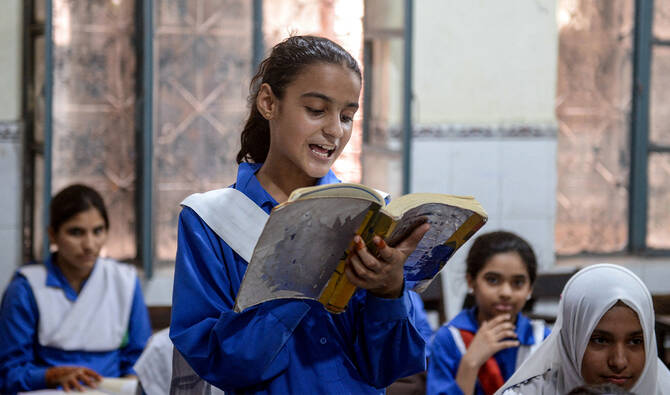
Students attend last day of class at a school before their early summer vacation in Lahore, Pakistan, on May 24, 2024. (AFP/File)
Short Url
Updated 08 September 2025
Follow

Pakistan says center, provinces united to promote learning on World Literacy Day 

  • Alarmingly, Pakistan has one of the highest populations of children out of schools, over 26 million 
  • Pakistan PM says country’s literacy rate below modern global requirements, other South Asian states

ISLAMABAD: Prime Minister Shehbaz Sharif on Monday expressed alarm at Pakistan’s low literacy rate, stressing that the country’s federal and provincial governments were united in their efforts to promote learning as the international community marks World Literacy Day today. 

Since 1967, annual celebrations of World Literacy Day have taken place on Sept. 8 around the world to remind policymakers, practitioners and the public of the critical importance of literacy for creating a more just, peaceful and sustainable society. According to the United Nations Educational, Scientific and Cultural Organization, at least 739 million youth and adults worldwide still lacked basic literacy skills in 2024. 

According to the government, Pakistan’s literacy rate stands at 60%. The country grapples with the challenge of 26 million out-of-school children, one of the highest populations of children around the world without access to education. 

“The federal and provincial governments are united in their efforts to promote learning and increase the literacy rate,” Sharif said, according to a statement by the Prime Minister’s Office (PMO). “The primary objective of this national campaign is to ensure that every child not only receives basic education but also has access to higher education, skills, and technical knowledge.”

Sharif said the process of education, training, literacy, and learning is a “continuous struggle to shape the generations of any nation.” He said education should be the foremost priority of every government for the overall and meaningful progress of a country.

He noted that Pakistan’s literacy rate is 60 percent, which is not only below modern global requirements but also lower than other South Asian countries. 

“This alarming situation reminds us that, as a nation, we must prioritize education and take every possible step to open the path of collective progress for our children, youth, and society,” he added. 

The Pakistani premier stressed the importance of the people’s support, urging teachers, parents, and citizens to recognize their responsibility and play a vital role in promoting education.

“Let us today reaffirm our commitment, as a nation, to dispel the darkness of illiteracy with the light of knowledge and lay the foundation of a strong, capable, and developed Pakistan,” he added. 


Pakistan’s Mahnoor Omer named among TIME’s ‘Women of the Year’ for 2026

Updated 01 March 2026
Follow

Pakistan’s Mahnoor Omer named among TIME’s ‘Women of the Year’ for 2026

  • Omer moved a Pakistani court against the so-called ‘period tax’ in Sept. 2025 which has since sparked a national debate
  • Taxes on sanitary pads in Pakistan can add up to 40 percent to retail price, UNICEF says only around 12 percent women use such products

ISLAMABAD: Pakistani women’s rights activist Mahnoor Omer, who fought against taxes on menstrual products, has been named among the TIME magazine’s ‘Women of the Year’ for 2026.

Omer’s efforts have been recognized alongside 16 activists, artists, athletes and businesswomen in the TIME’s Women of the Year 2026 list, including Olympic gold medalist Sydney McLaughlin-Levrone and Oscar-nominated filmmaker Chloe Zhao.

Dissatisfied with the efforts to educate Pakistani girls about sexual violence, Omer founded the Noor Foundation at the age of 14 and held her own workshops with village girls about everything from climate change to menstruation, according to the TIME magazine.

Two years later, a conversation with a domestic worker about the price of pads made her realize that not everyone could afford these essentials. She moved a court against the so-called “period tax” in Sept. 2025 and the case has sparked a national debate on the subject, considered a taboo by many in Pakistan, since its first hearing late last year.

“A decade and one law degree after her interest in activism was sparked, Omer, now 25, is putting her passion and expertise to work in the name of gender equity,” TIME wrote about Omer on its website.

Taxes imposed on sanitary products in Pakistan can add up to 40 percent to the retail price. UNICEF estimates just 12 percent of women in the country use commercially produced pads or tampons. The alternative, using cloth, risks health impacts including rashes and infections, and can make it impossible for girls to attend school while menstruating.

Omer’s suit, which awaits the government response, has sparked a national discussion. She says she spoke about menstruation to her father and male cousins, who thanked her for standing up for their daughters.
The 25-year-old, who is currently enrolled in a master’s degree in gender, peace, and security at the London School of Economics, sees this case as just the first of many.

“I’m not free until every woman is free,” she was quoted as saying by TIME. “I want to leave no stones unturned in terms of what I can do with the next few decades, as a lawyer for the women in my country and gender minorities in general.”