Pakistan skipper Agha dedicates UAE tri-nation series win to flood victims

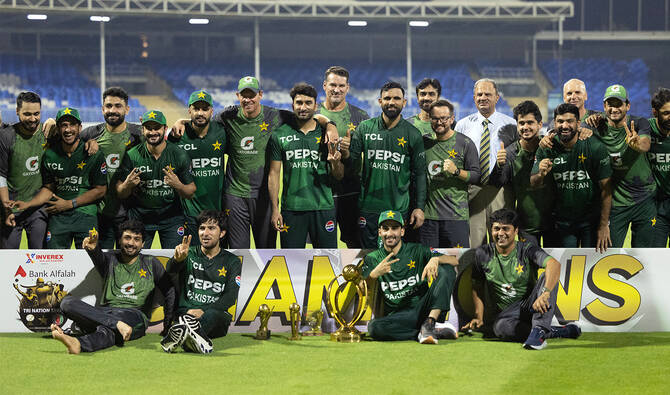
Pakistan's team pose with the trophy after winning the T20 international cricket match against Afghanistan and Pakistan in Sharjah on September 7, 2025. (AFP)
Short Url
Updated 08 September 2025
Follow

Pakistan skipper Agha dedicates UAE tri-nation series win to flood victims

  • Pakistan beat Afghanistan by 75 runs on Sunday to clinch tri-nation series also involving UAE
  • Salman Ali Agha, Shaheen Shah Afridi, donate match fees from entire series to flood relief fund

ISLAMABAD: Pakistan T20 cricket captain Salman Ali Agha dedicated his team’s victory in the tri-nation series in the UAE to flood victims in his country, the Pakistan Cricket Board (PCB) said on Sunday, urging others to come forward and help victims of the calamity. 

Floods in Pakistan’s eastern Punjab province, also known as the country’s breadbasket, have caused devastation for millions since late August. Torrential rains and excess floodwaters released by India have inundated over 4,100 villages in the province, killing at least 56 in Punjab and affecting over four million. 

Pakistan stomped Afghanistan in the final of the tri-nation series on Sunday in Sharjah, which also featured hosts UAE. The Green Shirts won the toss and elected to bat first, putting on 141/8 on a pitch that offered turn and bounce to spinners. In response, Afghanistan were bundled out for a paltry 66 runs in 15.5 overs, courtesy of stellar spin bowling by all-rounder Mohammad Nawaz, who returned figures of 5/19 from his four overs. 

“We stand with our brothers and sisters in this difficult time of hardship,” Agha was quoted as saying by the PCB. “Everyone should come forward together to help the flood victims.”

Agha and lethal left-arm pacer Shaheen Shah Afridi both announced they would dedicate their entire match fees from the tri-nation series to the government’s flood relief fund. 

“The soil of our homeland is demanding from us today to help the flood-affected people,” Afridi was quoted as saying by the board. “I appeal to the nation to actively contribute to the flood relief fund.”

The Green Shirts will now prepare for the upcoming Asia Cup tournament, slated to be held in the UAE from Sept. 9-28. Pakistan will begin their campaign to win the title on Sep. 12 against Oman before taking on defending champions India on Sept. 14 in Dubai. 


Rating firm S&P says it won’t rush Iran war downgrades, sees risks for countries like Pakistan

Updated 12 March 2026
Follow

Rating firm S&P says it won’t rush Iran war downgrades, sees risks for countries like Pakistan

  • Agency says it is monitoring indebted energy importers as higher oil prices strain finances
  • Gulf economies seen better placed to weather shock, though Bahrain flagged as vulnerable

LONDON: S&P Global ‌said it would not make any knee-jerk sovereign rating cuts following the outbreak of war in the ​Middle East, but warned on Thursday that soaring oil and gas prices were putting a number of already cash-strapped countries at risk.

The firm’s top analysts said in a webinar that the conflict, which has involved US and Israeli strikes ‌against Iran and Iranian ‌strikes against Israel, ​US ‌bases ⁠and Gulf ​states, ⁠was now moving from a low- to moderate-risk scenario.

Most Gulf countries had enough fiscal buffers, however, to weather the crisis for a while, with more lowly rated Bahrain the only clear exception.

Qatar’s banking sector could ⁠also struggle if there were significant ‌deposit outflows in ‌reaction to the conflict, although there ​was no evidence ‌of such strains at the moment, they ‌said.

“We don’t want to jump the gun and just say things are bad,” S&P’s head global sovereign analyst, Roberto Sifon-Arevalo, said.

The longer the crisis ‌was prolonged, though, “the more difficult it is going to be,” he ⁠added.

Sifon-Arevalo ⁠said Asia was the second-most exposed region, due to many of its countries being significant Gulf oil and gas importers.

India, Thailand and Indonesia have relatively lower reserves of oil, while the region also had already heavily indebted countries such as Pakistan, Bangladesh and Sri Lanka whose finances would be further hurt by rising energy prices.

“We ​are closely monitoring ​these (countries) to see how the credit stories evolve,” Sifon-Arevalo said.