

Pakistan offers tropical fruits, grains to China as it signs over $4 billion in agri MoUs

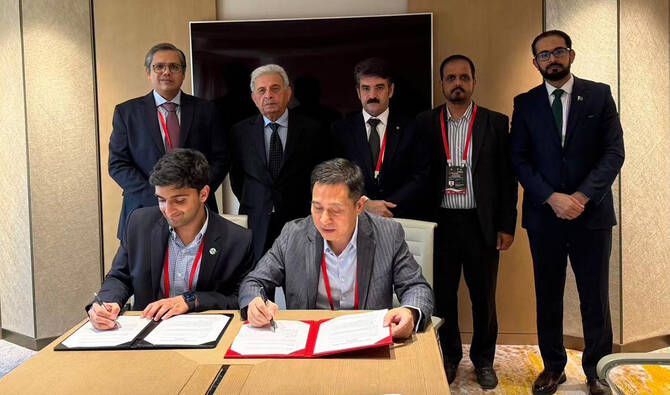
Pakistan’s Federal Minister for National Food Security and Research, Rana Tanveer Hussain (second left-standing), witnessing the signing of agricultural MoUs worth over $4 billion during the Pakistan-China B2B Investment Confrence in Bejing, China, on September 6, 2025. (PID)
Short Url
Updated 06 September 2025
Follow

Pakistan offers tropical fruits, grains to China as it signs over $4 billion in agri MoUs

  • Agriculture minister met over a dozen Chinese firms at B2B event during Sharif’s Beijing visit
  • Pakistan eyes China’s $215 billion annual agricultural import market to boost export-led growth

KARACHI: Pakistan has offered to supply tropical fruits, vegetable and cereal crops to China as it signed more than two dozen agriculture-sector memorandums of understanding worth over $4 billion, its national food security ministry said on Saturday.

The MoUs were finalized at a business-to-business (B2B) investment conference held in Beijing on Sept. 4, coinciding with Prime Minister Shehbaz Sharif’s visit to attend the Shanghai Cooperation Organization summit.

The country’s food security minister, Rana Tanveer Hussain, held meetings with leading agri-industry companies on the sidelines of the conference, inviting Chinese investment in areas like mechanization, seed development, smart farming and precision agriculture to enhance productivity and strengthen Pakistan’s food security.

“Highlighting China’s $215 billion annual agricultural import market, Mr.Hussain said Pakistan can play a significant role in supplying tropical and temperate fruits, vegetables and cereal crops,” the ministry said in a statement.

“He stressed that Pakistan, as China’s closest neighbor and a ‘brotherly country,’ offers geographical proximity and competitive pricing advantages compared to imports from Brazil and other Western countries,” it added.

Pakistan is already receiving agricultural assistance from China after Sharif’s visit last year, when Beijing launched a program to train 1,000 Pakistani agricultural graduates in three phases.

The first batch of about 300 students completed training in Shaanxi province in July, focusing on advanced farming practices, while a second group of 300 departed for China in August.

The initiative aims to equip Pakistan with innovative techniques such as precision agriculture, biotechnology mechanization and modern irrigation systems.

The latest MoUs also come as part of broader Pakistan-China economic cooperation.

Islamabad is planning to float Panda Bonds in the Chinese capital market to boost finances. The national food security ministry’s initiative reflects the government’s continued effort to tap into one of the region’s largest markets as the country pivots toward export-led growth.


Pakistan Navy launches fourth Hangor-class submarine ‘Ghazi’ in China 

Updated 17 December 2025
Follow

Pakistan Navy launches fourth Hangor-class submarine ‘Ghazi’ in China 

  • As per Islamabad’s agreement with Beijing, four of eight submarines will be built in China and the rest in Pakistan
  • Navy says all four submarines under construction in China undergoing sea trials, in final stages of being handed over

ISLAMABAD: The Pakistan Navy announced on Wednesday it has launched the fourth Hangor-class submarine named “Ghazi” at a Chinese shipyard in Wuhan, saying the development will help maintain peace in the region.

Pakistan’s government signed an agreement with China for the acquisition of eight Hangor-class submarines, the navy said in its press release. Under the contract, four submarines are being built in China while the remaining four will be constructed in Pakistan by the Karachi Shipyard and Engineering Works Ltd. company.

“With the launching of GHAZI, Pakistan Navy has achieved another significant milestone where all four submarines under construction in China are now undergoing rigorous sea trials and are in the final stages of being handed over to Pakistan,” the navy said. 

It further said that these submarines will be fitted with advanced weapons and sensors capable of engaging targets at standoff ranges. 

“Hangor-class submarines will be pivotal in maintaining peace and stability in the region,” the navy added. 

Pakistan’s agreement with China is set to strengthen its naval defenses, especially as ties with arch-rival India remain tense. 

India and Pakistan were involved in a four-day military confrontation in May this year before Washington intervened and brokered a ceasefire. Four days of confrontation saw the two countries pound each other with fighter jets, exchange artillery fire, missiles and drone strikes before peace prevailed. 

Pakistan’s air force used Chinese-made J-10 fighter jets in May to shoot down an Indian Air Force Rafale aircraft, made by France.

The altercation between the nuclear-armed neighbors surprised many in the military community and raised questions over the superiority of Western hardware over Chinese alternatives.

Islamabad has long been Beijing’s top arms customer, and over the 2020-2024 period bought over 60 percent of China’s weapons exports, according to data from the Stockholm International Peace Research Institute.