

At SCO, Pakistan demands Gaza ceasefire, reaffirms support for CPEC expansion

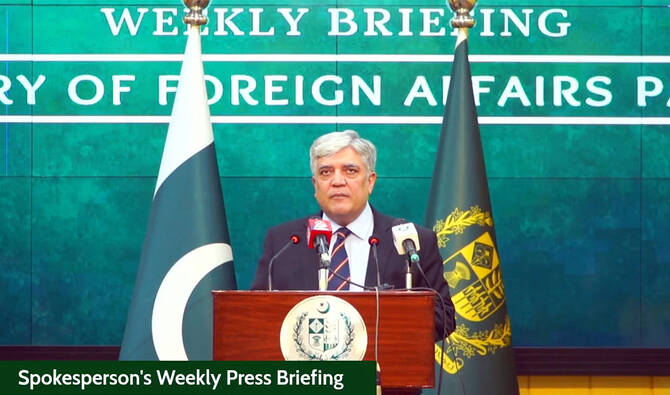
The screengrab taken from the press conference of Pakistan’s Ministry of Foreign Affairs shows the foreign office’s spokesperson Shafqat Ali Khan addressing the weekly media briefing in Islamabad on September 5, 2025. (MOFA)
Short Url
Updated 05 September 2025
Follow

At SCO, Pakistan demands Gaza ceasefire, reaffirms support for CPEC expansion

  • The development comes as Israeli troops operate in parts of Gaza City to take over all of it
  • Sharif, who was in China this week, held talks with Chinese leadership, oversaw several deals

ISLAMABAD: Pakistan condemned Israel’s ongoing military offensive against the Palestinians and called for an immediate ceasefire in Gaza at the Shanghai Cooperation Organization’s (SCO) heads of state meeting in China this week, the Pakistani foreign office said on Friday, with Prime Minister Shehbaz Sharif reaffirming his support for the next phase of the China-Pakistan Economic Corridor (CPEC).

Israeli troops have lately been operating in parts of Gaza City as they plan to take over all of the most populous Palestinian city that is home to around a million people many of whom have already been displaced multiple times.

On Thursday, Israeli strikes killed 28 people as the death toll from Israel’s two-year war rose to 64,000, according to Palestinian health officials. Last month, the Integrated Food Security Phase Classification (IPC) system said Gaza City was officially in famine, with around 514,000 people experiencing it.

Pakistan, which does not have diplomatic relations with Israel, has consistently condemned Israel’s war on Gaza, called for an uninterrupted flow of humanitarian aid into Palestinian territory and the establishment of an independent, sovereign and contiguous

Palestinian state based on pre-1967 borders with East Jerusalem as its capital.

“At the SCO CHS summit, the Prime Minister Sharif presented Pakistan’s perspective on pressing regional and global issues, highlighting strategies to strengthen SCO’s role in fostering regional cooperation and stability,” Shafqat Ali Khan, a Pakistani foreign office spokesman, said at a weekly press briefing in Islamabad.

“The prime minister unequivocally denounced Israel’s inhuman military offensive against Gaza and called for an immediate and unconditional ceasefire.”

The foreign office spokesman said PM Sharif, during his visit to China to attend the SCO summit, held meetings with Chinese President Xi Jinping and Premier Li Qiang, and appreciated Beijing’s support to Pakistan’s socio-economic development.

“He lauded the significance of China-Pakistan Economic Corridor as a flagship project of President Xi Jinping’s Belt and Road Initiative, and reaffirmed the desire to continue working closely with China for the successful implementation of the next phase of upgraded CPEC with its five new corridors,” Khan said.

“This would help both countries to build an even stronger Pakistan-China community with a shared future.”

China is a key strategic ally of Pakistan, with Beijing pouring in tens of billions in energy and infrastructure development projects in the South Asian country under CPEC.

The second phase of CPEC focuses on growth, livelihood and innovation, and reinforcement of Pakistan’s national development framework centered on ‘5 Es,’ representing exports, e-Pakistan, energy, environment and equity.

On Thursday, both countries also signed 21 memorandums of understanding and joint ventures worth $4.2 billion to enhance business-to-business (B2B) cooperation in diverse areas, Pakistani state media reported.


Pakistan forms committee to negotiate financial advisory services for Islamabad airport privatization

Updated 18 February 2026
Follow

Pakistan forms committee to negotiate financial advisory services for Islamabad airport privatization

  • Committee to engage Asian Development Bank to negotiate terms of financial advisory services agreement, says privatization ministry
  • Inaugurated in 2018, Islamabad airport has faced criticism over construction delays, poor facilities and operational inefficiencies

ISLAMABAD: Pakistan’s Privatization Ministry announced on Wednesday that it has formed a committee to engage the Asian Development Bank (ADB) to negotiate a potential financial advisory services agreement for the privatization of Islamabad International Airport.

The Islamabad International Airport, inaugurated in 2018 at a cost of over $1 billion, has faced criticism over construction delays, poor facilities, and operational inefficiencies.

The Negotiation Committee formed by the Privatization Commission will engage with the ADB to negotiate the terms of a potential Financial Advisory Services Agreement (FASA) for the airport’s privatization, the ministry said. 

“The Negotiation Committee has been mandated to undertake negotiations and submit its recommendations to the Board for consideration and approval, in line with the applicable regulatory framework,” the Privatization Ministry said in a statement. 

The ministry said Islamabad airport operations will be outsourced under a concession model through an open and competitive process to enhance its operational efficiency and improve service delivery standards. 

Pakistan has recently sought to privatize or outsource management of several state-run enterprises under conditions agreed with the International Monetary Fund (IMF) as part of a $7 billion bailout approved in September last year.

Islamabad hopes outsourcing airport operations will bring operational expertise, enhance passenger experience and restore confidence in the aviation sector.

In December 2025, Pakistan’s government successfully privatized its national flag carrier Pakistan International Airlines (PIA), selling 75 percent of its stakes to a consortium led by the Arif Habib Group. 

The group secured a 75 percent stake in the PIA for Rs135 billion ($482 million) after several rounds of bidding, valuing the airline at Rs180 billion ($643 million).

Pakistan’s Finance Minister Muhammad Aurangzeb said this week the government has handed over 26 state-owned enterprises to the Privatization Commission.