

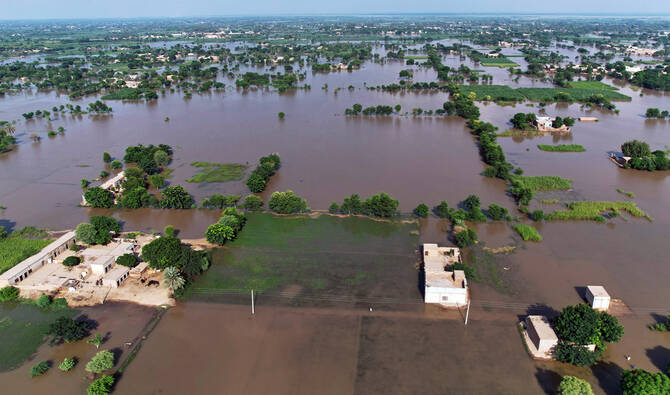

ISLAMABAD: India has warned Pakistan of fresh cross-border flooding in Sutlej as rains in upper parts of Pakistan continue to swell rivers in the eastern Punjab province, the Pakistani water resources ministry said on Friday, amid an already high flood situation at Trimmu and Panjnad headworks in the province.
Pakistan’s Punjab has been facing an emergency as monsoon floods have killed 46 people, displaced 1.8 million and inundated 1.3 million acres of agricultural land in the country’s breadbasket province over the last two weeks, official data shows. Another 3.9 million people have been affected.
The Indian high commission in Islamabad conveyed the warning to Pakistan through the ministry of water resources, which mentioned of the release of excess water in the Sutlej river from Harike and Ferozepur headworks in India, rather than the water-sharing Indus Waters Treaty, which India has said remains suspended.
The development comes as Chenab, Ravi and Sutlej continue to have a flood situation, particularly at the Trimmu and Panjnad headworks in Punjab’s Jhang and Bahawalpur districts, following fresh rains in upper parts of the country, according to the Punjab Provincial Disaster Management Authority (PDMA).
“Citizens should take precautionary measures and never go near rivers for recreational activities,” the PDMA said on Friday, adding that monsoon rains were predicted in most districts of Punjab till Sept. 9.
“Refrain from fishing and other activities in rivers.”
In its report about losses from floods in Ravi, Sutlej and Chenab, the PDMA said the deluges have affected more than 3,900 villages. Relief Commissioner Punjab
“A total of 3,892,000 people were affected due to flood situation,” Punjab Relief Commissioner Nabeel Javed said, adding that authorities had relocated more than 1.8 million people to safer places.
A total of 415 relief camps and 466 medical camps have been set up in affected districts, according to the official. Another 398 veterinary camps have been set up to provide treatment facilities to livestock.
“In the affected districts, 1,342,000 animals were shifted to safer places during rescue and relief activities,” he added.
Monsoon season brings Pakistan up to 80 percent of its annual rainfall, but increasingly erratic and extreme weather patterns are turning the annual rains, which are vital for agriculture, food security and the livelihoods of millions of farmers, into a destructive force.
Rains, floods, landslides and similar incidents have killed at least 884 people nationwide since June 26, according to the National Disaster Management Authority (NDMA). The disaster has revived memories of the 2022 deluges, when a third of the country was submerged, over 1,700 people were killed and losses exceeded $35 billion.
The floods, which have been moving downstream from Punjab, have prompted authorities in the southern Sindh province to evacuate people to safety.
On Thursday evening, the NDMA said Sindh’s northern districts of Sukkur, Ghotki, Larkana, Khairpur, Dadu and Jacobabad were at risk, while southern districts of Thatta, Sujawal, Badin, Tharparkar, Umerkot, Sanghar, Karachi, Hyderabad and Jamshoro could see heavy downpours in the coming days.
“Your lives are precious, and no unnecessary risk should be taken in the face of natural calamities,” First Lady Aseefa Bhutto Zardari told communities, while inspecting protective structures and relief camps during a preparedness visit to embankments near Nawabshah.
“Effective coordination between departments, close monitoring, and advanced planning are essential if we are to manage this challenge successfully.”
Pakistan, which ranks among the world’s most climate-vulnerable nations, has experienced increasingly erratic, frequent weather events, including heat waves, untimely rains, storms, cyclones and droughts, in recent years, which scientists have blamed on human-driven climate change.
In May, at least 32 people were killed in severe storms in the South Asian country.


