

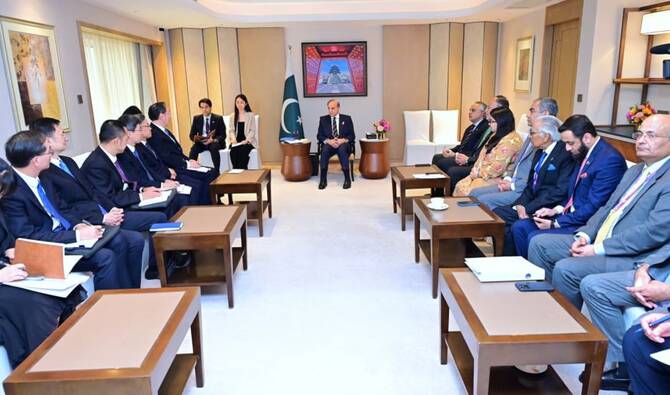

ISLAMABAD: Pakistan and China have signed 21 memorandums of understanding and joint ventures worth $4.2 billion to enhance business-to-business (B2B) cooperation in diverse areas, Pakistani state media reported on Thursday, with Prime Minister Shehbaz Sharif assuring Chinese businessmen removal of all hiccups in investment procedures.
The agreements were signed at the second Pakistan-China B2B Investment Conference in Beijing that Sharif as a reflection of the “iron-clad brotherhood” between Pakistan and China, unveiling his plans for greater economic cooperation between the two countries.
China is a key strategic ally of Pakistan, with Beijing pouring in tens of billions in energy and infrastructure development projects in the South Asian country under the China-Pakistan Economic Corridor (CPEC), part of President Xi Jinping’s Belt and Road Initiative (BRI).
Speaking at the investment conference in Beijing, the Pakistan prime minister highlighted Pakistan’s unwavering commitment to investor facilitation and told Chinese businessmen that “Pakistan is your second home, just as China is ours,” the Associated Press of Pakistan (APP) reported.
“This is one of the largest business conferences I have attended during my visit to this great country. Our relationship with China is unmatched, higher than the Himalayas, deeper than the deepest oceans, sweeter than honey and stronger than steel,” he was quoted as saying.
“We will not tolerate a second’s delay.”
Sharif was in China on a six-day visit to China since Aug. 30 to attend the Shanghai Cooperation Organization (SCO) heads of state summit in Tianjin. He also held talks with President Xi, Premier Li Qiang, Russian President Vladimir Putin and other world leaders on the sidelines of the summit.
The Pakistan prime minister described the B2B engagements as a “long march of economic development” between the two countries, which he commenced from Beijing and would conclude in Islamabad, the Radio Pakistan broadcaster reported.
The agreements were signed in the fields of agriculture, industry, health, trade, mining and minerals, and others.
“Agriculture is the backbone of Pakistan’s economy as sixty percent of its economy relies on agriculture,” Sharif said, encouraging Chinese companies to come forward and contribute their experience, expertise and investments to boosting this sector in Pakistan.
“Information Technology and Artificial Intelligence is another area, where China is a world leader, where both countries can enhance bilateral cooperation.”
On Thursday, Sharif also announced the launch of the second phase of CPEC, vowing to safeguard Chinese nationals working in the country and accelerate stalled projects.
Signed in 2015, CPEC is a multi-billion-dollar network of roads, railways, ports and power plants linking western China to the Arabian Sea through Pakistan. Pakistan’s Planning Commission (CPEC Secretariat) last year reported that the corridor projects were worth about $25.4 billion, with another $8 billion under implementation, putting the total Chinese investment at around $33 billion so far.
The scheme’s second phase, branded “CPEC 2.0,” aims to expand beyond roads and energy into industry, agriculture, information technology and special economic zones, with Islamabad looking to revive growth and attract new Chinese capital.


