CAIRO: Sudanese authorities said Thursday they recovered and buried the bodies of hundreds of people who died in a landslide over the weekend in Sudan’s western region of Darfur.
Mujib Al-Rahman Al-Zubair, head of the Civil Authority in the Liberated Territories, said in a video address shared with The Associated Press that the authority, along with help from local aid workers, was able to reach 375 bodies, but the remaining bodies remain trapped underground.
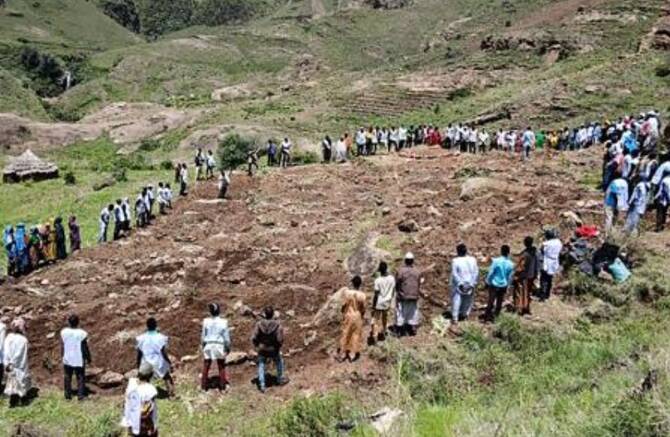
“May the victims of this devastating incident receive mercy,” he said as he and dozens of others gathered at the scene of the landslide to pray for the dead.
Al-Zubair is leading rescue missions, hoping to recover more bodies and find survivors despite the lack of equipment and resources.
The Aug. 31 landslide that followed days of heavy rainfall in Tarasin, in the Marrah Mountains, could have possibly killed as many as 1,000, Mohamed Abdel-Rahman Al-Nair, a spokesperson for the Sudan Liberation Movement-Army, previously told the AP. The United Nations’ Office for the Coordination of Humanitarian Affairs, OCHA, had a similar death toll estimate, but said it’s hard to confirm the magnitude of the tragedy because the area is hard to reach.
The UN has said that efforts have been mobilized to support the impacted area, located more than 900 kilometers (560 miles) west of the capital, Khartoum.
UN spokesperson Stéphane Dujarric said in a briefing on Thursday that an estimated 150 people from Tarseen and neighboring villages have been displaced.
OCHA and partners launched a rapid assessment and response mission Thursday, with teams from local NGOs, UN agencies and international groups reaching the site partly by donkey due to rough terrain, according to Dujarric. Their focus is to verify the number of people affected and deliver essential aid for up to 750 people, including medical kits and food. Mobile health clinics and emergency medical teams were also deployed to the area.
Al-Nair said in a statement Thursday that the landslide caused a “catastrophic humanitarian situation” that requires a rapid response from the international community to provide food and shelter for those who have lost everything.
The Marrah Mountains region is a volcanic area with a height of more than 3,000 meters (9,840 feet) at its summit. The mountain chain is a world heritage site and is known for its lower temperature and higher rainfall than its surroundings, according to UNICEF.
A small-scale landslide hit the area in 2018, killing at least 19 people and injuring dozens of others, according to the now-disbanded United Nations-African Union mission in Darfur.
Sudan is already impacted by one of the worst humanitarian crises in the world caused by the ongoing civil war that erupted in April 2023 in the capital city, Khartoum. The conflict spread across the country after simmering tensions escalated between the Sudanese army and its rival paramilitary Rapid Support Forces. More than 40,000 people have been killed and as many as 12 million displaced.
Some areas in the country are struggling with famine and disease outbreaks such as cholera.


![]()

Sudanese authorities bury hundreds of victims of Darfur landslide
Short Url
https://arab.news/ckepu
Sudanese authorities bury hundreds of victims of Darfur landslide
- “May the victims of this devastating incident receive mercy,” Al-Zubair said as he and dozens of others gathered at the scene of the landslide to pray for the dead
- The UN has said that efforts have been mobilized to support the impacted area


Latest updates





© 2026 SAUDI RESEARCH & PUBLISHING COMPANY, All Rights Reserved And subject to Terms of Use Agreement.