

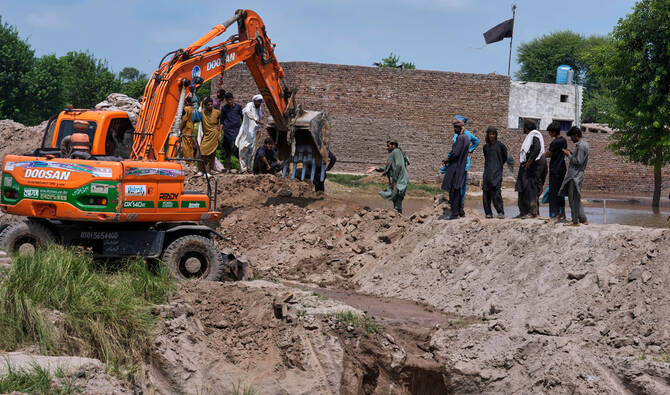

ISLAMABAD: Pakistan’s disaster agency on Thursday issued a high alert for Sindh as heavy monsoon rains and swollen rivers threatened to inundate large parts of the southern province, even as Punjab, the country’s most populous region, remained under severe pressure from surging Chenab River flows.
Nationwide, more than 883 people have died in rains, floods and landslides since the monsoon season began on June 26, according to the NDMA, reviving memories of Pakistan’s catastrophic 2022 deluges when a third of the country was submerged, 30 million displaced and economic losses exceeded $35 billion.
On Thursday evening, the National Disaster Management Authority (NDMA) said Sindh’s southern districts including Thatta, Sujawal, Badin, Tharparkar, Umerkot, Sanghar, Karachi, Hyderabad and Jamshoro could see heavy downpours in the coming days, while the northern districts of Sukkur, Ghotki, Larkana, Khairpur, Dadu and Jacobabad were also at risk.
With flood peaks still moving downstream from Punjab, the alert warned of “high to very high” flooding along the eastern rivers, urging residents of riverine areas to evacuate without delay.
“Your lives are precious, and no unnecessary risk should be taken in the face of natural calamities,” First Lady Bibi Aseefa Bhutto Zardari told communities during a preparedness visit to embankments near Nawabshah.
She inspected protective structures and relief camps, praising local authorities for round-the-clock monitoring and rescue readiness.
“Effective coordination between departments, close monitoring, and advanced planning are essential if we are to manage this challenge successfully,” Bhutto Zardari added.
PUNJAB CRISIS
In Punjab, home to half of Pakistan’s 240 million people and often described as the country’s breadbasket, officials said nearly 3.9 million people had been affected, 1.8 million displaced, and 46 killed in floods since late August. Thousands of villages have been submerged.
Punjab Disaster Management Authority chief Irfan Ali Kathia said the next 24 hours were “extremely critical” for Multan, a city of 2.6 million and the main economic hub of southern Punjab. Multan.
“The main surge of the Chenab has already reached Head Muhammad Wala at its peak and is now moving downstream,” he told reporters.
Kathia added that the Sher Shah Bridge flood gauge near Multan had reached 393.4 feet, against a danger mark of 393.5 feet, leaving only a few inches of space.
If authorities were forced to open a breaching section to relieve pressure, he said, 27 settlements including Shershah, Akbarpur and Mirzapur, home to around 35,000 people, could be inundated.
RIVER FLOWS
Fresh PDMA data from Thursday morning showed the Chenab easing at some upstream points but worsening downstream. Flows at Marala dropped sharply to around 117,000 cusecs from 192,000 recorded the previous evening, and at Khanki fell from 253,600 to 248,800 cusecs. Qadirabad also declined, from 489,000 to 385,000 cusecs.
But the danger has shifted further downstream: at Chiniot bridge levels climbed to nearly 555,000 cusecs, up from 540,000 only hours earlier, while gauges at Riwaz Bridge and Head Muhammad Wala edged higher and Sher Shah Bridge held just inches below its maximum capacity.
On the Ravi, flows steadied or fell slightly at most points, with Jassar down to 80,000 cusecs from 84,000, though Balloki remained elevated at nearly 139,000. On the Sutlej, Ganda Singh Wala dipped modestly to 319,000 cusecs from 327,000, while Panjnad surged to 224,000 from 200,500, suggesting pressure building in the south.
NORTHERN AREAS
Separately, the NDMA warned of landslides in Gilgit-Baltistan and Azad Jammu & Kashmir from Sept. 4–8, citing high risk in Muzaffarabad, Neelum Valley, Haveli, Bagh, Poonch and Sudhnuti.
Heavy rains could block the Karakoram Highway and other routes in Torghar, Batagram, Shangla, Lower Kohistan, Gilgit, Hunza, Rondhu, Skardu and Chitral.


