

Pakistan, Qatar hold second round of Higher Military Cooperation talks

Short Url
Updated 04 September 2025
Follow

Pakistan, Qatar hold second round of Higher Military Cooperation talks

  • CJCSC Gen. Mirza meets Qatar’s deputy PM, armed forces chief in Doha
  • Two sides discuss evolving regional security dynamics, defense partnership

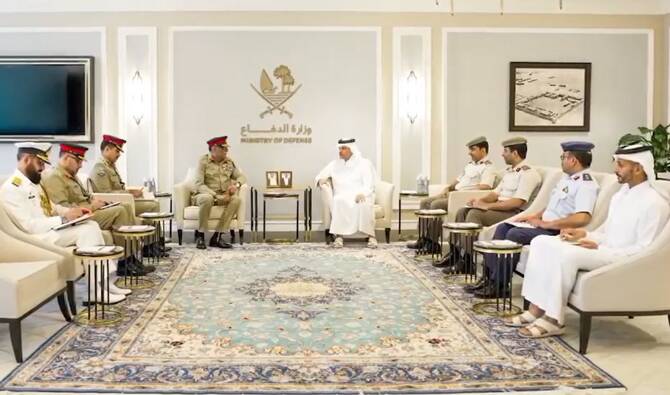
ISLAMABAD: Pakistan’s top military official, General Sahir Shamshad Mirza, held talks with Qatari leaders on Thursday as part of the second round of the Higher Military Cooperation Committee (HMCC), a bilateral platform for defense and security dialogue, the military said.

Mirza, who serves as Chairman Joint Chiefs of Staff Committee (CJCSC), met Deputy Prime Minister and Defense Minister Sheikh Saoud bin Abdulrahman Al Thani and Qatar’s Armed Forces Chief of Staff Lt. Gen. Jassim Mohammad Ahmed Al-Mannal during his official visit to Doha.

“Both sides discussed the evolving regional security dynamics and reaffirmed their shared commitment to peace and stability at regional and global level,” the Inter-Services Public Relations (ISPR) said in a statement.

It added that Mirza “highlighted historic brotherly ties between both nations and discussed the future dimensions of cooperation in defense and security domains within the ambit of HMCC.”

Qatar’s civil and military leadership, according to ISPR, “acknowledged Pakistan’s pivotal and responsible role in ensuring regional stability and appreciated professionalism and sacrifices of Pakistan Armed Forces in fight against terrorism.”

Pakistan and Qatar share close defense ties, including military training, joint exercises and strategic cooperation. 

The visit follows regular high-level exchanges, including the 2023 meeting between Qatar’s then armed forces chief Lt. Gen. Salem Hamad Eqail Al-Nabet and Pakistan’s army chief Asim Munir to discuss regional security.

Pakistan plans overhaul of agricultural research system to boost exports, food security

Updated 6 sec ago
Follow

Pakistan plans overhaul of agricultural research system to boost exports, food security

  • Government says research institutions must move beyond siloed structures, speed up commercialization
  • Officials say national research agenda should be aligned with export targets and development priorities

ISLAMABAD: Pakistan is planning a comprehensive overhaul of its agricultural research system to improve productivity, strengthen food security and increase export competitiveness, said an official statement on Wednesday.

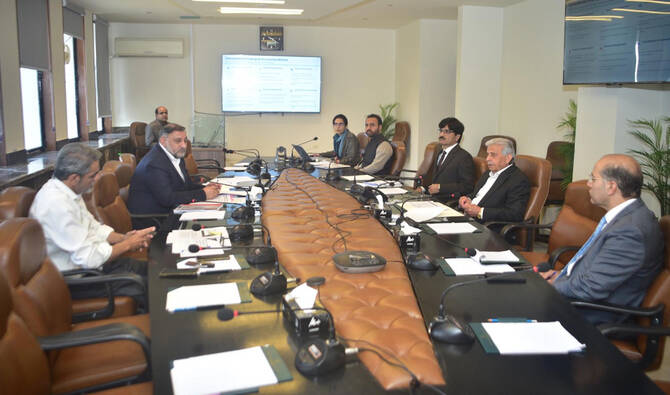
Federal Minister for National Food Security and Research Rana Tanveer Hussain discussed the reform plan during a meeting with Pakistan Agricultural Research Council (PARC) Chairman Syed Murtaza Hassan Andrabi, it said.

The initiative comes as Pakistan seeks to modernize its agriculture sector, which contributes about a fifth of the country’s economic output and employs a large share of its workforce but has long struggled with low productivity and weak technology adoption.

Hussain said the reform would address inefficiencies caused by overlapping mandates between federal and provincial research institutions and encourage closer collaboration across scientific disciplines.

“Research must move beyond siloed structures and adopt cross-disciplinary approaches, ensuring practical and commercially viable outcomes,” the minister said.

He also stressed the need to accelerate technology transfer from laboratories to farms and markets, noting that innovations such as vaccines had historically taken years to reach commercialization.

PARC chairman Andrabi said the country’s research priorities should directly support economic and food security objectives.

“Pakistan’s national research agendas must be aligned with export targets and food security goals, ensuring that all research efforts directly contribute to national priorities,” he said.

Under the reform plan, Pakistan will establish specialized Centers of Excellence focusing on climate-resilient crops, livestock improvement, food processing, artificial intelligence and precision agriculture, as well as sustainable land and water management.

The government also plans to introduce a Digital National Agricultural Research Information System (NARIS) platform to serve as a centralized repository for research data and collaboration among institutions.

Officials said a new scientific advisory committee, comprising both local and international experts, would be formed to guide strategic priorities and benchmark Pakistan’s research system against global standards.