

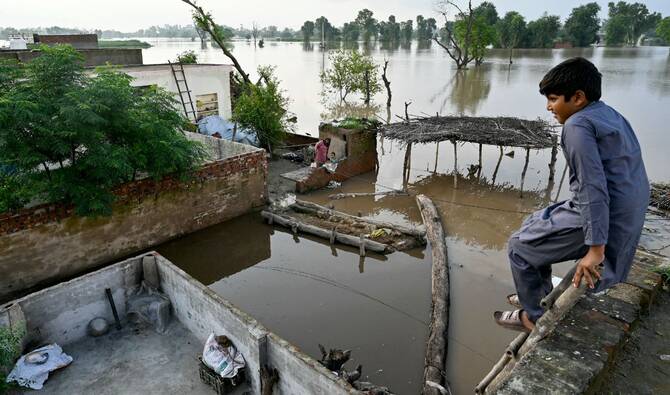

ISLAMABAD: Pakistan’s disaster management chief in Punjab warned on Thursday that the next 24 hours would be “extremely critical” as downstream gauges on the Chenab River swelled near danger levels, threatening the southern city of Multan and dozens of nearby villages after weeks of heavy monsoon rains.
Punjab, home to half of Pakistan’s 240 million people, is the country’s most populous and agriculturally vital province, often described as its breadbasket. Officials say 46 people have been killed, nearly 3.9 million people affected, 1.8 million displaced, and thousands of villages inundated as the Chenab, Ravi and Sutlej rivers have overflowed since late last month.
Nationwide, more than 883 people have died in floods, rains and landslides since the monsoon season began on June 26, according to the National Disaster Management Authority. The disaster has revived memories of the 2022 deluges, when a third of the country was submerged, 30 million people were displaced and losses exceeded $35 billion.
“This is a critical time for the city and district of Multan,” Punjab Disaster Management Authority (PDMA) Director General Irfan Ali Kathia told reporters at a press conference.
“The main surge of the Chenab has already reached Head Muhammad Wala at its peak and is now moving downstream.”
Multan, with a population of about 2.6 million, is the largest city in southern Punjab and the region’s economic hub, famous for mango exports, textiles and fertile farmland.
Kathia said while there was “no danger” yet at Head Muhammad Wala, a barrage point on the Chenab upstream of Multan, the Sher Shah Bridge flood gauge near the city had already reached maximum capacity with only “two to three inches of space” left.
If authorities were forced to operate a breaching section to relieve pressure, he warned, “there are about twenty-seven locations that can be affected by it,” including settlements such as Shershah, Akbarpur and Mirzapur, with 35,000 residents at risk.
Kathia said backwater flows on the Ravi River were worsening the crisis, creating stagnant water in Toba Tek Singh and Khanewal districts.
“At present, under the backwater effect… there are about two hundred and three villages that have been affected,” he said, adding that more than 1.8 million people and 1.3 million animals had already been evacuated with the help of the Pakistan Army and Rescue 1122.
Relief Commissioner Nabeel Javed said separately in a statement that 46 people had died in Punjab in the latest spell of monsoon rains and floods. He said 410 relief camps, 444 medical camps and 395 veterinary camps had been set up across the province to support those displaced.
RIVER FLOWS AND SINDH THREAT
River flows remained dangerously high on Thursday evening, according to the Punjab Disaster Management Authority.
On the Chenab, flows were recorded at 192,000 cusecs at Marala (steady), 253,600 at Khanki (falling) and 489,000 at Qadirabad (falling). At Chiniot bridge, levels had climbed to nearly 540,000 cusecs and were still rising.
Gauges at Riwaz Bridge (520.4 feet against a maximum of 526 feet), Trimmu Headworks (239,500 cusecs) and Head Muhammad Wala (413.9 feet against a danger level of 417.5 feet) were reported steady.
At Sher Shah Bridge, levels stood at 393.2 feet against a maximum of 393.5 feet, also steady.
On the Ravi, flows stood at 84,000 cusecs at Jassar (steady), 101,400 at Ravi Syphon (steady), 100,800 at Shahdara (steady), 137,000 at Balloki (rising) and 135,000 at Sidhnai (steady).
On the Sutlej, flows were 327,000 cusecs at Ganda Singh Wala (steady), 139,500 at Sulemanki (steady), 102,000 at Islam Headworks (steady), 200,500 at Panjnad (steady) and 93,000 at Malsi Syphon (rising).
(One cusec equals one cubic foot per second of water flow.)
With reservoirs on both sides of the border near full capacity — Tarbela at 100 percent, Mangla at 87 percent, and India’s Bhakra, Pong and Thein all above 90 percent — officials warned of further downstream pressure in the southern province of Sindh.
Chief Minister Murad Ali Shah said his province was preparing for a potential “super flood” as inflows from Punjab converged in the coming days.
“Our preparations are complete, and we pray this time passes without major damage,” Shah told reporters, warning that persuading riverine communities to evacuate remained the greatest challenge.
NORTHERN RISKS
Separately, the National Disaster Management Authority’s National Emergency Operation Center issued a landslide alert for Gilgit Baltistan and Azad Jammu & Kashmir from Sept. 4–8, warning of slope failures and road blockages due to forecast heavy rains.
Districts including Muzaffarabad, Neelum Valley, Haveli, Bagh, Poonch and Sudhnuti were identified as high risk. The alert said landslides could disrupt the Karakoram Highway at multiple points, including Torghar, Batagram, Shangla, Lower Kohistan, Tattapani, Gilgit, Hunza, Rondhu, Skardu and Chitral.
Authorities advised residents to avoid unnecessary travel in mountainous areas, remain updated on weather and road conditions, and follow local administration instructions. The NEOC said it was operating round the clock in coordination with civil and military agencies.


