

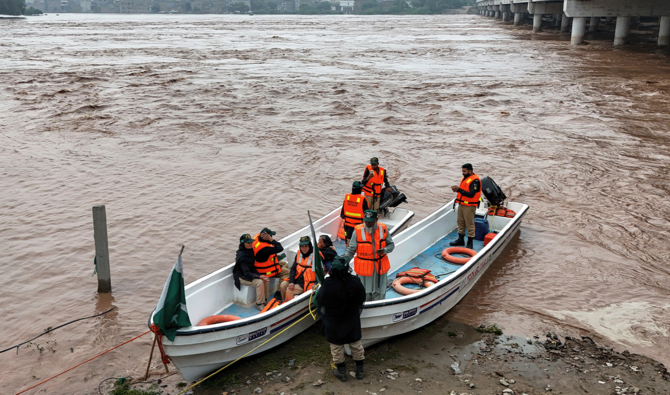

ISLAMABAD: As Pakistan reels from floods that have killed at least 43 people and displaced more than 1.3 million in Punjab this month, a surprise call by Khyber Pakhtunkhwa (KP) Chief Minister Ali Amin Gandapur to build the long-stalled Kalabagh Dam has reignited one of the country’s fiercest water disputes.
The Kalabagh Dam, proposed in 1984 on the Indus River in Punjab’s Mianwali district, is designed to generate 3,600 megawatts of electricity, irrigate farmland and store water to help manage floods. But the $10 billion project has never moved forward because of fierce opposition from the provinces of Sindh and KP, where leaders fear it would divert water southward, submerge districts like Nowshera, and displace thousands of families. Assemblies in the two provinces have passed multiple resolutions against the dam, while successive governments in Islamabad have avoided pushing it for fear of inflaming regional tensions.
For now, Gandapur’s comments appear unlikely to break the deadlock. But the fresh debate underscores Pakistan’s deepening struggle to balance water, energy and climate security — with storage dams seen by some as salvation and by others as relics of a bygone era.
“Future generations will benefit from this project,” Gandapur said this week, urging provinces to set aside reservations.
His Pakistan Tehreek-e-Insaf, Pakistan’s largest opposition party, which rules KP, has quickly distanced itself from the remarks, while the Pakistan Peoples Party, which governs Sindh, insisted the dam was unacceptable. The ruling Pakistan Muslim League-Nawaz of Prime Minister Shehbaz Sharif is the only major party backing the plan.
“We need consensus first on Kalabagh Dam,” Nadeem Afzal Chan, information secretary of the PPP, told Arab News. “There are provincial resolutions against the project. At a time when Pakistan is busy with flood rehabilitation, we should not lose focus.”
The Awami National Party, a long-time PTI opponent in KP, also rejected Gandapur’s statement.
“It’s a non-starter. People of this area will not allow its construction,” ANP leader Sardar Hussain Babak said, warning it would submerge the Peshawar valley.
While opposition remains entrenched, official reports prepared by the Water and Power Development Authority (WAPDA) have long sought to dismiss objections as misconceptions.
One such report reviewed by Arab News argues that KP’s fear of flooding in Nowshera and drainage problems in Mardan, Pabbi and Swabi are unfounded, citing engineering studies showing water levels would remain below critical thresholds.
It also downplays displacement risks, saying only about 14,500 of KP’s 82,500 potentially affected residents would need relocation.
Sindh’s concerns over desertification, reduced flows to the Indus delta, damage to mangroves and fisheries are countered by data showing canal withdrawals from the Indus have historically risen, with sufficient volumes still expected to flow downstream of Kotri Barrage to sustain ecology.
The report further notes that fish populations in Sindh have grown despite other major dams on the Indus, suggesting Kalabagh would not devastate aquatic life.
A senior WAPDA official, declining to be named because the issue is politically sensitive, said the project had been thoroughly studied:
“From an engineering perspective, the design addresses safety and water distribution concerns. The real obstacle is political consensus, not technical feasibility.”
“OLD TECHNIQUE”
Independent experts say the Kalabagh project reflects outdated thinking in the face of climate change.
“Flood control dams are always left empty so that they can break the wave of floods,” said Dr. Hassan Abbas, a hydrology specialist.
“Storage dams can only absorb the first wave of a flood. When they are full, the next wave can only be countered by opening spillways, an act that causes flooding in lower areas. This is an old technique.”
Muhammad Abdullah Deol, a flood-risk management scientist at IHE Delft Institute for Water Education, agreed, warning that Kalabagh’s capacity of 5–7.5 million acre-feet would be minuscule compared to the Indus River’s 145 million acre-feet flow.
“Storage of Kalabagh will only increase hydraulic pressure along the Indus, leading to more destructive releases downstream,” he said.
Other specialists stress that Pakistan’s flood challenges are rooted not in storage capacity but in poor planning and weak adaptation.
“You can’t engineer your way out of climate change with a single mega-dam,” said environmental planner Saira Rehman. “What Pakistan needs is zoning to stop construction on floodplains, stronger embankments, and restoring wetlands that absorb excess water.”
Experts also point to the Himalayan glaciers feeding the Indus, which ensure massive seasonal flows regardless of dam infrastructure.
“Glaciers will melt, and water will flow into the Arabian Sea,” Dr. Abbas said. “The modern mindset is to adapt — recharge groundwater, strengthen defenses, and live with floods rather than try to block them.”


