KILLA ABDULLAH, Pakistan: On a sweltering August morning earlier this month, 30-year-old Bibi Hajjira pulled a scarf tightly around her head, slipped on gloves, and covered her face with an embroidered mask before setting out from her small village in Pakistan’s southwestern Balochistan province.
Perched on the back of a motorbike driven by her husband, their two-year-old son wedged between them, she began the 40-kilometer ride across rocky tracks and water-cut ditches toward the District Emergency Operations Center in Killa Abdullah, one of Pakistan’s most high-risk polio districts, with chronic vaccine refusals, logistical challenges, and proximity to cross-border virus transmission from Afghanistan.
Hajjira has her job cut out for her: to convince reluctant mothers to let their children swallow two drops of the oral polio vaccine — a mission that makes her both a lifeline for the community and vulnerable to resistance, and sometimes even attacks, in one of Pakistan’s most polio-affected districts.”
“This work is very challenging because we have to move from village to village and house to house despite extreme heat and sunlight,” Hajjira told Arab News.
“It is a challenging task to convince the resisting families of polio drops, like trying to convert a non-Muslim to Islam.”
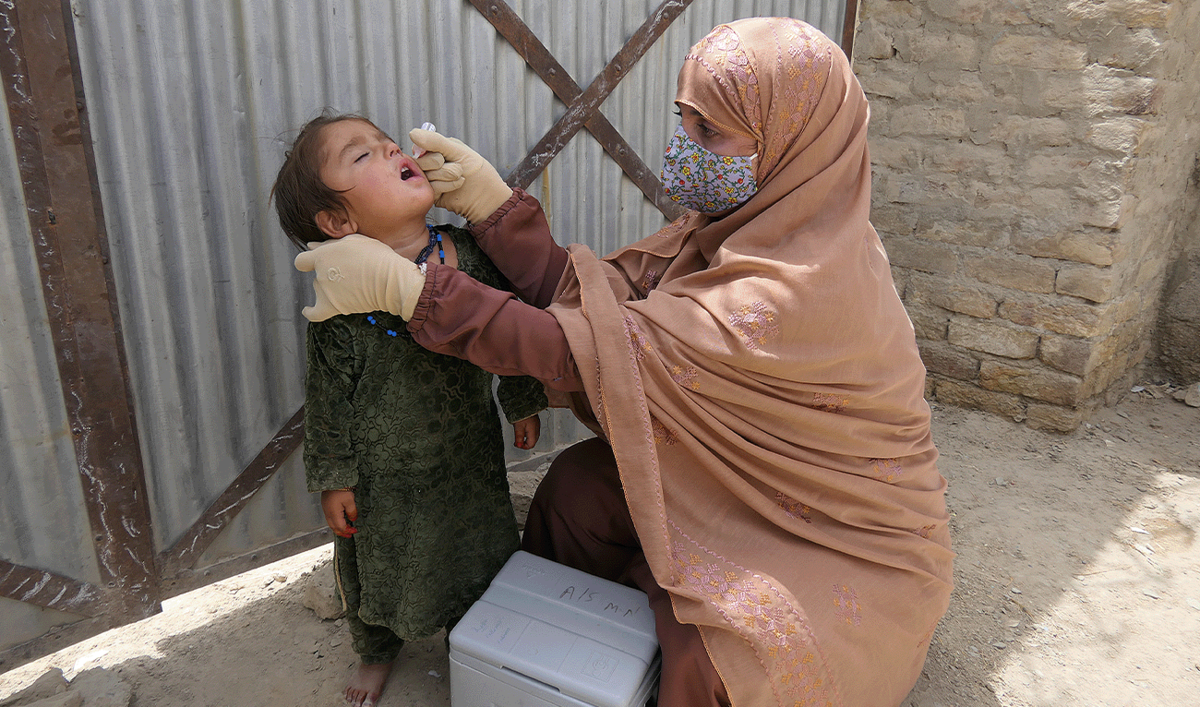
Bibi Hajira, a female polio worker vaccinates a child with polio drops in Killa Abdullah district Pakistan on August 28, 2025. (AN Photo)
Pakistan launched its fourth nationwide polio vaccination drive of the year on Sept. 1, aiming to immunize 28.7 million children under five by Sept. 9. Officials say the country has reported 24 cases so far in 2025, compared with 74 in all of last year, suggesting progress even as challenges remain.
Indeed, despite three decades of eradication efforts, Pakistan and neighboring Afghanistan remain the only two countries in the world where poliovirus is still endemic, according to the World Health Organization (WHO). The South Asian nation had reduced cases to just one in 2021, but vaccine refusals, poor routine immunization and security challenges have repeatedly allowed the virus to resurface.
The WHO last year also warned of “fake finger marking,” where vaccinators mark children’s fingers without actually giving drops, hampering eradication efforts.
Attacks on vaccination teams have further undermined progress. Since 2012, militants have killed nearly 100 polio workers and security personnel guarding them, particularly in Khyber Pakhtunkhwa and Balochistan, viewing the campaign as a Western plot.
Just this year, several police officers protecting vaccination teams were killed in ambushes in the northwest.
WOMEN ON THE FRONTLINES
Hajjira is one of around 225,000 women mobilized in Pakistan during recent nationwide campaigns, according to the National Emergency Operations Center (NEOC).
Officials say women make up nearly 60 percent of vaccinators in Balochistan, where cultural and religious norms often restrict male outsiders from entering private homes. In many conservative households, only women can interact freely with mothers and children, making female vaccinators not just important but essential to the program’s success. Without them, entire pockets of the province would remain inaccessible to immunization teams, officials say.
Balochistan, Pakistan’s largest but least developed province, is also among the hardest to reach: vast distances, rugged terrain, and porous borders with Afghanistan complicate campaigns. Resistance to polio drops is often rooted in illiteracy, poverty and mistrust of government initiatives, leaving female health workers on the frontlines of both persuasion and delivery.
“The female polio workers have been providing good support, especially in some hard areas of the province,” said Inam ul Haque, provincial coordinator for the Emergency Operation Center in Balochistan.
“They have access to go inside the houses and rooms to find and vaccinate children with polio drops.”
Gains have been made.
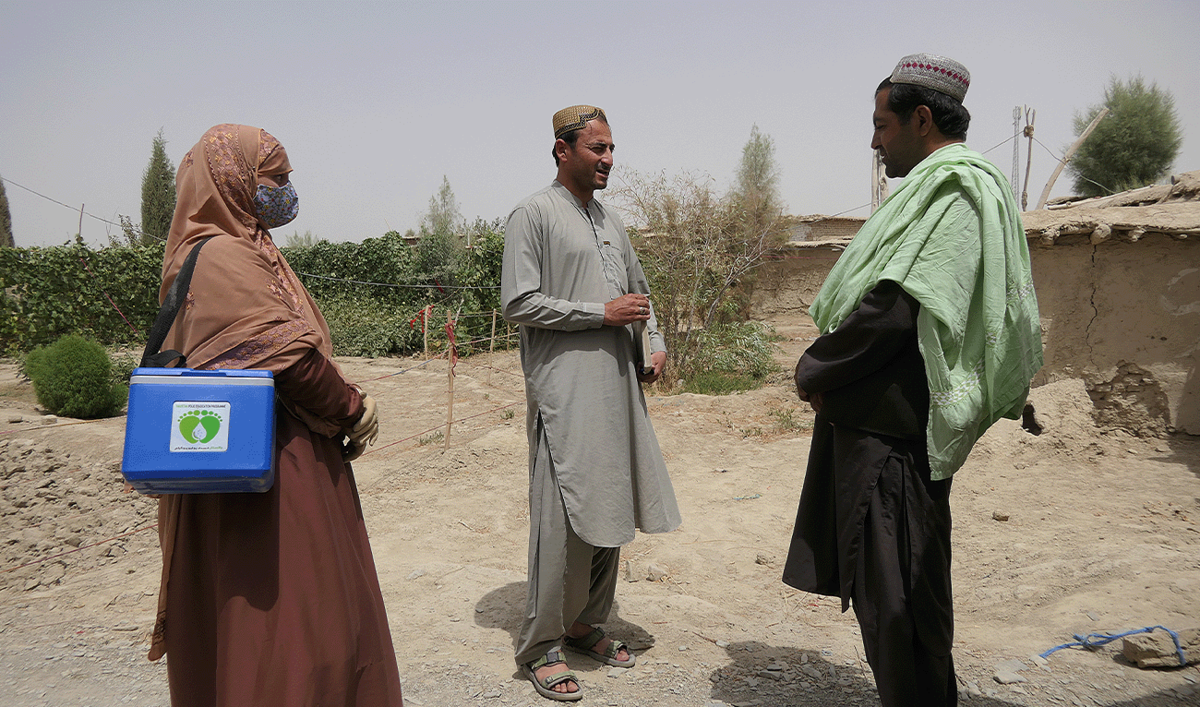
Bibi Hajira, a female polio worker meets with local tribesmen in Killa Abdullah district Pakistan on August 28, 2025. (AN Photo)
Last year, 27 of Pakistan’s human cases of polio came from Balochistan, but the province has reported none so far in 2025.
Out of 162 samples collected from 23 sites this year, only 77 tested positive, reducing the positivity rate to 48 percent. Additionally, the number of affected districts had dropped from 24 to 19.
The most encouraging development came in July 2025: only one out of 23 samples tested positive, bringing monthly positivity down to just 4 percent, a strong indicator that containment measures and intensified immunization efforts are taking effect.
But Haque said “the threat of the polio virus still looms over us.”
And the struggle to convince families remains fraught.
“Many parents here resist vaccination due to lack of education,” Hajjira said. “Some women even say, ‘Our husbands have sworn that if we give polio drops to the children, they will divorce us’.”
Yet she keeps going.
“This is a struggle, and no work succeeds without struggle, if even one child is vaccinated because of our efforts, it is a great success for us,” she said with a smile.
Her husband, Naimatullah, admitted he initially resisted his wife’s work because of the stigma around the vaccine.
“I have personally seen cases in our village where polio-affected children are now grown up with lifetime disabilities ... that convinced me and now I see this as an act of goodness,” he said.

Bibi Hajira, a female polio worker meets with local tribesmen (not in picture) in Killa Abdullah district Pakistan on August 28, 2025. (AN Photo)
Local residents say female vaccinators have changed attitudes in a district long marked by refusals.
“Women in remote parts of Killa Abdullah district were outright refusing polio vaccine for their children but since female polio workers started convincing them, now they are aware of the benefits,” said Muhammad Rahim, a villager from Killi Hajji Baqi.
Hajjira said she had managed to vaccinate nearly 800 “hidden children,” those whose parents initially refused. Now, she hopes more women can join this line of work.
“It is very hard to find women in Killa Abdullah who are willing or allowed by their families to join this profession,” Hajjira said.
“We endure negative attitudes, even insults and humiliation, but I keep persuading the families, hoping that once their thinking changes, the attitudes will also be changed.”