

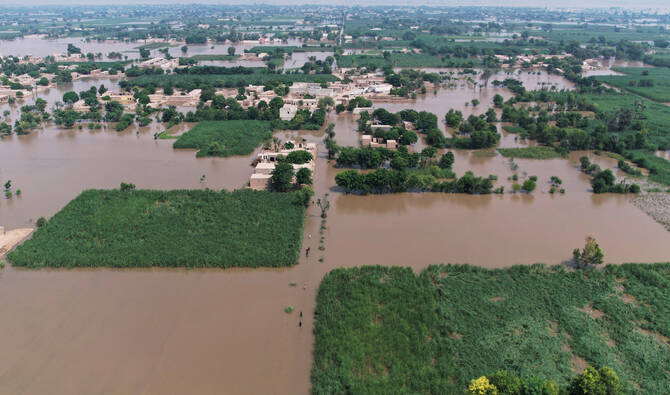

ISLAMABAD: A senior official at Pakistan’s Ministry of Food Security warned on Wednesday that devastating floods in the breadbasket province of Punjab have caused prices of food commodities to rise, as farmer groups fear shortages of agricultural commodities would spike inflation further.
Pakistan’s Punjab has reported 43 deaths and 1.3 million people displaced because of floods in the past 10 days. Punjab’s rivers swelled to dangerous levels after heavy monsoon showers and India’s move to release excess water from its dams.
A senior official at Pakistan’s Ministry of National Food Security confirmed that prices of wheat, tomatoes, and onions have surged by at least 10 percent in the past two weeks, as fears of food shortages grip the nation after the deluges destroyed large swathes of crops in Punjab.
“We have yet to complete our assessment of losses as we are seeking information from provincial governments and institutions like the Land Information and Management System (LIMS) and the Space and Upper Atmosphere Research Commission (SUPARCO),” the official said on condition of anonymity as he was not authorized to speak to media.
Pakistan’s National Disaster Management Authority (NDMA) has warned that floods are likely to stream downwards into the southern Sindh province and enter it on Sept. 6. The official warned that Sindh could see destruction greater than Punjab, as floodwater often stagnates in the province for months.
He said wheat prices have spiked sharply in the past two weeks, rising from Rs2,200 [$7.75] per 40 kilograms to Rs3,600 [$12.68] on Wednesday.
“I believe this is related to perception, as the wheat crop had already been harvested before the floods,” the official said.
He added that prices of tomatoes and onions have also risen by 12 and 10 percent since the floods began, respectively.
While insisting it was too early to predict losses, the official noted that “the disruption in supplies and destruction of crops will impact prices of food items in Pakistan.”
In Islamabad, tomatoes were selling for up to Rs138 [$0.49] per kilogram and onions for Rs75 [$0.26] per kilogram, according to the district administration’s official rate list.
Farmer groups, however, fear food inflation will worsen in the days to come.
“Prices of vegetables are expected to rise further in the next 15 to 20 days,” Khalid Mehmood Khokhar, president of the Pakistan Kissan Ittehad Council, a leading farmers group, told Arab News.
“Almost 80 percent of the cotton crop has been destroyed in my native Bahawalnagar district alone due to excessive monsoon rains.”
Khokhar said wheat prices have increased mainly because of damage to the storage in flood-hit areas. However, he said the “real impact” will be felt once crop losses in Sindh are fully assessed.
He also expressed concern about the possible shortages of rice and sugar across the country in the coming months.
Zahid Anwar, former chairman of the Pakistan Agriculture and Dairy Farmers Association, said farmers are not benefiting from surging wheat prices.
“Crippled by outstanding loans they took for fertilizers and seed, the desperate farmers sold wheat for a mere Rs2,200 [$7.75] per 40 kilograms just two weeks ago,” Anwar said.
“However, prices have now crossed Rs3,000 [$10.57] in days, benefitting only the middlemen and the rich,” he added.
Anwar said the worst-affected crops from the floods include rice, maize, cotton, sugarcane and vegetables. He pointed to massive losses of animal fodder in the floods, warning that this could adversely impact the production of dairy products.


