

Pakistan to boost naval training, joint maritime operations with Bahrain

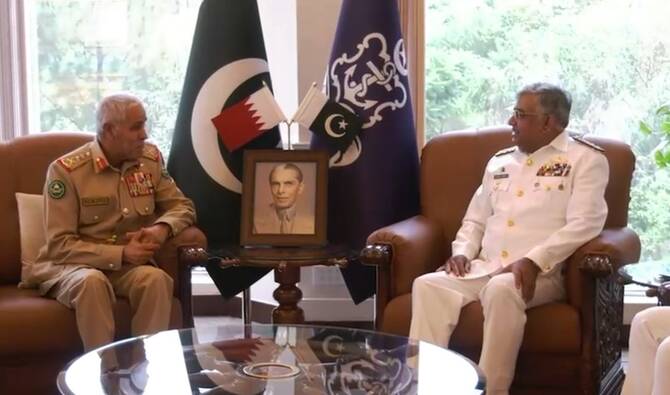
Bahrain’s Chief of Defense Staff Lt. Gen. Thiab Saqer Abdulla Al-Nuaimi’s meeting with Pakistan Navy Chief Admiral Naveed Ashraf (R) at the Naval Headquarters in Islamabad, Pakistan on Aeptember 2, 2025. (ISPR)
Short Url
Updated 02 September 2025
Follow

Pakistan to boost naval training, joint maritime operations with Bahrain

  • The statement comes after Bahrain’s defense staff chief calls on Pakistani naval chief to discuss bilateral cooperation
  • Pakistan, Bahrain maintain close diplomatic, trade and defense ties through various trainings, regular high-level exchanges

KARACHI: Pakistan and Bahrain have agreed to boost cooperation in naval training and regional maritime security operations, the Pakistan Navy said on Tuesday.

The statement came after Bahrain’s Chief of Defense Staff Lt. Gen. Thiab Saqer Abdulla Al-Nuaimi’s meeting with Pakistan Navy Chief Admiral Naveed Ashraf at the Naval Headquarters in Islamabad.

During the meeting, Admiral Ashraf underscored Pakistan Navy’s efforts to promote maritime stability through initiatives such as the regional maritime security patrols to safeguard sea routes, deter piracy, curb smuggling and protect commercial shipping.

“Both the leaders exchanged views on matters of mutual interest, focusing on regional maritime security and prospects for deepening cooperation in defense, training and joint maritime security operations,” the navy’s directorate general of public relations (DGPR) said in a statement.

“Both leaders reaffirmed commitment to strengthen and diversify the scope of existing bilateral defense relationship.”

The Bahraini general praised Pakistan Navy’s “professional capabilities and steadfast commitment” to ensure maritime security in the region, according to the statement.

“The visit will further deepen bilateral defense ties and enhance collaboration in regional security initiatives,” the DGPR added.

Pakistan and Bahrain have maintained close diplomatic, security, trade and defense ties through training, joint security initiatives and regular high-level exchanges.

On Monday, the Bahraini chief of defense staff met Pakistan Air Force (PAF) Chief Air Chief Marshal Zaheer Ahmed Baber Sidhu and expressed Bahrain’s interest in learning from the experience of PAF in multi-domain operations.

The meeting followed a four-day Pakistan-India military standoff in May, during which officials said the PAF successfully conducted multi-domain operations to down six Indian fighter jets, including the French-made Rafale jets. While India has acknowledged losses in the air, it has not specified the number of aircraft lost.

“Underscoring the significance of knowledge-sharing in Multi Domain operations to augment the operational readiness of Bahrain Air Force, he (Al-Nuaimi) conveyed his earnest desire to gain deeper insight into PAF’s complete methodology of multi-domain warfare, with the aim of learning from its rich operational experience,” the PAF said in a statement.

“The visiting dignitary also expressed interest in initiating joint training programs for Bahraini pilots and engineers at all levels.”

In July, Pakistan’s Interior Minister Mohsin Naqvi also met his Bahraini counterpart General Sheikh Rashid bin Abdullah Al-Khalifa to further strengthen security collaboration between both countries in various fields.


Pakistani minister urges universal rights, dialogue at UN civilizations forum in Riyadh

Updated 14 sec ago
Follow

Pakistani minister urges universal rights, dialogue at UN civilizations forum in Riyadh

  • Musadik Malik warns selective application of human rights and weakening multilateralism risk deepening global divisions
  • The minister also mentions water rights and urges equitable sharing by upper riparian states to support regional stability

ISLAMABAD: Pakistan’s climate change minister said principles of justice and human rights must be applied universally, according to an official statement released on Monday, warning against selective enforcement as he addressed a United Nations forum in Saudi Arabia focused on dialogue among civilizations.

The remarks came at the 11th Global Forum of the United Nations Alliance of Civilizations (UNAOC), held in Riyadh to mark the body’s 20th anniversary. The forum brings together political leaders, policymakers, and civil society groups to promote dialogue, mutual understanding, and cooperation across cultures and religions.

Its latest edition comes at a time of growing geopolitical fragmentation and conflict.

“I am firmly committed to women’s rights, minority rights, environmental rights, and children’s rights,” Musadik Malik said while addressing the gathering. “These rights are fundamental and non-negotiable.”

He said the global order was increasingly marked by weakening multilateralism, rising conflicts, and declining international funding for development and environmental priorities, cautioning that unilateral actions were replacing collective approaches with consequences for global peace and justice.

Malik questioned what he described as the selective application of human rights principles, drawing attention to the situations in Palestine and Kashmir, and said the rights of people in those regions must be recognized and protected in line with international norms.

The minister also highlighted water rights as a growing source of regional tension, emphasizing the responsibility of upper riparian states to ensure equitable and just sharing of water resources with downstream countries to support stability and sustainable development.

His statement comes months after India said unilaterally it was holding the Indus Waters Treaty “in abeyance,” a move described as illegal by the administration in Islamabad and as “an act of war.”

The 1960 agreement between India and Pakistan, brokered by the World Bank, divides the rivers of the Indus basin between the two countries and sets rules for how they can use and manage shared water resources to avoid conflict.

Malik said the UNAOC’s 20th anniversary was a timely reminder of the need to recommit to dialogue, peace, and mutual respect in an increasingly divided world.