

Israel mobilizes reservists as it pushes into initial stages of Gaza City offensive

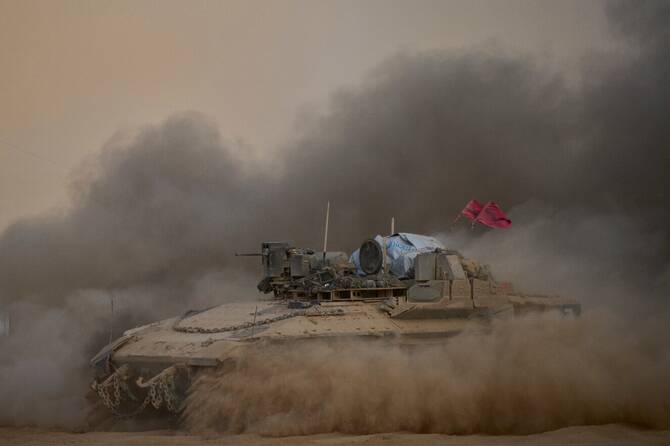
Israeli soldiers move on armored personnel carriers near the Israeli Gaza border, in southern Israel. (AP)
Short Url
Updated 03 September 2025
Follow

Israel mobilizes reservists as it pushes into initial stages of Gaza City offensive

  • Reservist call up will be gradual and include 60,000, Israel’s military said last month
  • At least 86 people were killed in Israeli strikes across Gaza, and scores more were wounded in the past 24 hours

DEIR AL BALAH: Tens of thousands of reservists started to report for duty on Tuesday ahead of a new Israeli offensive in Gaza City, which Prime Minister Benjamin Netanyahu wants to speed up, despite warnings from senior ranks.

Israeli Army Radio said that some 40,000 reservists would report for duty on Tuesday for the Gaza City offensive. The military said it was readying logistically for the intake of reservists ahead of the offensive.

Israel’s security cabinet, chaired by Netanyahu, approved a plan last month to expand the campaign in Gaza with the aim of taking Gaza City, where Israeli forces waged fierce urban warfare with Hamas in the early stages of the war. Israel currently holds about 75 percent of the Gaza Strip.

A security cabinet meeting late on Sunday included angry exchanges between Netanyahu and his ministers, who want to push ahead with the Gaza City offensive, and military chief Eyal Zamir, who has urged the politicians to reach a ceasefire deal.

Zamir said the campaign will endanger hostages and put further strain on the already over-stretched army, according to four ministers and two military officials present at the meeting.

This follows similar exchanges between Zamir and Netanyahu’s cabinet last month. Netanyahu said on August 20 that he gave the instruction to speed up the timetable for taking what he describes as Hamas’ last bastion.

But on August 21, in discussions to approve the battle plans, the military again warned against hostages being endangered and said it could not begin the campaign for at least two months, according to a source in Netanyahu’s circle and a defense official.

The military’s main reason was that more time was needed for humanitarian efforts. But surveys have shown a substantial proportion of reservists are unhappy with the cabinet’s plans, with some having taken the unusual step of openly accusing the government of lacking a cohesive strategy for Gaza, a post-war plan for the enclave or clear victory metrics.

“I don’t feel like I’m doing anything that really applies significant pressure to have Hamas release the hostages,” one combat reservist who has been serving in Gaza since October 7 told Reuters, speaking on condition of anonymity as he was not authorized to speak publicly.

Israeli strikes

At least 86 people were killed in Israeli strikes across Gaza, and scores more were wounded in the past 24 hours, local health authorities said.

Three separate airstrikes killed 26 people in total in houses in the Gaza City suburbs, where the Israeli forces stepped up aerial and ground bombardment in preparation for expanding the fighting.

Outside Gaza City’s Al-Shifa hospital, white plastic body bags with corpses were laid out on the street spattered with blood. Crowds wailed for slain relatives.

“We fled (our homes) with nothing. They went to get clothes and food from their homes, to bring clothes for their children and food for themselves... and Look now! They came back as martyrs!” said Nasr Nasr, a relative of some of the dead.

Hundreds of mourners carried bodies through the streets. Others stood and prayed around a group of five bodies in shrouds, including three tiny children.

The Israeli army’s Arabic service spokesperson told residents of Gaza there would be better humanitarian services in the south, as the army prepared to expand the Gaza City offensive.

The Israeli military did not immediately respond to a request for comment but it has stated that its forces are combating fighters on the outskirts of Gaza City, destroying tunnels and militant infrastructure and seizing weapons.

Other deaths reported on Tuesday included five people killed while waiting in a food line in the south, nine killed in a strike on an apartment, and seven killed by Israeli tank fire.

Thirteen more Palestinians, including three children, died of malnutrition and starvation in Gaza in the past 24 hours, the territory’s health ministry said on Tuesday, raising officially reported deaths from such causes to at least 361, including 130 children, the vast majority in recent weeks.

Israel disputes the hunger fatality figures given by the health ministry of Gaza’s government, arguing that deaths were due to other medical causes.

The war in Gaza began on October 7, 2023, when gunmen led by Hamas attacked southern Israeli communities near the border, killing some 1,200 people, mainly civilians, and taking 251 hostages including children into Gaza, according to Israeli figures.

Over 62,000 Palestinians have been killed in Israel’s air and ground war in Gaza since then, according to Gaza health officials, who do not say how many were militants but have said most of those killed have been women and children.

Ceasefire talks that would see a pause in the fighting ended in a deadlock in July.

Israeli authorities believe that of the 48 remaining captives, 20 hostages are still alive.


How Sudan’s volunteer medics are helping war survivors cope with mental trauma

Updated 9 sec ago
Follow

How Sudan’s volunteer medics are helping war survivors cope with mental trauma

  • Millions displaced by Sudan’s war face acute psychological distress, often without access to professional mental health support
  • Fighting has devastated hospitals and clinics, leaving only volunteer networks and community initiatives to fill critical healthcare gaps

DUBAI: After being displaced from the Sudanese capital, Khartoum, several times before finally reaching safety in Kassala to the east, Dr. Tayseer Ibrahim understood better than most the lasting scars Sudan’s war would leave on generations to come.

Before she could complete her final semester in medical school, the 27-year-old was forced to pack her belongings and leave when the sound of shelling drew closer and war raged through the streets of Khartoum, a city since recaptured by the army but still in ruins.

Boarding the first bus packed with displaced people bound for Wad Madani, capital of Al-Jazira state to the southeast of Khartoum, Ibrahim’s journey was perilous, marked by sudden clashes at checkpoints and sleepless nights spent under trees in search of safe passage.

After settling temporarily in a camp in the village of Al-Shakaba, she was forced to leave once again when the situation deteriorated. The journey to Kassala took more than a week, mostly on foot, before she finally arrived at the Omar Al-Haj Musa School camp.

“As a survivor, I understood better than anyone what my people truly needed,” Ibrahim told Arab News.

Driven by the pain and loss she endured and the suffering she witnessed, Ibrahim joined a group of displaced female doctors to establish the Youth Voluntary Mental Health Organization in Kassala.

Founded in partnership with the UN refugee agency, UNHCR, the center seeks to meet the growing need for psychological relief and protection, amid the collapse of Sudan’s healthcare system, for a young generation displaced by war and now facing lasting trauma.

Now in its third year, the war between the Sudanese Armed Forces and the paramilitary Rapid Support Forces has triggered one of the world’s worst humanitarian crises, displacing nearly 12 million people and making Sudan home to the world’s largest internally displaced population.

The war also fueled what the UN describes as the world’s most extensive hunger crisis, with famine already declared in at least five locations.

The situation has been exacerbated by a new wave of displacement, with nearly 90,000 people fleeing El-Fasher in the past two weeks, according to the UN, following the RSF’s capture of the North Darfuri capital on Oct. 26 after an 18-month siege.

With the economy on its knees and public services almost nonexistent, aid groups say the war is leaving an entire generation traumatized, out of school, and malnourished.

Exposure to violence, hunger, disease, and mass displacement, compounded by the collapse of healthcare infrastructure, has led to a surge in cases of depression, anxiety, and post-traumatic stress disorder, particularly among children and adolescents.

“Most of the displaced in the camps suffer from trauma and depression; some to the point of suicide,” Ibrahim told Arab News.

“Conditions for those diagnosed before the war worsened alongside the new cases brought on by violence and displacement.”

A 2024 survey by the UN children’s fund, UNICEF, found that 67 percent of Sudanese children in displacement camps showed signs of severe emotional distress, yet only five percent had access to any form of psychological support.

Experts said Sudan’s mental health system, weakened by years of economic turmoil and a 22-year civil war, was already limited and severely underfunded.

The latest conflict has further eroded access to medical care as most psychiatrists and mental health workers have fled or been displaced, while medical supplies remain scarce.

Local psychiatrists also report that social stigma toward mental health disorders remains widespread in Sudanese society.

“Many people are not aware of the importance of psychological treatment and support,” said Ibrahim.

She described the “inhumane conditions” facing displaced families in Kassala, many of whom live in schools turned into emergency shelters or in overcrowded tents with no privacy and limited access to clean water or sanitation — conditions ripe for disease, exacerbated by natural disasters such as floods and droughts.

“The majority of the displaced are women and children who live without income or a family provider,” said Ibrahim. “Many displaced families include members suffering from chronic, infectious, or mental illnesses, yet they have little or no access to medical services.”

Such conditions put women at risk of gender-based violence, experts warn.

Ibrahim recalled the case of a 17-year-old girl who attempted suicide in the camp, driven to desperation by a lack of privacy, an uncertain future, and domestic abuse by her mentally unstable father.

“Fortunately, intervention came in time. She survived and is now receiving treatment,” said Ibrahim.

With only a handful of psychiatrists and medical professionals left in Sudan, community-based initiatives like Ibrahim’s have become a lifeline.

Despite these efforts, she said the most urgent needs, including food, medicine, shelter, and psychological support, far exceed the humanitarian aid currently available.

Her organization, funded by UNHCR, focuses on mental health and psychosocial support, gender-based violence, child protection, and primary healthcare.

Ibrahim works alongside a small team comprising a psychologist, a neurologist, and social workers to offer free diagnostic and therapeutic services to displaced persons, along with regular follow-ups for chronic and mental health conditions.

Women and girls affected by gender-based violence receive counseling sessions, supported by a referral network to ensure their protection and safety.

The team provides counseling across several displacement sites, including Sittat Arab Camp in Halfa, Omar Al-Haj Musa School, Al-Saadiya School, Tajoug School, and a camp west of the city’s airport. 

Ibrahim said the organization focuses on children and youth in the hope of contributing to Sudan’s long-term recovery.

She was among more than 80 medical students who received UNHCR funding to complete their final semester after the war disrupted their studies.

Without that support, she said, she could not have afforded the fees or earned her degree, which later enabled her to establish the organization as a way to pay it forward and help her community rebuild.

Not many students, particularly children, were so fortunate. The conflict has devastated the education system, leaving more than 10,400 schools closed and forcing 19 million children out of formal education, including 4 million who are displaced, according to UNICEF.

The UN agency says Sudan is now facing the world’s largest child displacement crisis.

Aid groups and humanitarian organizations have warned that school closures and economic instability are deepening long-term psychological distress among Sudanese youth, creating a lost generation that could deprive the country of a skilled workforce and prolong its economic instability for years to come.

Malnutrition is another deep and lasting scar of the war. A March 2024 UNICEF report found that nearly 3.8 million children in Sudan are acutely malnourished, including 730,000 suffering from severe acute malnutrition, as health experts warn of the long-term impact of hunger on children’s cognitive development, memory, and ability to learn during their formative years.

To encourage emotional expression and a sense of security, Ibrahim said her organization has established child-friendly spaces as safe environments equipped with educational games and creative activities.

Besides providing one-on-one counseling, the center organizes recreational events for children and mothers, and sports activities targeting young people and adolescents to promote their mental and physical well-being.

The center aims to expand its outreach by training volunteers and community members to provide immediate support to those suffering from trauma.

It also holds seminars on mental health and developmental workshops designed to build the capacities of women and youth, empowering them to create lasting change in their communities.

Healthcare professionals want to see mental health treated as a core component of global humanitarian efforts, emphasizing that psychological support is as vital as food, shelter, and medical care in helping conflict-affected communities recover and rebuild.

Calls for a ceasefire and global action have surged amid mounting evidence from UN human rights bodies and independent experts of war crimes in El-Fasher.

Both the army and the RSF have been accused of crimes against humanity. The RSF has also been implicated in atrocities in Darfur that the UN said may amount to genocide.

RSF leader Mohamed Hamdan Dagalo, also known as Hemedti, has promised to investigate the El-Fasher allegations, but both sides categorically reject accusations of war crimes and genocide.

Mindful of Khartoum’s long road to recovery, Ibrahim said she hopes to return to her hometown and contribute to its reconstruction now that she has established a lifeline for displaced communities in Kassala.

“Communities in Khartoum are in dire need of psychological and medical support, and I feel that my experience as a doctor, a displaced person, and a survivor can make a difference.”