

Mob burns Nigerian woman to death over Islam blasphemy claim: police

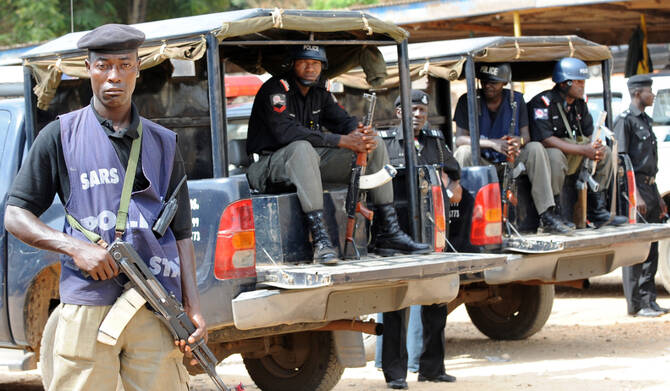
Policemen stand guard at the police headquarters in Jos. (AFP file photo)
Short Url
Updated 02 September 2025
Follow

Mob burns Nigerian woman to death over Islam blasphemy claim: police

  • Sharia law operates alongside common law in 12 predominantly Muslim states in Nigeria — including Niger — and blasphemy is punishable by death

KANO, Nigeria: A mob burnt a woman to death in central Nigeria over the weekend after accusing her of blasphemy against Islam, police said Monday.
The woman “was set ablaze” on Saturday in a “mob attack” after she made comments about the Prophet Muhammad, police spokesman Wasiu Abiodun in Niger state said in a statement.
He said the woman was a food vendor named Amaye from northwest Nigerian Katsina state.
Abiodun added that the police condemned any act of “jungle justice” and urged members of the public to remain calm during the search for the attackers.
Sharia law operates alongside common law in 12 predominantly Muslim states in Nigeria — including Niger — and blasphemy is punishable by death.
In many cases the accused are killed by mobs without going through the legal process, though the attack on the weekend is not thought to have involved a legal process.
Such attacks are rare though a butcher in the northern city of Sokoto was stoned to death in June 2023 and a Christian college student was killed by Muslim students a year earlier, both after blasphemy allegations.


Most of Iranian women’s soccer team leave Australia

Updated 11 March 2026
Follow

Most of Iranian women’s soccer team leave Australia

GOLD COAST: The Iranian women’s soccer team left Australia without seven squad members after tearful protests of their departure outside Sydney Airport and frantic final efforts inside the terminal by Australian officials, who sought to ensure the women understood they were being offered asylum.

As the team’s flight time drew nearer and they passed through security late on Tuesday, each woman was taken aside to meet alone with officials who explained through interpreters that they could choose not to return to Iran.

Before the team traveled to the airport, seven women had accepted humanitarian visas allowing them to remain permanently in Australia and were ushered to a safe location by Australian police officers. 

One has since changed her mind, underscoring the tense and precarious nature of their decisions.

“In Australia, people are able to change their mind,” said Australian Home Affairs Minister Tony Burke, who had hours earlier posted photos of the seven women granted humanitarian visas to his social media accounts, their identities clearly visible.

After what Burke described as “emotional” meetings between the remaining women who reached the airport and Australian officials, the rest of the team declined offers of asylum and boarded their flight.

It was a dramatic conclusion to an episode that had gripped Australia since the Iranian team’s first game at the Asian Cup soccer tournament, when they remained silent during their national anthem.