UK, Japan, South Korea endure hottest summer on record

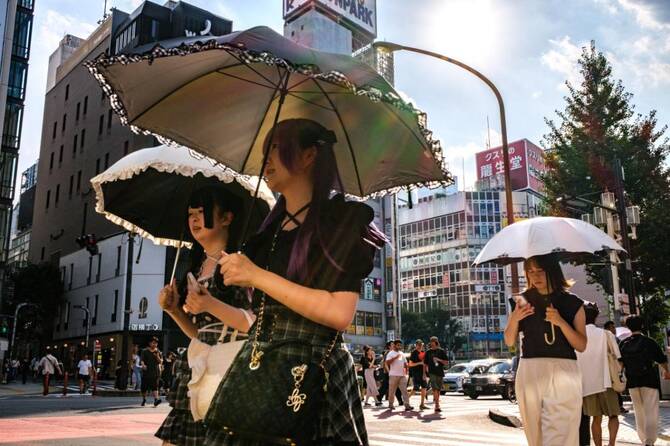
Pedestrians holding umbrellas walk on a hot day amid a heatwave in Tokyo's Shinjuku district on August 30, 2025. (AFP)
Short Url
Updated 01 September 2025
Follow

UK, Japan, South Korea endure hottest summer on record

  • Britain struggled through the record hot summer, which poses a host of challenges for a country ill-equipped for such conditions

LONDON: The UK, Japan and South Korea sweltered this year through the hottest summers since each country began keeping records, their weather agencies said Monday.

Temperatures the world over have soared in recent years as human-induced climate change creates ever more erratic weather patterns.

The UK’s provisional mean June-August temperature was 16.1C, which was 1.51C above the long-term average and surpassed all years since 1884, including the previous record, set in 2018, the Met Office said.

The British summer saw four heatwaves, below-average rainfall and sustained sunshine, and followed the nation’s warmest spring in more than a century.

Japan’s average temperature spike was even starker over the same three summer months, at 2.36C above “the standard value,” making it the hottest since records began in 1898, the Japan Meteorological Agency (JMA) said.

It was the third consecutive summer of record high temperatures, the agency noted.

This year’s scorching heat left some 84,521 people hospitalized nationwide from May 1 to August 24, according to Japan’s Fire and Disaster Management Agency.

In South Korea, the average June-August temperature was 25.7C, “the highest since data collection began in 1973,” the Korea Meteorological Administration said in a press release.

The previous record over the same period was 25.6C, set just last year.

Britain — known for its damp and grey climate — struggled through the record hot summer, which poses a host of challenges for a country ill-equipped for such conditions.

Homes in the UK are designed to keep the heat in during the winter, and air conditioners are rare in homes and public places, such as much of London’s sprawling underground “Tube” metro system.

“It’s hard to spend a hot day (here),” Ruidi Luan, a 26-year-old student from China, told AFP in London during the August heatwave.

“There’s no air conditioner in our dorm. It is sometimes very hot, and especially in public transport.”

Drought was declared in five out of 14 regions in England, while the Environment Agency classed the water shortfall as “nationally significant,” as farmers struggle with stunted harvests.

In Tokyo, Miyu Fujita, a 22-year-old businesswoman, said she had mostly socialized indoors this summer to escape the oppressive temperatures.

“When I was a child, summer was the time to go outside and play,” she told AFP. “Can kids play outside now? I think it’s impossible.”

Japan’s beloved cherry trees are blooming earlier due to the warmer climate, or sometimes not fully blossoming because autumns and winters are not cold enough to trigger flowering, experts say.

The famous snow cap of Mount Fuji was absent for the longest recorded period last year, not appearing until early November, compared with the average of early October.

South Korea is meanwhile grappling with a prolonged drought that has hit the eastern coastal city of Gangneung.

A state of national disaster has been declared in the city of 200,000 people, with water levels at the Obong reservoir, the city’s main source of piped water, falling below 15 percent.

The dry spell has forced authorities to implement water restrictions, including shutting off 75 percent of household meters.

Kim Hae-dong, professor of meteorological studies at Keimyung University, told AFP the hot weather streak was linked to “the weakening of Arctic cold air due to global warming.”

“Because it is expected to continue weakening with global warming in place, we forecast similar weather patterns to repeat next year,” he said.

Heatwaves are becoming more intense and frequent worldwide because of human-caused climate change, scientists say.

The UK’s provisional record this year means all of its five warmest summers have taken place this century.

The Met Office noted “a summer as hot or hotter than 2025 is now 70 times more likely than it would be in a ‘natural’ climate with no human caused greenhouse gas emissions.”

But the speed of temperature increases across the world is not uniform.

Of the continents, Europe has seen the fastest warming per decade since 1990, followed closely by Asia, according to global data from the US National Oceanic and Atmospheric Administration.

The United Nations warned last month that rising global temperatures are having an ever-worsening impact on the health of workers, and also hitting productivity, which they say dropped by two to three percent for every degree above 20C.


Bangladesh sets February date for first vote since 2024 mass uprising

Updated 5 sec ago
Follow

Bangladesh sets February date for first vote since 2024 mass uprising

  • At least 1,400 protesters were killed in violent crackdown under ex-PM Hasina’s rule
  • Interim government promises ‘all necessary support’ for upcoming elections

DHAKA: Bangladesh will hold national elections on Feb. 12, its chief election commissioner has announced, setting the timeline for the nation’s first vote since a student-led uprising that ousted long-serving Prime Minister Sheikh Hasina.

Hasina, whose Awami League party-led government was marred by allegations of human rights violations, rigged elections and corruption, was removed from office in August last year after 15 uninterrupted years in power.

Bangladesh has since been led by interim leader Muhammad Yunus, a Nobel Prize-winning economist, who took over governance after Hasina fled to India, where she is now in self-exile.

In a televised address on Thursday, chief election commissioner A.M.M. Nasir Uddin confirmed the voting date to elect 300 lawmakers and said a national referendum on political reforms would also be held on the same day.

“It’s a relief for the voters; it’s a relief for the country. It’s a relief for the investors, it’s a relief for the development partners and for the political parties and the people who did a massive job in July 2024 by sacrificing their lives and limbs to oust a tyranny,” said Prof. A.S.M. Amanullah, political analyst and vice chancellor of the National University in Dhaka.

Mass protests that broke out in 2024 began in early July as peaceful demonstrations, triggered by the reinstatement of a quota system for the allocation of civil service positions.

Two weeks later, they were met with a communications blackout and a violent crackdown by security forces.

A special tribunal in Dhaka found Hasina guilty of allowing lethal force to be used against the protesters, at least 1,400 people of whom died, according to estimates from the UN’s human rights office.

After a months-long trial, she was sentenced to death in November for crimes against humanity.

The February elections will take place in the aftermath of Hasina’s reign, with the Yunus-led administration banning all activities of Awami League, meaning the former ruling party would not be able to join the race next year.

Minor political tensions now revolve around the more than 40 million voters of the Awami League, as the public speculate “how they would move, in which party they would support or whether they would remain silent,” Amanullah said.

“(But) if you consider other than Awami League, if we consider the other political parties, I think the other political parties are sufficient, you know, to make the next poll participatory, and free and fair.”

Bangladesh last held elections in January 2024, which saw Hasina return to office for a fourth consecutive term. That vote was boycotted by the country’s main opposition parties, which accused her administration of rigging the polls.

“There is a growing demand within the society and in the community that they would cast their first vote after almost 15, 16 years. And that would be an (occasion) of big national celebration,” Amanullah said.

In February, more than 127.6 million Bangladeshis will be eligible to cast their vote. It will be Bangladesh’s 13th election since the country gained independence in 1971.

The long-awaited election process now begins with the filing of nominations from Dec. 12 to 29, which will then be reviewed over the following six days. The last date for withdrawing nominations is Jan. 20.

After the voting date was announced, Yunus pledged to “provide all necessary support” to encourage festivity, participation and fairness in the upcoming polls.

“After the historic mass uprising (last year), the country is now moving toward a new path,” he said in a statement. “This election and referendum will consolidate that trajectory, prioritize the will of the people and further strengthen the foundation of a new Bangladesh.”

For Malaika Nur, a 24-year-old Dhaka University student who took part in the 2024 protests, the elections are an opportunity for young people to formally take part in politics.

“Young people have been showing much interest in politics since July 2024. They showed us how the youth can reshape a country’s political condition. If they have a few seats in the parliament, it can be a game-changer for the future of politics in Bangladesh,” she said.

“I hope this election will be different from the last three elections held in the previous regime. There will be a festive mood, people will cast their valuable votes and will get to choose their representative … I hope the elected government will ensure safety and basic rights of every citizen, and will hold fair elections in the future and will not become another fascist.”