

UK, Japan, South Korea endure hottest summer on record

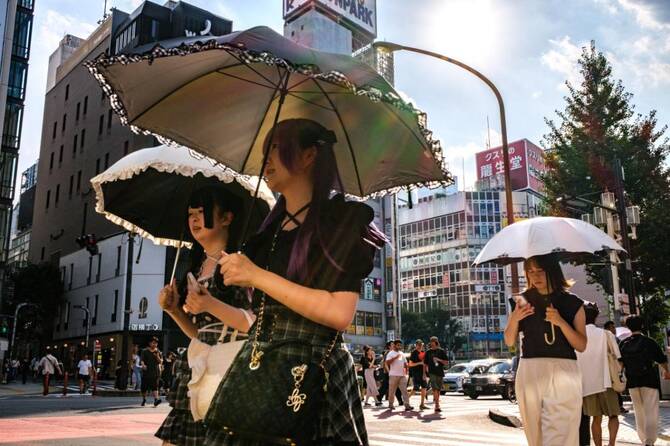
Pedestrians holding umbrellas walk on a hot day amid a heatwave in Tokyo's Shinjuku district on August 30, 2025. (AFP)
Short Url
Updated 01 September 2025
Follow

UK, Japan, South Korea endure hottest summer on record

  • Britain struggled through the record hot summer, which poses a host of challenges for a country ill-equipped for such conditions

LONDON: The UK, Japan and South Korea sweltered this year through the hottest summers since each country began keeping records, their weather agencies said Monday.

Temperatures the world over have soared in recent years as human-induced climate change creates ever more erratic weather patterns.

The UK’s provisional mean June-August temperature was 16.1C, which was 1.51C above the long-term average and surpassed all years since 1884, including the previous record, set in 2018, the Met Office said.

The British summer saw four heatwaves, below-average rainfall and sustained sunshine, and followed the nation’s warmest spring in more than a century.

Japan’s average temperature spike was even starker over the same three summer months, at 2.36C above “the standard value,” making it the hottest since records began in 1898, the Japan Meteorological Agency (JMA) said.

It was the third consecutive summer of record high temperatures, the agency noted.

This year’s scorching heat left some 84,521 people hospitalized nationwide from May 1 to August 24, according to Japan’s Fire and Disaster Management Agency.

In South Korea, the average June-August temperature was 25.7C, “the highest since data collection began in 1973,” the Korea Meteorological Administration said in a press release.

The previous record over the same period was 25.6C, set just last year.

Britain — known for its damp and grey climate — struggled through the record hot summer, which poses a host of challenges for a country ill-equipped for such conditions.

Homes in the UK are designed to keep the heat in during the winter, and air conditioners are rare in homes and public places, such as much of London’s sprawling underground “Tube” metro system.

“It’s hard to spend a hot day (here),” Ruidi Luan, a 26-year-old student from China, told AFP in London during the August heatwave.

“There’s no air conditioner in our dorm. It is sometimes very hot, and especially in public transport.”

Drought was declared in five out of 14 regions in England, while the Environment Agency classed the water shortfall as “nationally significant,” as farmers struggle with stunted harvests.

In Tokyo, Miyu Fujita, a 22-year-old businesswoman, said she had mostly socialized indoors this summer to escape the oppressive temperatures.

“When I was a child, summer was the time to go outside and play,” she told AFP. “Can kids play outside now? I think it’s impossible.”

Japan’s beloved cherry trees are blooming earlier due to the warmer climate, or sometimes not fully blossoming because autumns and winters are not cold enough to trigger flowering, experts say.

The famous snow cap of Mount Fuji was absent for the longest recorded period last year, not appearing until early November, compared with the average of early October.

South Korea is meanwhile grappling with a prolonged drought that has hit the eastern coastal city of Gangneung.

A state of national disaster has been declared in the city of 200,000 people, with water levels at the Obong reservoir, the city’s main source of piped water, falling below 15 percent.

The dry spell has forced authorities to implement water restrictions, including shutting off 75 percent of household meters.

Kim Hae-dong, professor of meteorological studies at Keimyung University, told AFP the hot weather streak was linked to “the weakening of Arctic cold air due to global warming.”

“Because it is expected to continue weakening with global warming in place, we forecast similar weather patterns to repeat next year,” he said.

Heatwaves are becoming more intense and frequent worldwide because of human-caused climate change, scientists say.

The UK’s provisional record this year means all of its five warmest summers have taken place this century.

The Met Office noted “a summer as hot or hotter than 2025 is now 70 times more likely than it would be in a ‘natural’ climate with no human caused greenhouse gas emissions.”

But the speed of temperature increases across the world is not uniform.

Of the continents, Europe has seen the fastest warming per decade since 1990, followed closely by Asia, according to global data from the US National Oceanic and Atmospheric Administration.

The United Nations warned last month that rising global temperatures are having an ever-worsening impact on the health of workers, and also hitting productivity, which they say dropped by two to three percent for every degree above 20C.


Thailand-Cambodia fighting rages on as Trump signals intent to intervene 

Updated 5 sec ago
Follow

Thailand-Cambodia fighting rages on as Trump signals intent to intervene 

  • Clashes raged at more than a dozen locations along their 817-km border
  • “I hate to say this one, named Cambodia-Thailand, and it started up today, and tomorrow I am going to have to make a phone call,” Trump said

BANGKOK/PHNOM PENH: Thailand and Cambodia traded accusations of targeting civilians in artillery and rocket attacks on Wednesday, as US President Donald Trump said he would try to intervene to stop the fighting and salvage a ceasefire he brokered earlier this year.
Clashes raged at more than a dozen locations along their 817-km (508-mile) border in some of the most intense fighting since a five-day battle in July, which Trump stopped with calls to both leaders to halt their worst conflict in recent history.
The Southeast Asian neighbors have blamed each other for the clashes that started on Monday.

’IT CANNOT BE AS SIMPLE AS PICKING UP THE PHONE’
Trump at a rally in Pennsylvania late on Tuesday said he would try to stop the renewed hostilities, after enumerating the conflicts he said he had helped stop, such as those between Pakistan and India, and Israel and Iran.
“I hate to say this one, named Cambodia-Thailand, and it started up today, and tomorrow I am going to have to make a phone call,” he said.
“Who else could say, ‘I’m going to make a phone call and stop a war of two very powerful countries, Thailand and Cambodia?’“
Thailand’s army has made clear it wants to cripple Cambodia’s military capabilities and Prime Minister Anutin Charnvirakul on Tuesday said operations would not stop.
He declined to comment on Wednesday on what the military’s end-game was. Asked about Trump’s remarks, he said the conflict was a matter between the two countries involved.
“Other national leaders may have good intentions in wanting peace,” Anutin told reporters. “It cannot be as simple as picking up the phone and calling. There must be proper appointment and agreed talking points. We still have time to prepare these issues if such discussions are to take place.”
Cambodian government spokesperson Pen Bona said Phnom Penh’s position was that it wanted only peace and had acted in self-defense. A top adviser to Cambodia’s prime minister has signalled the country was ready to negotiate.
Malaysian Prime Minister Anwar Ibrahim, who helped Trump broker the ceasefire, said he had spoken with leaders of Thailand and Cambodia on Tuesday and, though no definitive resolution was reached, he appreciated “the openness and willingness of both leaders to continue negotiations in order to ease tensions.”

ROCKETS, JETS AND DRONE-BOMBS
Thailand’s army said fighting took place on 16 different fronts on Wednesday, including both ends of the border. It reported an onslaught of BM-21 rockets fired by Cambodian forces, some of which it said landed near a hospital in Surin province, forcing the evacuation of patients and staff.
The army said Cambodian drones were being used to drop bombs and BM-21 rockets, and tanks were used at other border areas, including near the contested 11th Century Preah Vihear temple, a flashpoint for previous diplomatic and military conflicts.
Cambodia’s military said Thailand used artillery fire and armed drones and fired mortars into homes, while F-16 fighter jets had entered Cambodian airspace on multiple occasions, some dropping bombs near civilian areas.
“Cambodian forces have been fighting fiercely against the advancing enemy and have stood firm in their role of protecting Cambodia’s territorial integrity,” the defense ministry said in a statement.
In July, Trump used the leverage of trade negotiations to broker a ceasefire. Thai Foreign Minister Sihasak Phuangketkeow on Tuesday told Reuters that tariff threats should not be used to pressure his country into talks.
Last month, Thailand suspended de-escalation measures, agreed at an October summit in Trump’s presence, after a Thai soldier was maimed by a land mine that Bangkok said was newly laid by Cambodia, which rejects the accusation.

HEAVY TOLL ON CIVILIANS
The three days of clashes have taken a heavy toll on civilians, with nine people killed in Cambodia, including an infant, and 46 people wounded, according to its government. Five Thai soldiers had been killed in the fighting and 68 people were wounded, the Thai army said.
On Wednesday, Cambodia withdrew its athletes from the Southeast Asian Games in Thailand, citing safety reasons and their families’ concern.
Hundreds of thousands of people have been evacuated from border areas, though some people have chosen not to leave.
“I have to stay behind,” said Wuttikrai Chimngarm, as he hunkered down behind a makeshift bunker of tires stacked six high while shelling shook Thailand’s border province of Buriram.
“I’m the head of the village, if not me, then who? Who will be safeguarding the houses and belongings of the villagers from looters?“
As soon as Monday’s fighting erupted, residents fled the disputed village of Kaun Kriel, about 25 km (15 miles) northwest of Cambodia’s city of Samraong.
“This is my second run because the place I live ... was under attack both times,” said Cambodian Marng Sarun, a 31-year-old harvester, who left with his wife and two children.