

First Afghan families allowed into Germany from Pakistan

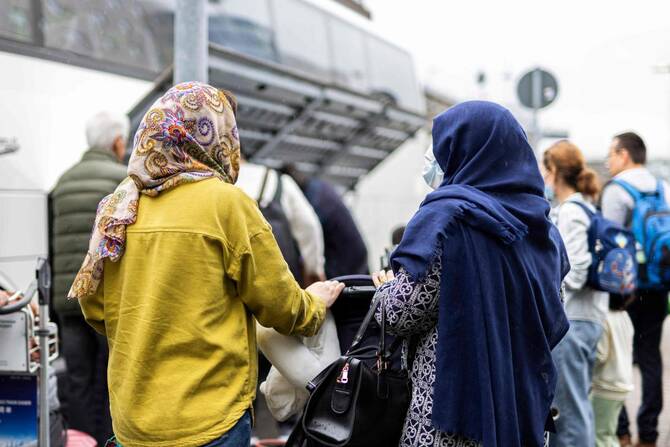
Afghan nationals board a bus after they landed at the airport in Hannover-Langenhagen, northwestern Germany, Sept. 1, 2025. (AFP)
Short Url
Updated 01 September 2025
Follow

First Afghan families allowed into Germany from Pakistan

  • Most of the Afghans have arrived in Hanover on a commercial flight from Istanbul on Monday
  • Authorities set up a scheme to offer sanctuary to Afghans who worked for German institutions after Taliban returned to power in 2021

HANOVER: A group of 47 Afghans who fled the Taliban arrived in Germany on Monday after months of waiting in Pakistan until German court rulings forced Berlin to offer them refuge.

The 10 families have been among more than 2,000 Afghans caught in limbo in Pakistan as Germany’s conservative-led government this year froze a program to offer them sanctuary.

Most of them arrived in Hanover on a commercial flight from Istanbul around 2:00 p.m. (1200 GMT), said an AFP reporter and the Airbridge Kabul initiative set up to help those affected.

An interior ministry spokeswoman confirmed that “45 Afghan nationals entered Germany. These are all individuals who obtained visas through legal proceedings... All of these individuals have fully completed the admission procedure and security screening.”

The Airbridge Kabul initiative later said that two more people had arrived after catching a later connection from Istanbul.

A mother and daughter who did not want to give their names told AFP they were looking forward to their new life in Germany.

“It feels very good and pleasant when girls can go to school, study, and I can also work, study, integrate into society, and learn the language,” the mother said.

“I am very happy that after many difficulties and challenges, we finally managed to reach a good life,” said the daughter, aged 20.

“I could have done many things, studied, achieved a position and reached the goals I had for myself, but unfortunately, I couldn’t. From now on, I will achieve them,” she said.

Sanctuary scheme

After the Taliban returned to power in 2021, Germany set up a scheme to offer sanctuary to Afghans who had worked for German institutions or were otherwise deemed at high risk of persecution, including rights activists and journalists.

But the scheme was frozen under conservative Chancellor Friedrich Merz, who took office in May, as part of a wider crackdown on immigration.

While the Afghans have been left stranded in Pakistan, authorities there have also stepped up a crackdown on Afghans living in the country without residency.

Last month, Berlin said around 450 Afghans waiting to come to Germany had been detained, and more than 200 of them were sent back to their Taliban-run homeland.

While alarm has grown about their fate, Germany has agreed to resume accepting some of the others.

The government said last week that Afghans for whom “courts have found that Germany is legally obliged to issue visas” would travel to Germany “in stages” once they had cleared security checks.

The 10 main applicants who arrived on Monday were eight women and two men who had been involved in “politics, the justice system and journalism,” said Eva Beyer, a spokeswoman for the Airbridge Kabul initiative.

Around 85 other stranded Afghans have begun legal proceedings against Germany, “and there are more every day,” Beyer said.


Australia to toughen gun laws as it mourns deadly Bondi attack

Updated 16 December 2025
Follow

Australia to toughen gun laws as it mourns deadly Bondi attack

  • Footage showed one man, identified by local media as fruit seller Ahmed al Ahmed, grabbing one of the gunmen as he fired
  • Prime Minister Anthony Albanese convened a meeting of leaders of Australia’s states and territories in response on Monday, agreeing with them “to strengthen gun laws across the nation”

SYDNEY: Australia’s leaders have agreed to toughen gun laws after attackers killed 15 people at a Jewish festival on Bondi Beach, the worst mass shooting in decades decried as antisemitic “terrorism” by authorities.
Dozens fled in panic as a father and son fired into crowds packing the Sydney beach for the start of Hanukkah on Sunday evening.
A 10-year-old girl, a Holocaust survivor and a local rabbi were among those killed, while 42 others were rushed to hospital with gunshot wounds and other injuries.
Prime Minister Anthony Albanese convened a meeting of leaders of Australia’s states and territories in response on Monday, agreeing with them “to strengthen gun laws across the nation.”
Albanese’s office said they agreed to explore ways to improve background checks for firearm owners, bar non-nationals from obtaining gun licenses and limit the types of weapons that are legal.
Mass shootings have been rare in Australia since a lone gunman killed 35 people in the town of Port Arthur in 1996, which led to sweeping reforms long seen as a gold standard worldwide.
Those included a gun buyback scheme, a national firearms register and a crackdown on ownership of semi-automatic weapons.
But Sunday’s shooting has raised fresh questions about how the two suspects — who public broadcaster ABC reported had possible links to the Daesh group — obtained the guns.

- ‘An act of pure evil’ -

Police are still unraveling what drove Sunday’s attack, although authorities have said it targeted Jews.
Albanese called it “an act of pure evil, an act of antisemitism, an act of terrorism on our shores.”
A string of antisemitic attacks has spread fear among Australia’s Jewish communities after the October 7, 2023, Hamas assault on Israel and the ensuing war in Gaza.
The Australian government this year accused Iran of orchestrating a recent wave of antisemitic attacks and expelled Tehran’s ambassador nearly four months ago.
But Israeli Prime Minister Benjamin Netanyahu accused Australia’s government of “pouring oil on the fire of antisemitism” in the months before the shooting, referring to Canberra’s announcement that it would recognize Palestinian statehood in August.
Other world leaders expressed revulsion, with US President Donald Trump condemning the “antisemitic attack.”
The gunmen opened fire on an annual celebration that drew more than 1,000 people to the beach to mark Hanukkah.
They took aim from a raised boardwalk at a beach packed with swimmers cooling off on the steamy summer evening.
Witness Beatrice was celebrating her birthday and had just blown out the candles when the shooting started.
“We thought it was fireworks,” she told AFP. “We’re just feeling lucky we’re all safe.”
Carrying long-barrelled guns, they peppered the beach with bullets for 10 minutes before police shot and killed the 50-year-old father.
The 24-year-old son was arrested and remains under guard in hospital with serious injuries.
Australian media named the suspects as Sajid Akram and his son Naveed Akram.
Tony Burke, the home affairs minister, said the father arrived in Australia on a student visa in 1998 and had become a permanent resident. The son was an Australia-born citizen.
Hours after the shooting, police found a homemade bomb in a car parked close to the beach, saying the “improvised explosive device” had likely been planted by the pair.
Rabbi Mendel Kastel said his brother-in-law was among the dead.
“We need to hold strong. This is not the Australia that we know. This is not the Australia that we want.”
Wary of reprisals, police have so far avoided questions about the attackers’ religion or ideological motivations.
Misinformation spread quickly online after the attacks, some of it targeting immigrants and the Muslim community.
Police said they responded to reports on Monday of several pig heads left at a Muslim cemetery in southwestern Sydney.

- Panic and bravery -

A brave few dashed toward the beach as the shooting unfolded, wading through fleeing crowds to rescue children, treat the injured and confront the gunmen.
Footage showed one man, identified by local media as fruit seller Ahmed al Ahmed, grabbing one of the gunmen as he fired.
The 43-year-old wrestled the gun out of the attacker’s hands, before pointing the weapon at him as he backed away.
A team of off-duty lifeguards sprinted across the sand to drag children to safety.
“The team ran out under fire to try and clear children from the playground while the gunmen were firing,” said Steven Pearce from Surf Life Saving New South Wales.
Bleeding victims were carried across the beach atop surfboards turned into makeshift stretchers.
On Monday evening, a flower memorial next to Bondi Beach swelled in size as mourners gathered.
Hundreds, including members of the Jewish community, sang songs, clapped and held each other.
Leading a ceremony to light a menorah candle, a rabbi told the crowd: “The only strength we have is if we bring light into the world.”