

Pakistani politician arrives in Tunisia to sail with global flotilla seeking to break Gaza blockade

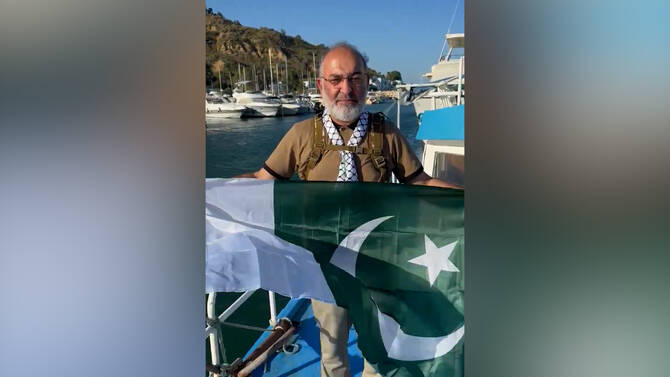
The screengrab taken from a video posted by Pakistani politician Mushtaq Ahmad Khan on August 31, 2025, shows Mushtaq Ahmad Khan speaking in a video message from a Tunisian port. (Mushtaq Ahmad Khan)
Short Url
Updated 01 September 2025
Follow

Pakistani politician arrives in Tunisia to sail with global flotilla seeking to break Gaza blockade

  • Mushtaq Ahmad Khan is part of global Sumud flotilla, comprising over 100 ships carrying food, water and humanitarian supplies for Gaza
  • Flotilla, deemed as largest civilian maritime mission for Gaza, features climate activist Greta Thunberg, Hollywood actress Susan Sarandon

ISLAMABAD: Former Pakistani senator Mushtaq Ahmad Khan arrived in Tunisia on Sunday to set sail with a global flotilla seeking to break Israel's blockade of Gaza, amid fears of starvation and disease becoming widespread in the Palestinian territory.

The fleet of more than 100 vessels, which will converge in the Mediterranean, brings together four regional alliances: Sumud Nusantara from Asia, Sumud Maghrib from Africa, the Global March to Gaza from the Middle East and the Freedom Flotilla Coalition from Europe. Swedish climate campaigner Greta Thunberg and Hollywood actress Susan Sarandon, who are part of the flotilla, left Barcelona on Sunday vowing to try to "break the illegal siege of Gaza."

Khan, affiliated with the Pakistani Jamaat-e-Islami religious party, earlier said he would be part of the Global Sumud Flotilla, which is deemed as the largest civilian maritime mission ever assembled for Gaza. Training for the voyage will be held in Tunisia from Sept. 1 to 3, after which Khan and others will set sail on Sept. 4. The cargo will consist of food, water and medicine.

"From this very [Tunisian] port and on these very ships, we will break the Gaza blockade," Khan said in a video message he posted on social media platform X on Sunday, carrying a large flag of Pakistan atop a ship.

Khan urged the people to pay their part in supporting the flotilla by highlighting its activities on social media and protesting against Israel's military offensive in Gaza. 

The development takes place as Israel intensifies its military offensive in Gaza, limiting the deliveries of food and basic supplies there. The move has earned the ire of several countries around the world, including Pakistan, who have demanded Israel lift the blockade and allow medicines and food to reach the people. Food experts warned in August that Gaza was in famine and that half a million people across the territory were facing catastrophic levels of hunger.

The Sumud flotilla will be the fourth attempt to break Israel's maritime blockade so far this year. In June this year, Thunberg sailed from Sicily with humanitarian supplies on another Freedom Flotilla vessel, the Madleen, which was intercepted and seized by Israeli forces in international waters.

In a statement last week, Khan had said he and other participants of the flotilla were prepared for the risks. He recalled blockades of and attacks on past flotillas, including a deadly 2010 raid on the Turkish ship Mavi Marmara that left 10 activists dead.

Israel's war on Gaza has killed more than 63,000 people, with at least 332 Palestinians dying of malnutrition, including 124 children, according to the Gaza Health Ministry.


Pakistan reviews austerity measures amid Middle East crisis, urges strict nationwide implementation

Updated 11 March 2026
Follow

Pakistan reviews austerity measures amid Middle East crisis, urges strict nationwide implementation

  • Deputy Prime Minister Ishaq Dar chairs review meeting of austerity steps
  • Officials briefed on salary cuts, school closures, four‑day week, petrol conservation

ISLAMABAD: Pakistan’s government on Wednesday assessed progress on a sweeping set of austerity measures introduced to mitigate the country’s economic strain from sharply rising global oil prices and supply disruptions linked to the ongoing war in the Middle East.

Prime Minister Shehbaz Sharif this week announced a series of austerity steps, including a four‑day work week for government offices, requiring 50  percent of staff to work from home, cutting fuel allowances for official vehicles by half, grounding up to 60  percent of the government fleet and closing all schools for two weeks to conserve fuel amid the global oil crisis.

The measures were unveiled in response to global oil market volatility triggered by the conflict involving the United States, Israel and Iran, which has disrupted supply routes such as the Strait of Hormuz and pushed crude prices sharply higher, straining Pakistan’s heavily import‑dependent energy sector.

“The meeting stressed the importance of strict and transparent adherence to the austerity measures, promoting fiscal responsibility and prudent use of public resources,” Deputy Prime Minister and Foreign Minister Senator Mohammad Ishaq Dar said in a statement.

He was chairing a meeting of the Committee for Monitoring and Implementation of Conservation and Additional Austerity Measures, constituted under the directions of the PM, bringing together federal and provincial officials to review execution of the broad cost‑cutting plan. 

Dar emphasized the government’s commitment to enforcing the PM’s austerity steps nationwide. The committee’s review also covered reductions in departmental expenditure, deductions from salaries of senior officials earning over Rs. 300,000 ($1,120), and coordination with provincial administrations to ensure uniform implementation of the plan.

Participants at the meeting reiterated that all ministries and divisions must continue strict monitoring and reporting, with transparent oversight mechanisms, as Pakistan navigates the economic pressures from the prolonged Middle East crisis and its fallout on global energy and trade markets.