
ISLAMABAD: Prime Minister Shehbaz Sharif on Monday alleged Islamabad had irrefutable evidence of the involvement of “foreign hands” in terror attacks in Pakistan, in a veiled reference to India, alleging the country has suffered $152 billion in economic losses as a result.
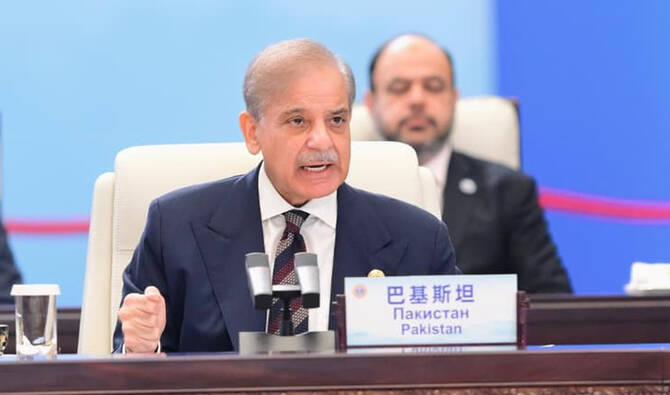
The Pakistani prime minister was addressing the Shanghai Cooperation Organization’s (SCO) two-day Council of Heads of State (CHS) summit in Tianjin, China. The SCO summit saw participation from member states such as Russia, India, Central Asian countries and others, who seek greater regional connectivity and economic cooperation.
This was the first time Sharif had attended a regional summit with his Indian counterpart, Narendra Modi, after Pakistan’s brief military confrontation with India in May. Islamabad has blamed New Delhi for supporting militant attacks in Pakistan, including an attack on the Jaffar Express train in Balochistan in March. Fighters belonging to the separatist Balochistan Liberation Army (BLA) had stormed the train with hundreds of passengers on board and took them hostage.
The military rescued them after an hours-long operation that left 33 militants, 23 soldiers, three railway staff and five passengers dead.
“We have, ladies and gentlemen, irrefutable evidence of the involvement of some foreign hands in the devastating Jaffar Express train hostage incident, as well as countless other terrorist attacks against us in Balochistan and Khyber Pakhtunkhwa province of Pakistan,” Sharif said during his address.
Sharif said Pakistan has rendered “great sacrifices” in its battle against militancy, saying it has lost over 90,000 lives to various attacks over the years.
“[Pakistan] has endured economic losses over $152 billion, a sacrifice which has no parallel in the annals of history,” the Pakistani premier said.
He said Islamabad supports and respects the sovereignty and integrity of all SCO member states and its neighbors.
“We respect all international and bilateral treaties and expect similar principles to be followed by all SCO members,” Sharif said in another veiled reference to India.
Delhi announced following an attack in Indian-administered Kashmir on Apr. 22 that it was holding the Indus Waters Treaty, which governs the use of the Indus River system between India and Pakistan, in abeyance. Delhi announced the move as ties deteriorated between the nuclear-armed nations after it held Pakistan responsible for the April militant attack that killed 26. Pakistan denies having a hand in the attack.
“Pakistan seeks normal and stable relationship with all its neighbors. It seeks dialogue and diplomacy over conflict and confrontation,” the Pakistani premier said.
He reiterated Islamabad’s demand for a comprehensive dialogue to resolve all outstanding disputes in the region.
The May fighting between India and Pakistan was the worst between the two neighbors since 1999. The militaries of the two countries pounded each other with fighter jets, drones, missiles and artillery fire before US President Donald Trump brokered a ceasefire on May 10.
The fragile ceasefire continues to remain in place, but tensions remain high.
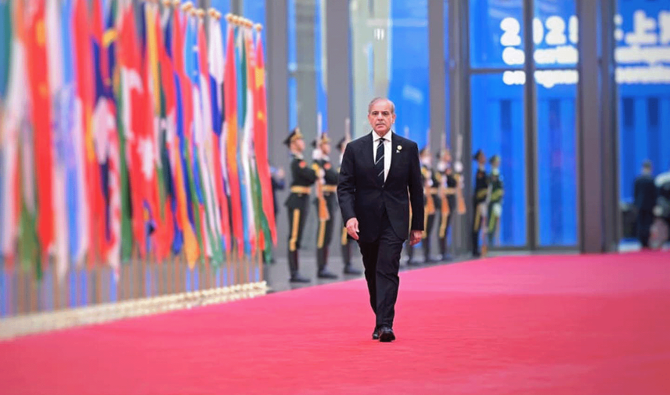
Pakistan’s Prime Minister, Shehbaz Sharif, pictured at the Tianjin Meijang Convention Center upon his arrival to attent the welcome banquet organized in honor of the world leaders participating in the 25th SCO Heads of States Council Meeting in Tianjin, China, on August 31, 2025. (Government of Pakistan)
PAHALGAM, JAFFAR EXPRESS TRAIN ATTACKS
In a joint declaration issued later, the SCO member states condemned militant attacks in Pahalgam in Indian-administered Kashmir, which killed 26 tourists on April 22, as well as the hijacking of the Jaffar Express passenger train and the Khuzdar school bus bombing in Pakistan this year. Islamabad blamed the attacks on Indian-sponsored militarnt groups, an allegation denied by New Delhi.
The SCO members expressed their sympathy and condolences to the families of those killed and injured, and called for the accountability of the perpetrators, organizers and sponsors of such attacks.
“Member States strongly condemn terrorism in all its forms and manifestations, emphasize that double standards in the fight against terrorism are unacceptable, and call upon the international community to combat terrorism, including the cross-border movement of terrorists,” the declaration read.
Pakistan and India routinely accuse each other of supporting militant groups waging attacks against the other. The two countries have fought multiple wars, including two of them over the disputed region of Kashmir, since their independence from British rule in 1947. Both rule the region in part but claim it in full.