

On SCO summit sidelines, Pakistani PM meets key global leaders including Putin, Erdogan

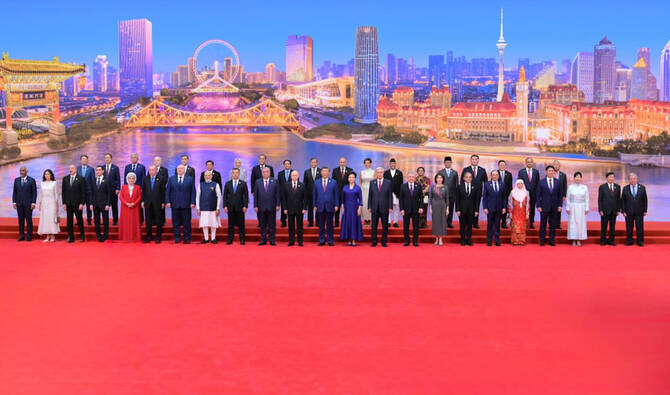
World leaders gesture for a group photograph at the welcome banquet during the 25th SCO Heads of States Council Meeting, in Tianjin on August 31, 2025. (Handout/ Pak PMO)
Short Url
Updated 31 August 2025
Follow

On SCO summit sidelines, Pakistani PM meets key global leaders including Putin, Erdogan

  • President Xi Jinping welcomed PM Shehbaz Sharif at a banquet organized for SCO heads of states in Tianjin
  • During his visit, Sharif will meet with Chinese leadership, chair Pakistan-China B2B Investment Conference

ISLAMABAD: Pakistan Prime Minister Shehbaz Sharif on Sunday met with world leaders, including Russian President Vladimir Putin and Turkiye’s Recep Tayyip Erdogan, on the sidelines of a two-day summit of the Shanghai Cooperation Organization’s (SCO) Council of Heads of State (CHS), Sharif’s office said.

Sharif, who arrived on a six-day visit to China this week, was welcomed by President Xi Jinping at a banquet organized for leaders participating in the 25th SCO Council of Heads of States meeting in Tianjin.

The prime minister also held informal meetings with Malaysian PM Anwar Ibrahim, Belarusian President Alexander Lukashenko, Azerbaijan’s Ilham Aliyev, Tajik President Emomali Rahmon, Turkmenistan’s Serdar Berdimuhamedov, Kyrgyz President Sadyr Japarov, Maldivian President Mohamed Muizzu and United Nations Secretary-General António Guterres.

“Prime Minister Shehbaz Sharif was seen receiving extraordinary warmth from world leaders,” Sharif’s office said. “The closeness observed in these meetings reflects the brotherly and friendly relations between Pakistan and these countries.”

The SCO comprises China, India, Russia, Pakistan, Iran, Kazakhstan, Kyrgyzstan, Tajikistan, Uzbekistan and Belarus, with 16 more countries affiliated as observers or “dialogue partners.”

China has long sought to present the regional group as a counterweight to Western-led power blocs and has pushed for greater collaboration between its member states.

On Sunday, Sharif held a meeting with Turkiye’s Erdogan, according to the former’s office. The two leaders condemned Israel’s “genocidal” policies in Gaza and vowed to advocate for Palestinian rights at all international platforms.

“The two sides exchanged views on key regional and international developments,” Sharif’s office said. “They expressed grave concern over the worsening humanitarian situation in Gaza and reaffirmed their shared commitment to using international platforms to advocate for the legitimate rights of the Palestinian people and to condemn the ongoing Israeli aggression and genocidal policies.”

Sharif, who arrived in China on Saturday, will remain in the country till Sept. 4 to hold talks with senior Chinese leadership, including the country’s President Xi Jinping and Prime Minister Li Qiang, an earlier statement from the foreign office said.

China has long been Pakistan’s largest investor and its closest strategic ally, anchored by the multibillion-dollar China-Pakistan Economic Corridor (CPEC). Both sides are working to advance into “CPEC 2.0,” focused on industrialization, agriculture, energy and connectivity.

During the visit, the Pakistani prime minister will also chair the second Pakistan-China B2B Investment Conference in Beijing on Sept. 4 to boost trade and investment ties, the PM Office said in an earlier statement on Saturday.


Pakistan says $50 million meat export deal with Tajikistan nearing finalization

Updated 5 sec ago
Follow

Pakistan says $50 million meat export deal with Tajikistan nearing finalization

  • Islamabad expects to finalize agreement soon after Dushanbe signals demand for 100,000 tons
  • Pakistan is seeking to expand agricultural trade beyond rice, citrus and mango exports

ISLAMABAD: Tajikistan has expressed interest in importing 100,000 tons of Pakistani meat worth more than $50 million, with both governments expected to finalize a supply agreement soon, Pakistan’s food security ministry said on Tuesday.

Pakistan is trying to grow agriculture-based exports as it seeks regional markets for livestock and food commodities, while Tajikistan, a landlocked Central Asian state, has been expanding food imports to support domestic demand. Pakistan currently exports rice, citrus and mangoes to Dushanbe, though volumes remain small compared to national production, according to official figures.

The development came during a meeting in Islamabad between Pakistan’s Federal Minister for National Food Security and Research Rana Tanveer Hussain and Ambassador of Tajikistan Yusuf Sharifzoda, where agricultural trade, livestock supply and food-security cooperation were discussed.

“Tajikistan intends to purchase 100,000 tons of meat from Pakistan, an import valued at over USD 50 million,” the ambassador said, according to the ministry’s statement, assuring full facilitation and that Islamabad was prepared to meet the demand.

The statement said the two sides agreed to expand cooperation in meat and livestock, fresh fruit, vegetables, staple crops, agricultural research, pest management and standards compliance. Pakistan also proposed strengthening coordination on phytosanitary rules and establishing pest-free production zones to support long-term exports.

Pakistan and Tajikistan have long maintained political ties but bilateral food trade remains below potential: Pakistan produces 1.8 million tons of mangoes annually but exported just 0.7 metric tons to Tajikistan in 2024, while rice exports amounted to only 240 metric tons in 2022 out of national output of 9.3 million tons. Pakistan imports mainly ginned cotton from Tajikistan.