

Film AlUla hosts reception for ‘Hijra’ cast at Venice Film Festival

Short Url
Updated 31 August 2025
Follow

Film AlUla hosts reception for ‘Hijra’ cast at Venice Film Festival

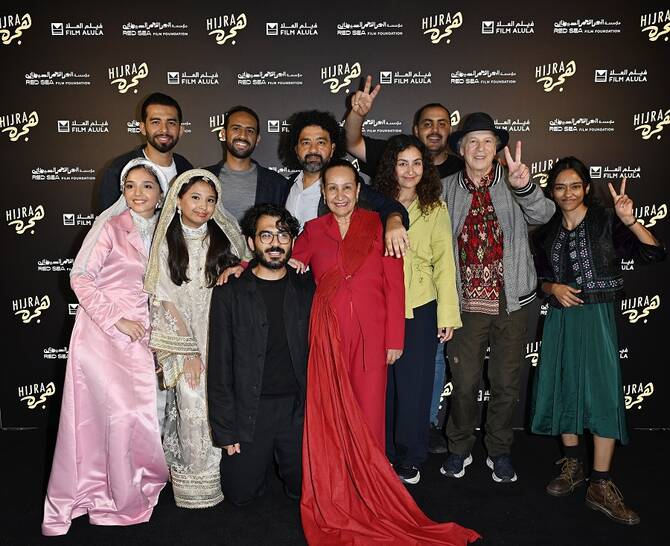
DUBAI: The cast and crew of the Saudi film “Hijra” have attended a reception hosted by Film AlUla at the Venice Film Festival.

The reception took place after the premiere screening of “Hijra,” with guests invited to the St. Regis Venice after the credits rolled.

Saudi director Shahad Ameen was on hand at the event, alongside stars Khairia Nazmi and Lamar Faden.

The film follows a grandmother (Nazmi) and her granddaughter (Faden) as they journey across northern Saudi Arabia to find a missing teenage girl.

Shot over about 55 days in eight Saudi cities — Taif, Jeddah, Madinah, Wadi Al-Faraa, AlUla, Tabuk, Neom, and Duba — the story unfolds against the backdrop of Hajj.

Saudi Arabia’s Red Sea Film Foundation has returned to the 82nd edition of the world’s longest running film festival to present a strong lineup of films and industry initiatives to reinforce its commitment to nurturing emerging talent from Saudi Arabia, the Arab world, Africa and Asia.

“Hijra” is among the highlights, while Lebanese filmmaker Cyril Aris’ “A Sad and Beautiful World” — a drama developed with the support of the Red Sea Labs, Red Sea Fund and Red Sea Souk — is also being featured.

Algerian director Yanis Koussim’s “Roqia” and Sudanese filmmaker Suzannah Mirghani’s “Cotton Queen” are both being screened in the Venice Critics’ Week section, offering urgent narratives that reflect the complexity of contemporary Arab identity. Completing the lineup is Damien Hauser’s “Memory of Princess Mumbi.”


Alia Bhatt, Sigourney Weaver talk love for authenticity, strong women

Updated 10 December 2025
Follow

Alia Bhatt, Sigourney Weaver talk love for authenticity, strong women

JEDDAH: On the seventh day of the ongoing Red Sea International Film Festival, two actresses — set apart by geography and time — spoke of their love for telling authentic stories and depicting strong women.

Bollywood superstar Alia Bhatt and Hollywood great Sigourney Weaver, on their respective In Conversation panels, reflected on their varied careers and the choices that led them to enduring success.

From a teenager stepping onto her first film set to a respected actress in her early thirties, Bhatt’s journey is a testament to the power of curiosity and instinct.

Bollywood superstar Alia Bhatt. (Getty Images)

“When I started out, I was ... maybe 17, 18,” she said. “I was way more enthusiastic and full of beans, trying really hard because I was just starting out.”

Her approach has evolved, but the core remains unchanged. “I’m still enthusiastic, still full of beans, but the approach is more silent. It comes with a little more sense of intent,” she said.

“I approach my work truly through pure instinct. The way I choose a part is like, ‘Oh, I've done this. Now I want to do this.’”

This approach, she said, led her to take creative risks — from “Highway” to “Udta Punjab” to Gangubai Kathiawadi” — always seeking variety.

Turning producer with Eternal Sunshine Productions was a natural progression of that curiosity. “I have a real strong passion for stories, so I like to get into it.

“And I like to think, ‘Okay, this has this potential, or this has that potential,’ and either I’m in it or I’m not, but I like to assess the initial stages of a story which is just a synopsis or first draft on paper.”

 Hollywood heavyweight Sigourney Weaver. (Getty Images) 

Weaver said she never set out to become an action hero. Initially shy and unsure, she was drawn not to specific roles but compelling stories.

When “Alien” came along, she approached the script with an open mind, unaware she was about to redefine female characters in science fiction.

“We were just trying to make a good, small movie,” she recalled. “The writers had cleverly crafted a script with a mixed-gender crew of “dirty space truckers,” deliberately subverting expectations by making the young woman the survivor and hero.

Weaver did not see it as a feminist statement at the time, but as a natural storytelling choice. Her character, Ellen Ripley, represented the idea that women could be self-reliant.

“She reminds us all that we can rely on ourselves and we don’t need a man to fly in and save us,” said Weaver.