PARIS: French President Emmanuel Macron’s decision to recognize a Palestinian state, prompting similar moves from other Western nations, angered Israel and its US ally by putting a two-state solution back at the heart of diplomatic efforts to end the devastating war in Gaza.
In a letter to Israeli Prime Minister Benjamin Netanyahu last week, Macron wrote that “our determination to see the Palestinian people have their own state is rooted in our conviction that lasting peace is essential to the security of the state of Israel.”
France’s diplomatic efforts “stem from our outrage at the appalling humanitarian disaster in Gaza, for which there can be no justification,” Macron added. Israel on Friday declared Gaza’s largest city a combat zone as the death toll surpassed 63,000 Palestinians, according to the territory’s Health Ministry.
France, the UK, Canada, Australia and Malta have said they would formalize their pledge during the annual gathering of world leaders at the UN General Assembly, which starts Sept. 23. Some others, including New Zealand, Finland and Portugal, are considering a similar move.
Netanyahu rejects Palestinian statehood and plans to expand the military offensive in Gaza.
Israel and US say recognizing a Palestinian state emboldens militants
Macron’s letter comes after Netanyahu accused him of “fueling” the “antisemitism fire” with his call for a Palestinian state, remarks Macron denounced as “abject.”
Last week, US Ambassador to France Charles Kushner also wrote a letter arguing that “gestures toward recognition of a Palestinian state embolden extremists, fuel violence and endanger Jewish life in France.” Kushner was summoned by the French foreign ministry and represented in his absence by his deputy.
Such angry reaction “shows that symbols matter,” said geopolitics expert Pascal Boniface, director of the Paris-based Institute for International and Strategic Relations. “There is some kind of race against time between the diplomatic path, with the two-state solution back at the heart of the debate, and the situation on the ground (in Gaza), which is every day making this two-state solution a little more complicated or impossible.”
Boniface said some supporters of a two-state solution showed disappointment at leaders’ decision to wait until September to officially recognize a Palestinian state, because they “fear that recognition will come when Gaza has even more become a graveyard.”
Calls on Israel to stop the Gaza offensive
Macron and other international leaders have urged Israel to stop its offensive in the besieged territory, where most of its over 2 million residents are displaced, neighborhoods lie in ruins and a famine has been declared in Gaza City.
“The occupation of Gaza, the forced displacement of Palestinians, their reduction to starvation ... will never bring victory to Israel,” Macron wrote in his letter to Netanyahu. “On the contrary, they will reinforce the isolation of your country, fuel those who find pretext for antisemitism, and endanger Jewish communities around the world.”
More than 140 countries already recognize a Palestinian state in what is a mostly symbolic move.
“The world will be the same the day after,” said Muhammad Shehada, a Gaza political analyst and visiting fellow at the European Council on Foreign Relations think tank.
Still, it adds diplomatic pressure on Israel, he stressed. Heavyweight Western nations demonstrating strong support for a two-state solution “shatters the illusion that Netanyahu is trying to sell to the Israelis and to the international community that mass population transfer or depopulation is the only way to solve the Palestinian issue,” Shehada said.
Strengthening moderate Palestinians
French Foreign Minister Jean-Noël Barrot insisted this week that diplomatic efforts led by France and Saudi Arabia also resulted, for the first time, in highly significant condemnation of the Hamas attacks against civilians by all 22 members of the Arab League.
During a July conference co-hosted by France and Saudi Arabia at the UN, Arab League nations agreed in their New York Declaration that “Hamas must end its rule in Gaza and hand over its weapons to the Palestinian Authority.”
Shehada expects the move to strengthen the camp of moderate Palestinians, including by demonstrating to the public that the Palestinian Authority is gaining weight in negotiations.
He said it may weaken the most violent leadership in Hamas by “creating a diplomatic track that provides Palestinians with an alternative to violence, sending a message that diplomatic engagement will pay off and will lead to a Palestinian state, whereas violence will not take you anywhere.”
The Palestinian Authority hopes to establish an independent state in the West Bank, east Jerusalem and Gaza — areas captured by Israel in the 1967 Mideast war. Hamas drove out the PA when it seized Gaza in 2007, a year after winning Palestinian parliamentary elections. After the Hamas takeover of Gaza, the PA was left with administering semiautonomous pockets of the Israeli-occupied West Bank.


![]()
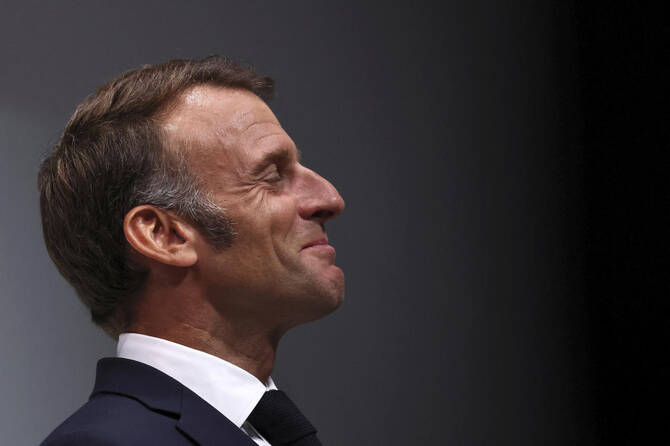
Macron’s decision to recognize a Palestinian state in September angers Israel and the US

Short Url
https://arab.news/58fvs
Macron’s decision to recognize a Palestinian state in September angers Israel and the US
- France, along with the UK, Canada, Australia and Malta, plans to formalize the Palestinian recognition at the UN General Assembly next month
- The recognition is symbolic but increases diplomatic pressure on Israel to end the nearly 23-month war in Gaza


Latest updates


© 2026 SAUDI RESEARCH & PUBLISHING COMPANY, All Rights Reserved And subject to Terms of Use Agreement.