

Pacifist Japan struggles to boost troops as China anxiety grows

1 / 3
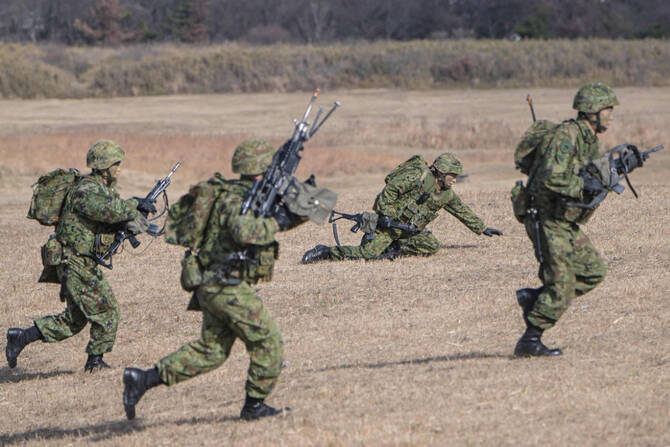
Japanese troops take position during a joint military drill and demonstration in the city of Funabashi, Chiba prefecture, east of Tokyo. (AFP file photo)
2 / 3
Japanese troops fire from a helicopter as they take part in a joint military drill and demonstration in the city of Funabashi, Chiba prefecture, east of Tokyo. (AFP file photo)
3 / 3
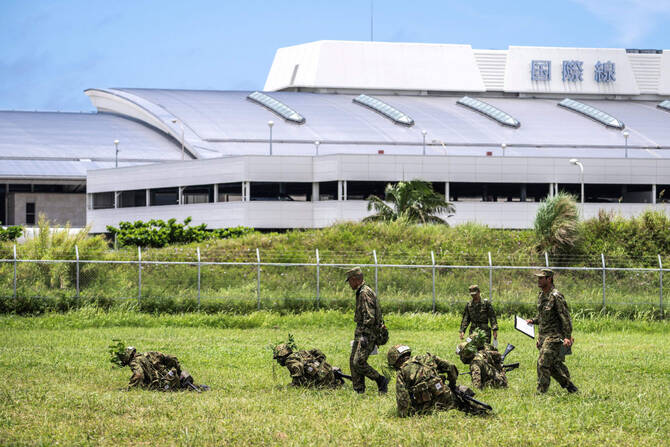
Members of the Japan Ground Self-Defense Force (JGSDF) taking part in an exercise at JGSDF Camp Naha in Okinawa Prefecture on June 9, 2025. (AFP)
Short Url
Updated 31 August 2025
Follow

Pacifist Japan struggles to boost troops as China anxiety grows

  • Japan fears that China could attempt a forceful takeover of Taiwan potentially triggering a conflict with Washington that could drag in Tokyo as well
  • But it has been hard to convince enough young Japanese to enlist, discouraged by dangerous duties, low pay and a young retirement age of around 56 

NAHA, Japan: Sporting dark face paint and clutching a gun, teenage soldier-in-training Takuma Hiyane crawls across a field on Japan’s Okinawa, the front line of the nation’s defense as anxiety grows over China’s territorial ambitions.
As the world marks the 80th anniversary of World War II, Japan — which has been officially pacifist since its defeat — is trying to lure more talent into its armed forces.
Tokyo began upping its military spending in 2023 and aims to make it two percent of its gross domestic product by the end of the 2027 fiscal year, but has come under pressure from Washington to boost it even further.
Japan fears that China could attempt a forceful takeover of Taiwan — the self-governed island it claims — potentially triggering a conflict with Washington that could drag in Tokyo as well.
But it has been hard to convince enough young Japanese to enlist.
Hiyane, a 19-year-old former high school badminton player who signed up after his graduation in March, was swayed by the idea of helping victims of natural disasters, he said.
“I thought this was a job that I could contribute to my country and be proud of, so I decided to join,” he told AFP, carefully dodging questions on the sensitive topic of national defense.
Tokyo wants a beefed-up military in southwestern regions such as Okinawa, home to some 70 percent of US military facilities in Japan and seen as strategically important for monitoring China, the Taiwan Strait and the Korean peninsula.
In 2023, the Japan Self-Defense Forces (SDF) aimed to hire almost 20,000 people, but recruited just half that number, according to the defense ministry.
Dangerous duties, low pay and a young retirement age of around 56 are off-putting for young Japanese, officials and experts say.
Japan’s low birth rate, shrinking population and tight labor market are also complicating recruitment, leaving around 10 percent of the force’s 250,000 positions unfilled.


Members of the Japan Ground Self-Defense Force (JGSDF) taking part in an exercise at JGSDF Camp Naha in Okinawa Prefecture on June 9, 2025. (AFP)


On Okinawa, Hiyane and his fellow trainees braved scorching heat to stage a line formation, before dashing forward to capture a mock enemy fort.
“I find training here very physical and hard, but I am used to it in a way since I played sports at school,” he said.
“I find it more exhausting and nerve-racking when I have to shoot guns.”
Prime Minister Shigeru Ishiba said in June that increasing SDF numbers was “a top priority” given Japan’s worsening security environment.
Kazuyuki Shioiri, who helps manage an infantry regiment in Okinawa where Hiyane trains, said increased defense expenditure was gradually making troops’ lives better through various upgrades including air conditioning, cleaner bathrooms and more privacy in dormitories.
“We have been able to improve conditions,” he said.
Before the extra funds, Japanese troops had complained that they lacked bullets and basic supplies.
They used to strip old tanks and jets for parts to repair newer equipment, the defense ministry said.
But it’s not simply “muscular troops with high combat capabilities” that the force wants, said Toshiyuki Asou, an SDF recruiter on Okinawa.
“We are looking for a wide range of personnel now as national security involves everything from cybersecurity, space defense, electromagnetic warfare, and of course intelligence work,” he added.


Japan Ground Self-Defense Force (JGSDF) battle tanks take part in a live fire exercise at East Fuji Maneuver Area in Gotemba. (AFP file photo)


Despite the government’s defense push, Japanese citizens have traditionally kept their distance from the subject, with some still carrying bitter memories of the nation’s militarist past.
Japan’s constitution, which was drafted by the US after World War II and enjoys wide public support, bans Tokyo from using force and does not recognize the SDF as a formal military.
While the troops are highly respected, the public have loudly opposed any attempt to amend the constitution to grant them that status.
In a Gallup International survey released last year, only nine percent of Japanese respondents said they would fight for the country if there was a war, while 50 percent said they would not.
That compares with greater willingness in some other countries, with 46 percent of South Koreans, 41 percent of Americans and 34 percent of Canadians saying they would fight.
Ryoichi Oriki, the former head of the Joint Staff of the SDF, said during a recent press briefing that he wished for “greater understanding among the public about the reality of national defense.”
In the field, new recruits said they were excited about launching their military careers despite the geopolitical turbulence.
“I have learned the spirit and skills of Self-Defense Force personnel,” said Hiyane, who is about to complete his initial training. “I feel I have grown.”


US House Speaker Johnson was ready to move on from ACA subsidies. But his members had other plans

Updated 5 sec ago
Follow

US House Speaker Johnson was ready to move on from ACA subsidies. But his members had other plans

WASHINGTON: US House Speaker Mike Johnson had a ready-made refrain when asked why Republicans weren’t moving to extend federal health care subsidies: their party wanted to help 100 percent of Americans with their costs, not just the 7 percent of Americans enrolled in Affordable Care Act plans.
But not 100 percent of his conference agreed.
A rare revolt from the moderate wing of the party has upended Johnson’s plans. Four Republicans this week signed onto a Democratic discharge petition that guarantees that the House will vote on extending the ACA subsidies sometime in January, with Republican leaders now powerless to stop it.
For Democrats, it was vindication of a months-long strategy, starting with the government shutdown in the fall, that pushed the expiration of the ACA support to the forefront of politics. Republicans from competitive districts most at risk of losing their seats in next year’s midterms felt the political pressure as they heard from constituents about their skyrocketing premiums.
“Nothing has changed with House Republican leadership, but something has changed within their own ranks,” said Rep. Pete Aguilar, chair of the House Democratic Caucus.
Flanked by his caucus Thursday on the Capitol steps, House Democratic Leader Hakeem Jeffries demanded that Johnson allow a vote on the three-year extension of ACA subsidies before lawmakers leave for the holidays: “Not tomorrow. Not next week. Not next year. Today.”
Johnson refused, saying it will “be on the floor that first week of January when we return.”
Lawmakers prepare to leave in limbo
The impasse left lawmakers with a cliffhanger as they headed home for the holiday break. Republican leaders now face growing pressure to appease centrist members who are threatening to side with Democrats to approve an extension of Affordable Care Act subsidies for three years.
Senate Majority Leader John Thune has to confront the issue as well. Any ACA bill clearing the House would simply push the fight to the Senate, which has already rejected a three-year extension.
A bipartisan group of senators has been meeting and discussing possible compromise bills that would extend the subsidies but put new limitations on them. But they would not consider anything until January.
Thune told reporters Thursday that a three-year extension of “a failed program that’s rife with fraud, waste and abuse is not happening.”
Yet Republican leaders in both chambers have not offered a plan that fully addresses members’ concerns about the sharp insurance cost increases many Americans are expected to face in 2026 and potentially beyond.
House Republicans on Wednesday passed a 100-plus-page health care package centered on long-standing GOP priorities, including expanding coverage options for small businesses and the self-employed. The bill would also rein in pharmacy benefit managers — middlemen that manage drug costs and process insurance claims.
Johnson touted the measure as “a bigger and better and more important thing for 100 percent of Americans, not just 7 percent of Americans.” But some Republicans who face tough reelection bids remain fixated on the looming spike in ACA costs.
The holidays provide Johnson with a brief window to try to persuade moderates to abandon the effort. The discharge petition froze once it reached the 218-signature threshold, meaning that while only four Republicans have publicly signed on, more may be willing to support the Democratic bill.
Rep. Ryan Mackenzie, one of the four Republicans who signed the Democratic petition, said it has “generated more conversations” and that “hopefully over the next three weeks, we will actually see some changes in some bipartisan efforts that actually can generate a meaningful vote that gets 218 in the House and 60 in the Senate.”
“I think allowing a vote is critically important,” Mackenzie said. “I think everybody should be able to put up their votes on the board, and they should be able to let everybody in the American public see how they voted on these individual issues.”
Leader Jeffries’ waiting game pays off
For months, Jeffries refused to support a one-year extension of ACA subsidies that a bipartisan group of lawmakers had been pursuing, dismissing it as a “non-starter” and “a laughable proposition.”
Instead, he held firm on a three-year extension with no income caps or cost offsets. That strategy paid off, as GOP moderates were forced to move in his direction when Johnson refused to allow any vote on an ACA extension.
Jeffries has faced criticism this year from progressive members of his caucus and grassroots groups who have urged him to push back more forcefully against Trump and Republicans. But on Thursday, much of the party rallied behind him on the Capitol steps, with several lawmakers praising his approach.
“As Leader Jeffries has said all along, this is the only real plan on the table,” said Aguilar.
Still, while Democrats have secured a vote, insurance costs for millions are set to rise next year, and passage of a three-year ACA subsidies extension remains a long shot even if it does pass the House. Senate Republicans have already rejected the three-year extension, but some GOP senators who are open to a deal on the subsidies said a House vote could provide momentum.
“We could have a vehicle — if we could get Republicans and Democrats behind it — then we could send it back,” said GOP Sen. Thom Tillis, adding that it “means that there’s still a chance.”
For Democrats, the fight has also allowed them to unify around a message they believe could prove potent on the campaign trail.
“The Republican health care crisis is unacceptable, unconscionable, and un-American,” Jeffries said.
A Republican House divided

The decision by four Republicans to break with party leadership and join Democrats is only the latest sign of discontent in the narrowly divided House.
Johnson has argued that the criticism directed at his leadership — and lawmakers repeatedly bypassing leadership to force votes — is inevitable given the slim GOP majority. He said he lacks the advantages of a large majority, where “the speaker had a long stick that he would administer punishment.”
“I don’t have that, because we have a small margin,” he said. Of the ACA extensions, Johnson said leadership had “talked about it at length” with GOP moderates, describing the conversations as “some intense fellowship.”
“Everybody’s in good spirits now and everybody understands what’s happening,” he added.
Some GOP members, however, don’t appear to share that assessment. There was lingering discontent as lawmakers headed home for the holidays.
“I don’t know how we did not vote on a good bipartisan extension,” said GOP Rep. Don Bacon, adding that Democrats will use the health care issue “like a sledgehammer” on the campaign trail.
House Majority Leader Steve Scalize, R-Louisiana, insisted that Republicans are finishing the year “as united as we’ve ever been.”
“We set out on a course to do big things, not little things, and that means we’re going to have some differences along the way.”