

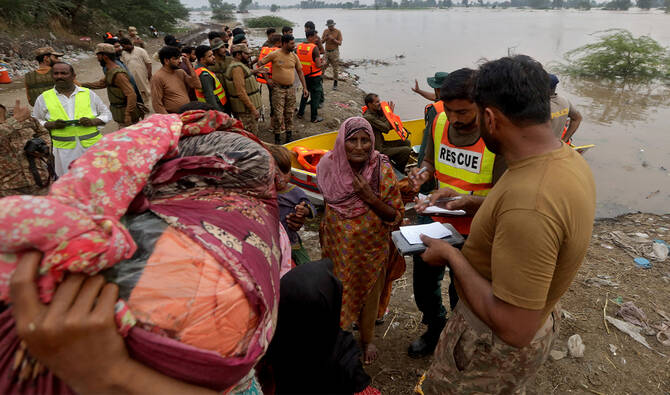

ISLAMABAD: At least 30 people have been killed and more than 1.5 million affected as high floods in the Chenab, Ravi and Sutlej rivers submerged over 2,300 villages across Pakistan’s breadbasket province of Punjab this week, the provincial disaster management authority (PDMA) said on Saturday.
The deluge, driven by record monsoon rains and water releases from upstream India, has inundated swathes of Pakistan’s most populous province, crippling rescue and relief operations and forcing the evacuation of nearly half a million people. Officials said nearly half a million residents had been evacuated to safer areas, while millions more remained affected through damaged homes, livestock losses and flooded farmland.
Officials now warn that the flood threat is likely to spread further south, with the National Disaster Management Authority (NDMA) cautioning that the Indus River at Guddu and Sukkur barrages is expected to reach very high flood levels between September 4–5.
According to the NDMA’s most recent monsoon toll, more than 830 people have died across Pakistan since June 26.
“Due to severe flooding in rivers Ravi, Sutlej and Chenab, 2,308 villages have been affected,” Punjab Relief Commissioner Nabeel Javed said in a statement released by the PDMA.
In Lahore, the provincial capital, the PDMA official confirmed two lightning-related deaths during the latest thunderstorms, while 30 people had died across Punjab.
“A total of 1.516 million people have been impacted while 481,000 trapped residents were rescued to safer places.”
He said 511 relief camps and 351 medical camps had been set up in flood-hit districts, along with 321 veterinary camps. Around 405,000 animals have also been shifted to higher ground.
“Compensation for citizens’ losses will be ensured under the instructions of the Punjab chief minister,” Javed said, adding that damages to farmers would also be assessed.
The NDMA said it had dispatched emergency rations to Sialkot and Narowal, some of the worst-affected districts, at the request of Punjab authorities. “NDMA has provided 500 ration bags each for flood-hit areas of Sialkot and Narowal,” the agency said. “A convoy of eight trucks has been sent carrying relief goods … while more consignments are planned for Wazirabad, Hafizabad, Chiniot and Jhang in the coming days.”
RISING WATERS
Flood Forecasting Division (FFD) data on Saturday showed exceptionally high flood levels at Ganda Singh Wala on the Sutlej and at Balloki on the Ravi, with the Chenab at Trimmu projected to rise to similar levels within 24 hours and Panjnad expected to reach very high flood on September 3. The Indus at Guddu was also forecast to swell dangerously by September 5.
“Exceptionally high flood level will continue in river Sutlej at Ganda Singh Wala,” the FFD bulletin warned, adding that the Chenab at Trimmu was on track to reach the same threshold within a day.
DG PDMA Irfan Ali Kathia told reporters in Lahore 303,000 cusecs of water were flowing at Ganda Singh, where the army and local administration had evacuated 20 villages overnight. He added that more than 175,000 cusecs were flowing at Head Marala on the Chenab, while dangerous levels were expected at Head Islam in the next 24 hours.
Punjab’s flooding crisis comes amid what the Met Office described as the ninth spell of monsoon rains, expected to continue until September 2. Heavy showers were recorded in Mandi Bahauddin (81 mm), Hafizabad (63 mm), Jhelum (50 mm), Sialkot (47 mm), and other districts over the past 24 hours.
The PDMA also reported that India’s Bhakra Dam is currently 84 percent full, Pong 94 percent, and Thein 92 percent, raising concerns of further cross-boundary water surges. Pakistan has repeatedly accused India of releasing excess flows into downstream rivers during monsoon peaks, intensifying flood risks in Punjab’s agricultural belt.
Meanwhile, the Pakistan Meteorological Department said hot and humid weather would persist across Sindh, with scattered rain and thunderstorms forecast in Jacobabad, Kashmore, Ghotki, Khairpur, Kamber Shahdadkot, Sanghar, Umerkot and Tharparkar.
The Indus at Guddu and Sukkur barrages was already at medium flood levels, with “very high flood” expected in coming days.


