Russia strikes across Ukraine as peace prospects flounder

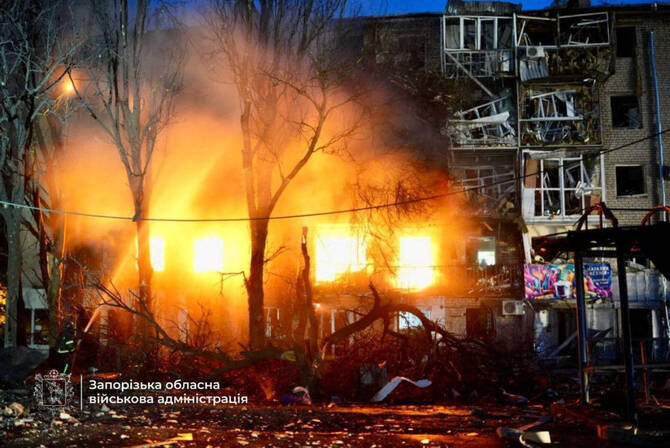
Firefighters work at the site of an apartment building hit during a Russian drone and missile strike in Zaporizhzhia, Ukraine in this handout picture released Aug. 30, 2025. (Zaporizhzhia Regional Military Administration via Telegram/Reuters)
Short Url
Updated 30 August 2025
Follow

Russia strikes across Ukraine as peace prospects flounder

  • Ukrainian rescue services said on Telegram that overnight strikes on the southern city of Zaporizhzhia had killed at least one person and wounded at least 25
  • Russia confirmed it had launched overnight attacks, saying they were against “military” targets

KYIV: Russia launched “massive” strikes across Ukraine overnight, rescue services said on Saturday, a new blow to peace efforts that drew a fresh appeal from President Volodymyr Zelensky for US and European help.

Despite a recent flurry of international efforts to broker a truce in the three-and-a-half-year conflict, led by US President Donald Trump, there have been no signs of a let-up in fighting on the ground.

Ukrainian rescue services said on Telegram that overnight strikes on the southern city of Zaporizhzhia had killed at least one person and wounded at least 25.

Three children aged between nine and 16 were admitted to hospital.

Russia confirmed it had launched overnight attacks, saying they were against “military” targets.

Zaporizhzhia regional governor Ivan Fedorov said residential buildings were hit and scores of homes left without gas or electricity.

The cities of Dnipro and Pavlograd in the central region of Dnipropetrovsk also came under attack early on Saturday, causing fires, regional governor Sergiy Lysak wrote on Telegram, warning residents to take cover.

Since Russia launched its full-scale invasion of Ukraine in February 2022, Dnipropetrovsk had been largely spared from intense fighting.

Ukraine’s air force said the Russian army had launched 582 drones and missiles overnight, most of which it had downed.

Zelensky, who has been pushing for a peace summit with Russian President Vladimir Putin, said a total of 14 regions had been targeted overnight.

He accused the Kremlin of using “the time meant for preparing a leaders’-level (peace) meeting to organize new massive attacks,” and called for more international sanctions on Moscow and its backers.

Ukraine’s army general staff meanwhile said its forces had hit two oil refineries in Russia, which it said were supplying fuel to Russian military units.

It said they had struck the Krasnodarsky refinery in Krasnodar Krai and the Sizransky refinery in Samara, causing a fire near the latter.

Russia for its part said its forces had taken a new village, Komyshuvakha, in the eastern Donetsk region.

The latest strikes by both sides followed a Russian attack on Kyiv on Thursday, in which at least 25 people died, including four children. Around 50 others were wounded.

The assault — the deadliest attack on the capital in months — led the European Union, Britain and Sweden to summon the Russian ambassadors in their capitals to protest.

Zelensky said Ukraine needed more action from the international community.

“This war won’t stop with political statements alone... The only way to reopen a window of opportunity for diplomacy is through tough measures against all those bankrolling the Russian army and effective sanctions against Moscow itself — banking and energy sanctions.”

Defense Minister Denys Shmygal announced the US State Department had approved the sale of Patriot air defense systems for Ukraine for an estimated cost of $179.1 million and satellite communications services worth $150 million.

And following Thursday’s attack on Kyiv, France and Germany said they had agreed to send additional air-defense hardware to Ukraine.

Trump met Putin in Alaska earlier this month to discuss ending the hostilities, and hosted Zelensky and European leaders at the White House last week.

But efforts to end the war appear to have lost steam, and Moscow has played down the likelihood of a Putin-Zelensky summit.

The Kremlin said on Thursday Russia wanted to “achieve our goals through political and diplomatic means” but would continue attacks until then.

Turkiye, which hosted peace talks with Russian and Ukrainian negotiators earlier this year, said on Thursday Moscow had scaled back its previous demands.

It now wanted Ukraine to cede all of its eastern Donbas region, but would be willing to freeze the conflict in the south of the country along current front lines, the Turkish foreign minister said.

Russia occupies around one-fifth of Ukraine’s territory and says it had unilaterally annexed five of the country’s regions — Donetsk, Lugansk, Kherson, Zaporizhzhia and Crimea.


UK populist Farage targets Scottish town hit by immigration protests

Updated 3 sec ago
Follow

UK populist Farage targets Scottish town hit by immigration protests

  • The Brexit champion will host a “Scotland Needs Reform” event in Falkirk
  • The town has seen rival pro- and anti-immigration protests outside a hotel housing asylum seekers

FALKIRK, UK: Populist leader Nigel Farage will rally supporters in Scotland on Saturday, bidding to build on unexpectedly strong backing for his anti-immigration Reform UK party five months before elections to its devolved parliament.
The Brexit champion, whose party has been leading in UK-wide polls throughout the year, will host a “Scotland Needs Reform” event in Falkirk, northwest of the capital Edinburgh.
The town has seen rival pro- and anti-immigration protests outside a hotel housing asylum seekers, mirroring similar scenes in English towns and cities.
On the eve of Farage’s visit, some Falkirk voters voiced unease at the migrants being housed in its Cladhan Hotel since 2021.
“I don’t feel safe, I don’t feel comfortable,” retiree Karen, who declined to give her surname, told AFP.
“And that’s changed in the past few years, I would say, a lot.”
Farage’s planned two-hour rally at another Falkirk hotel follows Reform’s surprising rise in popularity among Scottish voters.
It has leapfrogged Labour — which governs in the UK parliament in London — to take second place behind the Scottish National Party (SNP) in several surveys focused on next May’s elections to the parliament in Edinburgh.
Reform UK, which has no leader and minimal political infrastructure in Scotland, won just seven percent of Scottish votes at the 2024 UK general election but is now regularly polling in the high teens.

- ‘Laying the ground’ -

It has been luring voters from the Conservatives and to, a lesser extent, Labour, according to political analysts.
They expect Reform to win its first Scottish Parliament seats on May 7, when a proportional voting system is used.
“They’ll be happy to have what could be more than a dozen Reform MSPs (Member of the Scottish Parliament) in Holyrood arguing the party’s case,” pollster John Curtice, politics professor at Glasgow’s University of Strathclyde, told AFP.
He added they would be “laying the ground for maybe going further in 2029” when the next UK-wide election is due and crucial Scottish constituencies will be up for grabs.
The party — formed in 2021 from the ashes of Farage’s Brexit Party — this week grabbed a massive financial boost after Thailand-based cryptocurrency investor and aviation entrepreneur Christopher Harborne gave it £9 million ($12 million).
Saturday is a rare visit north of the English border for Farage, 61, the veteran Euroskeptic who has long struggled for popularity among Scots.
In 2013, when leading his UK Independence Party (UKIP), police had to escort him from an Edinburgh pub after angry confrontations with opponents he later dubbed anti-English.

- ‘Niche market’ -

Scots overwhelmingly backed staying in the EU in the divisive 2016 Brexit referendum, making Farage an unpopular figure to many.
Dubbed an English nationalist by his critics, he has also long repelled supporters of Scottish independence from the UK.
His personal popularity remains low with 69 percent of Scots viewing him unfavorably, according to a November YouGov poll.
But Reform’s messaging appears to resonate with growing numbers in Scotland.
University of Edinburgh electoral politics lecturer Fraser McMillan said, like in England, it has established itself as a “protest vote against the mainstream parties” and “the most credible vehicle for socially conservative immigration attitudes.”
“There’s a relatively strong contingent of that in Scotland,” he told AFP.
However, it struggles to woo voters away from the SNP, who are typically pro-EU and back Scottish independence.
The SNP has governed in Edinburgh for nearly two decades and is expected to top the May 7 contest, but with a diminished vote share.
Curtice said the SNP was losing “virtually nothing” to Reform, whose rise was instead fragmenting the anti-independence vote.
Ultimately, Farage’s unpopularity among Scotland’s many Brexit opponents means he is tapping into “a niche market” of voters, Curtice told AFP.
“The ability of the party to do well in Scotland has to be lower than elsewhere,” he said.