Pakistan finalizing five-year textiles and industrial policies to boost exports — minister

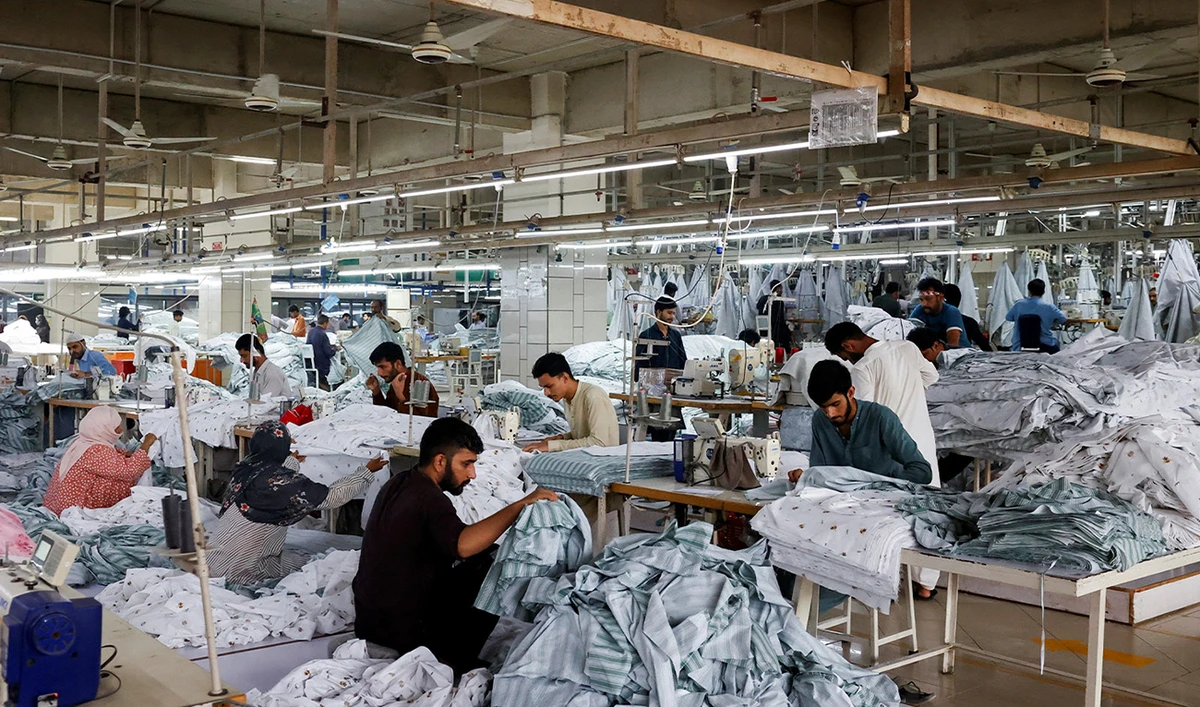
Workers sew, while others sort out fabric sheets, at a stitching unit of the textiles manufacturer of the Liberty Mills Limited, in Karachi, Pakistan August 2, 2025. (Reuters/File)
Short Url
Updated 29 August 2025
Follow

Pakistan finalizing five-year textiles and industrial policies to boost exports — minister

  • Textile sector makes up over half of Pakistan’s exports but faces high costs, outdated infrastructure, policy uncertainty
  • Exporters warn new facilitation scheme amendments could disrupt cotton supply chains, risking delays, supply shocks

ISLAMABAD: Pakistan is finalizing a five-year Textiles and Apparel Policy as well as a National Industrial Policy aimed at making industry regionally competitive, removing trade barriers and ensuring long-term export growth, Commerce Minister Jam Kamal Khan said on Friday.

The textile and apparel sector is Pakistan’s largest export earner, accounting for more than half of the country’s total exports, contributing around 8.5 percent of GDP and employing nearly 40 percent of the industrial labor force. But high energy costs, outdated infrastructure and policy uncertainty have slowed growth and left the country trailing regional peers such as Bangladesh.

“Pakistan must rely on export growth,” Khan said in remarks released by the commerce ministry after a meeting with industry representatives, including the All Pakistan Textile Mills Association (APTMA), where he discussed the new textile policy. 

“The government is committed to ensure all decisions are taken in consultation with stakeholders. For the first time, the government and industry are aligned in their determination to revive and enhance momentum of increasing exports.”

He added: “We will announce permanent and predictable policies to promote exports.”

Khan said the government would also analyze regional competitors’ policies, citing his recent visit to Dhaka where he observed Bangladesh’s “remarkable success in industrial development and exports of ready-made garments.” 

Bangladesh’s ready-made garment sector now generates about $50 billion annually and accounts for nearly 80 percent of its total exports, a scale Pakistan has struggled to match.

Prime Minister’s Special Assistant on Industries and Production Haroon Akhtar Khan said the new industrial policy would extend beyond a few sectors to cover the broader industrial landscape, including energy, tariffs and taxation, financing and economic zones. 

“The policy will also include facilitation for Greenfield projects, land-lease models under Public-Private Partnership, and a one-window facility for investor facilitation,” he said, adding that the initiative would “inject new vigor into industrial development” under Prime Minister Shehbaz Sharif’s vision.

APTMA representatives urged the government to remove structural inefficiencies and provide a more enabling environment to improve competitiveness in global markets.

Separately this week, the Pakistan Textile Council (PTC) raised concerns over recent amendments to the Export Facilitation Scheme that removed essential raw materials such as cotton, cotton yarn and grey cloth without specifying tariff codes. 

PTC Chairman Fawad Anwar said the ambiguity was causing delays and inconsistent implementation, risking disruption to supply chains. 

“This ambiguity is already causing delays, inconsistent implementation, and risks of disruption in the supply chain, which could harm Pakistan’s largest foreign exchange–earning sector, the textile industry,” he warned.

Imran Khan not a ‘national security threat,’ ex-PM’s party responds to Pakistan military

Updated 4 sec ago
Follow

Imran Khan not a ‘national security threat,’ ex-PM’s party responds to Pakistan military

  • Pakistan’s military spokesperson on Friday described Khan’s anti-army narrative as a “national security threat”
  • PTI Chairman Gohar Ali Khan says words used by military spokesperson for Khan were “not appropriate”

ISLAMABAD: Former prime minister Imran Khan’s Pakistan Tehreek-e-Insaf (PTI) party on Saturday responded to allegations by Pakistan military spokesperson Lt. Gen. Ahmed Sharif Chaudhry from a day earlier, saying that he was not a “national security threat.”

Chaudhry, who heads the military’s media wing as director general of the Inter-Services Public Relations (ISPR), spoke to journalists on Friday, in which he referred to Khan as a “mentally ill” person several times during the press interaction. Chaudhry described Khan’s anti-army narrative as a “national security threat.”

The military spokesperson was responding to Khan’s social media post this week in which he accused Chief of Defense Forces Field Marshal Asim Munir of being responsible for “the complete collapse of the constitution and rule of law in Pakistan.” 

“The people of Pakistan stand with Imran Khan, they stand with PTI,” the party’s secretary-general, Salman Akram Raja, told reporters during a news conference. 

“Imran Khan is not a national security threat. Imran Khan has kept the people of this country united.”

Raja said there were several narratives in the country, including those that created tensions along ethnic and sectarian lines, but Khan had rejected all of them and stood with one that the people of Pakistan supported. 

PTI Chairman Gohar Ali Khan, flanked by Raja, criticized the military spokesperson as well, saying his press talk on Thursday had “severely disappointed” him. 

“The words that were used [by the military spokesperson] were not appropriate,” Gohar said. “Those words were wrong.”

NATURAL OUTCOME’

Speaking to reporters earlier on Saturday, Pakistan’s Defense Minister Khawaja Asif defended the military spokesperson’s remarks against Khan.

“When this kind of language is used for individuals as well as for institutions, then a reaction is a natural outcome,” he said. 

“The same thing is happening on the Twitter accounts being run in his [Khan’s] name. If the DG ISPR has given any reaction to it, then I believe it was a very measured reaction.”

Khan, who was ousted after a parliamentary vote of confidence in April 2022, blames the country’s powerful military for removing him from power by colluding with his political opponents. Both deny the allegations. 

The former prime minister, who has been in prison since August 2023 on a slew of charges he says are politically motivated, also alleges his party was denied victory by the army and his political rivals in the 2024 general election through rigging. 

The army and the government both deny his allegations.