

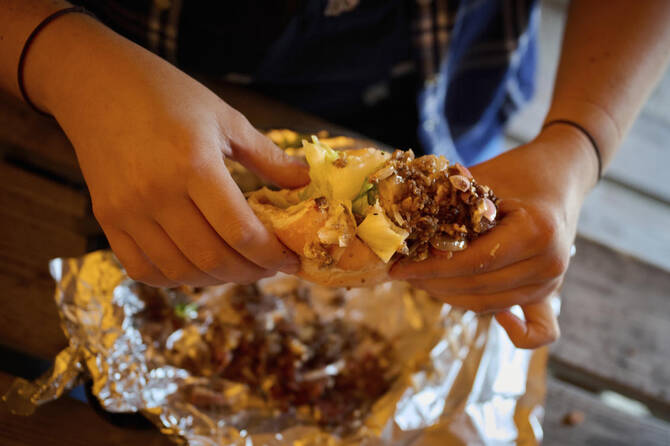

KIRUNA, Sweden: Forget Philadelphia: In the far north of Sweden, locals and tourists alike chow down on Arctic cheesesteaks, their hoagie rolls piled high with moose and reindeer meat.
At Stejk Street Food in Kiruna, some 200 kilometers (125 miles) north of the Arctic Circle, owners Zebastian Bohman and Cecilia Abrahamsson modeled their specialty after the famous Philly cheesesteak.
Last week, thousands of visitors descended upon Kiruna to watch as the historic Kiruna Church moved 5 kilometers (3 miles) east as part of the town’s relocation. The journey was necessary because the world’s largest underground iron-ore mine is threatening to swallow the town.
Hundreds of those spectators dined at Stejk Street Food, including Don and Anita Haymes, tourists from the United Kingdom. They’ve stopped by Stejk Street Food three years running during their trips to northern Sweden.
This year, the couple dined on reindeer meat cooked and served by employees wearing shirts that proclaimed “I’m glad Rudolph is dead!”
Just don’t tell their grandchildren.
Philly cheesesteaks
Typically made with thinly sliced beef, cheese and onions, cheesesteaks are Philadelphia’s religion. There’s an art form to ordering (’wit’ or ‘wit-out’ onions) and an unspoken rule that Cheez Whiz, a gooey processed cheese advertised as having a mild cheddar taste, is irreplaceable.
The rival landmarks of Geno’s Steaks and Pat’s King of Steaks, located on opposite corners of the same intersection, are a requisite pit stop for cheesesteak connoisseurs and any Pennsylvanian seeking a political office.
And because it’s a swing state, presidential candidates often run through as well. John Kerry, the former US senator from Massachusetts, is still mocked more than 20 years later for the unforgivable sin of ordering Swiss on his cheesesteak at Pat’s during his unsuccessful 2004 run for president.
Arctic ingredients
In Kiruna, meanwhile, Bohman and his wife, Abrahamsson, sought to design a dish to whet the appetite of visitors to Swedish Lapland as well as local miners who needed a meal to keep them full through their long shifts.
“We asked around what Kiruna people would like to eat and they said Subway,” the American fast-food sandwich chain, Abrahamsson, a Kiruna native, said.
Even though they’ve never been to Philadelphia, the couple decided to make their own sandwich modeled off the Philly cheesesteak but with the locally harvested meats of moose and reindeer. The latter is an homage to the area’s long tradition of reindeer herding by the Sami Indigenous people.
The hardest part, Bohman said, was sourcing the famous hoagie roll — a big, soft bun that’s everywhere in Philadelphia but nearly nowhere in Sweden. They now get them delivered once a week from the middle of the Nordic country.
Since the food truck’s 2015 opening, the menu has expanded to burgers, salads and French fries topped with moose or reindeer (or both) for those who don’t relish sticking their face into an enormous sub.
The locals like the burgers best, Bohman said, while those from Stockholm usually order the salads.
Sweeter flavor than beef
Each week, the business goes through 100 kilograms (220 pounds) of ground moose and 50 kilograms (110 pounds) of specialty smoked reindeer for about 500 cheesesteaks and 500 meat-and-fries orders.
But Bohman admits that the meat doesn’t come cheap. While a Philly cheesesteak runs a diner between $16 (Geno’s) and $18 (Pat’s), a regular-size Arctic cheesesteak costs 245 Swedish krona (nearly $26).
The Haymeses, the British couple, said it’s worth it.
“In England, we have game, like deer and venison and pheasant, partridge, but it’s not gamey like that,” Don Haymes said. “So it hasn’t got that really strong flavor. So I think it’s nice, and more people probably like it for that.”
Anna Capoccia, an Italian tourist, said her reindeer and moose sub tasted sweeter — and better — than a beef-filled Philly cheesesteak, which she ate more than a decade ago.
While Bohman and Abrahamsson have never tried Philly’s finest, they can’t imagine adding Cheez Whiz to their menu.
“That’s a little bit too greasy for Sweden,” Bohman said.


