



KARACHI/ISLAMABAD: Sindh Chief Minister Syed Murad Ali Shah said on Thursday his government is “well prepared” to tackle the looming threat of downstream floods from Punjab, saying officials were monitoring the River Indus and its embankments while climate activists and residents expressed fear.
Pakistan’s National Disaster Management Authority (NDMA) has warned that rising water levels in Chenab, Ravi and Sutlej rivers were carrying exceptionally high flows and were likely to course downstream into Sindh.
Torrential rains and excess water released by India have caused devastating floods in Punjab, where 17 people have been killed this week and over 1,600 villages have been submerged with water. Pakistan’s Meteorological Department has warned that Sindh is likely to receive heavy downpours on Aug. 30 and 31 in Tharparkar, Umerkot, Sukkur, Larkana, Jacobabad and Dadu districts.
“The government is well prepared to face the situation we are anticipating,” Shah told Arab News.

Members of Rescue 1122 evacuate residents from a flooded area following monsoon rains and rising water levels in Qadirabad village near the Chenab River in Punjab province, Pakistan on August 28, 2025. (REUTERS)
He added that the provincial irrigation department is closely monitoring River Indus and its embankments at the Guddu, Sukkur and Kotri barrages.
Shah said his government has activated its emergency response mechanism to counter the looming threat of floods. He said the provincial government had reconstructed headworks and strengthened embankments after the cataclysmic floods of 2022, with several projects still ongoing.
The provincial government has also constructed eco-friendly homes for people affected by the 2022 floods in Sindh under the Peoples Housing Project initiative, the chief minister said.
“This time under the Peoples Housing Project, we have constructed houses damaged during the flood of 2022 in elevated areas,” Shah said.
Shah said relief measures taken by the province included officials stocking relief goods such as tents and mosquito nets. He said the government will also seek cooperation from the Pakistan Navy to evacuate people if necessary.
The Indus River passes through most of Sindh’s districts, leaving them vulnerable to floods when upstream rivers swell. Pakistan’s 2022 monsoon floods, the worst in its history, submerged a third of the country, killed more than 1,700 people and displaced 33 million.
Sindh bore the brunt of the calamity with 1,093 deaths, 1.8 million homes destroyed and the loss of 4.4 million acres of crops. Over a decade earlier in 2011, more than 430 people were killed as over 17 districts were flooded with water. A year before that in 2010, large areas of Pakistan and Sindh were inundated by “super-floods,” resulting in the displacement of millions.
‘SUBMERGED FOR SEVERAL MONTHS’
Sindh-based writer Manzoor Solangi, who has extensively written in newspapers on the province’s previous floods, recalled the 2010 calamity that also damaged his house. He said it was one of the five largest floods recorded worldwide since 1887, adding that nearly one million cusecs of water flowed downstream into the province.
Solangi remembered how his home district of Naushahro Feroze received an unprecedented 1,763 millimeters of rainfall in 2022.
“There are fears the flow this time could exceed 1.2 million cusecs, a level beyond the capacity of the flow of Sindh’s all three barrages, Guddu, Sukkur and Kotri,” Solangi warned.
He noted that authorities may be forced to create breaches in flood protection dikes, which could result in large-scale flooding in Sindh’s settled areas.”
Climate activists agree.
“Climate change is a reality — a harsh reality we have to deal with,” Shahzeb Shah Jillani, a Khairpur-based climate activist, told Arab News.
“Vulnerable dikes and embankments must be reinforced, disposal systems functional, and health services ready for the outbreak of diseases that we witnessed in 2022.”
‘REMAIN VIGILANT’
Senior NDMA official Dr. Tayyab Shah told Arab News that Pakistan was expecting another heavy spell of rains in its northern parts which would increase the flow of rivers in the country.
“I would strongly emphasize that this situation would start becoming more imminent in the southern part of Pakistan,” Dr. Shah said at the National Emergency Response Center in Islamabad.
“Because the flood is now moving toward the southern region of Pakistan.”
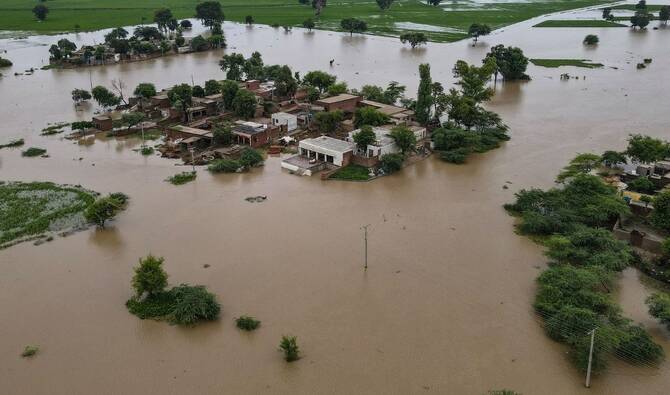
This aerial photograph shows partially submerged houses in the flood-affected area of Haqu Wala village in Pakistan's Kasur district on August 24, 2025. (AFP)
Pointing to an area of the NDMA’s response center where large LEDs depicting weather patterns across the country could be seen, Dr. Shah said this was where the disaster management authority generates early warnings before any imminent threat.
“In the month of June, we provided the first early warning that this year Pakistan would have a substantial, heavier downpour in the northeastern regions of Pakistan,” the NDMA official said.
He said people living in southern Punjab’s Mandi Bahauddin, Jhang, Sargodha, Chiniot, Bahawalpur, Bahawalnagar and Rajanpur cities to be wary of the floods.
In Sindh, he warned floods may affect people in Ghotki, Kashmore and Sanghar districts.
“All those people who are living near the proximity of the rivers, they should remain vigilant,” the NDMA official said.


