

ADB partnerships in rail, transport, minerals to be ‘revolutionary’ for Pakistan economy — PM

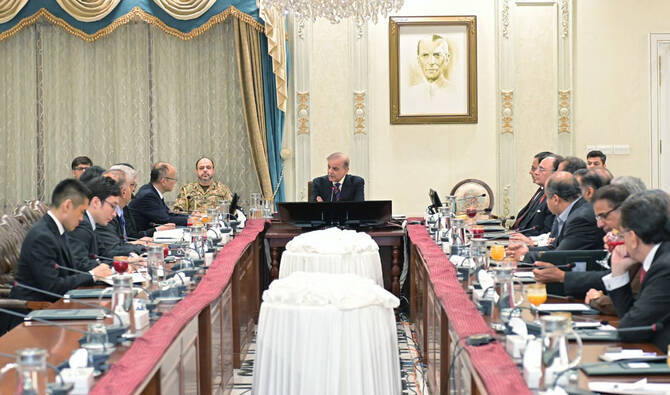
Pakistan Prime Minister Shehbaz Sharif speaks during a meeting with Asian Development Bank President Masato Kanda in Islamabad on August 27, 2025. (Handout/PMO)
Short Url
Updated 27 August 2025
Follow

ADB partnerships in rail, transport, minerals to be ‘revolutionary’ for Pakistan economy — PM

  • PM briefs ADB delegation on reforms in tax, energy, subsidies and social protection
  • Calls ADB “reliable partner in Pakistan’s journey of development and prosperity”

ISLAMABAD: Prime Minister Shehbaz Sharif on Wednesday said the Asian Development Bank’s (ADB) plans to partner in railways, public transport and mineral development in Pakistan could prove “revolutionary” for the country’s economic trajectory.

Media reports this week said ADB is in advanced talks to lead the financing of a $2 billion upgrade of a 500-km stretch of a railway line from Karachi to Rohri in the country’s south that was previously supposed to be funded by China. The upgrade has become urgent as it is needed to transport copper ore from the Reko Diq mine currently being developed by Canada’s Barrick Mining Corp. in the southwestern Balochistan province.

ADB will also reportedly provide a $410 million financing package to help develop the Reko Diq copper mine, one of the world’s largest untapped deposits.

“It is highly encouraging that ADB is interested in partnering in several major projects of Pakistan which will prove revolutionary in the country’s economic trajectory,” Sharif said after he met the lender’s president Masato Kanda in Islamabad, describing the Manila-based institution as “a reliable partner in Pakistan’s journey of development and prosperity.”

The PM added that cooperation in railways, public transport and mineral development would be “extremely beneficial for Pakistan’s economy.”

The prime minister also briefed the visiting team on reforms introduced by his government, including tax revenue mobilization, restructuring of the energy sector, fiscal stability measures, reductions in untargeted subsidies, expansion of social protection, and initiatives to counter climate change.

Kanda, in turn, praised Pakistan’s long association with the bank as a founding member and lauded recent reforms, according to Sharif’s office. He reaffirmed the ADB’s commitment to continued support, pledging enhanced cooperation in infrastructure development, institutional reforms, and climate change initiatives.


Pakistan’s president defends ongoing strikes in Afghanistan, urges Kabul to dismantle militants

Updated 02 March 2026
Follow

Pakistan’s president defends ongoing strikes in Afghanistan, urges Kabul to dismantle militants

  • Afghanistan on Thursday launched attacks in retaliation for Pakistani airstrikes the previous Sunday
  • Pakistan’s military says it is only targeting Afghan military installations to avoid civilian casualties

ISLAMABAD: Pakistan’s president on Monday defended his country’s ongoing military strikes in neighboring Afghanistan, saying Islamabad tried all forms of diplomacy before targeting militants operating from Afghan territory, and called on the Taliban government in Kabul to disarm groups responsible for attacks in Pakistan.

Pakistan earlier said it is in “open war” with Afghanistan, alarming the international community. The border area remains a stronghold for militant organizations including Al-Qaeda and the Daesh (Islamic State) group.

“(The Afghan Taliban) must choose to dismantle the terror groups that survive on conflict and its war economy,” Asif Ali Zardari said during a speech to lawmakers, adding that “no state accepts serial attacks on its soil.”

Afghanistan on Thursday launched attacks in retaliation for Pakistani airstrikes the previous Sunday. Since then, Pakistan has carried out operations along the border, with Information Minister Attaullah Tarar claiming the killing of 435 Afghan forces and the capture of 31 Afghan positions.

Kabul has denied such claims.

In Afghanistan, the deputy government spokesman Hamdullah Fitrat said Pakistan’s military fired mortar shells at a refugee camp in eastern Kunar province, killing three children and injuring three others.

Afghanistan’s defense ministry said Afghan forces carried out strikes targeting a Pakistani military facility near Paktia province, causing “substantial losses and heavy casualties.”

Pakistan’s military did not respond to questions. It has said Pakistan is only targeting Afghan military installations to avoid civilian casualties.

Pakistan has witnessed a surge of violence in recent months and blames it on the outlawed Pakistani Taliban, known as Tehreek-e-Taliban Pakistan or TTP. It operates both inside Pakistan and from Afghan territory.
Islamabad accuses Afghanistan’s Taliban government of providing safe havens for the TTP, which Kabul denies.

The latest cross-border fighting ended a ceasefire brokered by Qatar and Turkiye in October. The two sides failed to reach a permanent agreement during talks in Istanbul.

Zardari reiterated Pakistan’s call for talks, saying, “We have never walked away from dialogue.”

The Pakistani leader again accused Afghanistan of acting as a proxy for India by sheltering militant groups.

“Stop being used by another country as a battlefield for their ambitions,” he said.

Zardari cited a recent report from the United Nations Security Council’s monitoring team that described the presence of militant groups in Afghanistan as an extra-regional threat.