

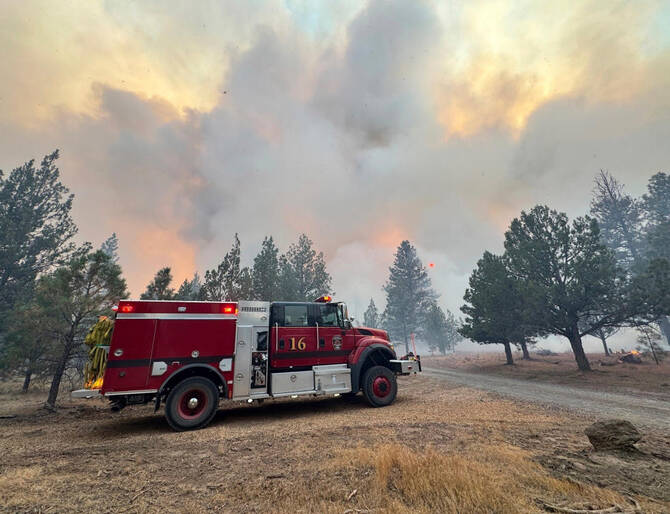

A wildfire that destroyed four homes in central Oregon was starting to stabilize on Monday, authorities said, while a blaze in Northern California wine country has so far spared some of the state’s most famous vineyards.
Moisture helped the 1,200 firefighters battling Oregon’s Flat Fire, but more work needed to be done. Dry, hot weather had fueled a rapid expansion of the blaze across 88 square kilometers of rugged terrain in Deschutes and Jefferson counties since the fire began late Thursday.
“Gotta love Mother Nature. It brought in a little bit of rain. Cooled the temps, relative humidity came up,” Travis Medema, the state’s chief deputy state fire marshal, told a community meeting in the town of Sisters. “The incident, for the first time in the last three days, is really beginning to stabilize.”
Officials said firefighters had protective lines of some sort around the entire fire, including roads, but the fire remained at five percent containment.
Authorities at one point ordered evacuations for more than 4,000 homes but lifted orders for some areas in the evening.
A heat advisory was in place through Wednesday, and forecasters warned that potential thunderstorms could create erratic winds that would challenge firefighters.
Flames in California’s wine country
Meanwhile, the Pickett Fire in Northern California has charred about 26 square kilometers of remote Napa County, known for its hundreds of wineries. It was 15 percent contained on Monday.
Flames spared the home and adjacent vineyards of Jayson Woodbridge of Hundred Acre wines, but he said it was a close call on Thursday when the fire broke out and raced along nearby slopes.
He and his son grabbed hoses and futilely began spraying down the steep hillsides. “The water was evaporating as fast as we were spraying it out there,” Woodbridge recalled Monday. “It was just a hot funnel of air. Fire was just engulfing everything.”
Before long, crews with bulldozers and air support arrived to protect the property. Water-dropping helicopters continued their flights on Monday, keeping the flames contained to canyons about 130 kilometers north of San Francisco.
With about a month to go before harvest, Woodbridge said his grapes won’t be damaged because of the “pure luck” of wind direction.
“The smoke won’t affect the fruit because the wind’s coming in from the west, thankfully,” Woodbridge said. That wasn’t the case in 2020 when toxic smoke from the Glass Fire caused Woodbridge and other wineries to scrap much of that year’s crop.
There have been no reports of damage to any vineyards from the Pickett Fire, said Michelle Novi with Napa Valley Vintners, a nonprofit trade association.
Firefighting resources have been put in place to protect wineries, especially as winds pick up later in the day, according to the California Department of Forestry & Fire Protection, or Cal Fire.
“With the weather over the last 48 hours, we’re seeing high temperatures, low humidity paired with some increasing wind in the late afternoon, which was giving our troops some additional work on the eastern side of this incident,” Cal Fire spokesperson Curtis Rhodes said on Monday.
A firefighter dies in Montana
In southwest Montana, a 60-year-old contract firefighter from Oregon died Sunday afternoon, from a cardiac emergency while battling the Bivens Creek fire.
Ruben Gonzeles Romero was among more than 700 firefighters working on the lightning-caused fire in the Tobacco Root Mountains about 24 kilometers north of Virginia City, Montana.
The Bivens Creek fire has burned approximately nine square kilometers since Aug. 13 in a remote area with thick timber and numerous dead trees.
Heat wave complicates the firefighting efforts
Residents of the western United States have been sweltering in a heat wave that hospitalized some people, with temperatures hitting dangerous levels throughout the weekend in Washington, Oregon, Southern California, Nevada and Arizona.
After a weekend of triple-digit temperatures, authorities in Multnomah County, Oregon, said they were investigating the death of a 56-year-old man as possibly heat-related.
The area of the Oregon fire is in a high desert climate, where dried grasses and juniper trees are burning and fire is racing through tinder-dry canyon areas where it’s challenging to create containment lines, said Deschutes County sheriff’s spokesperson Jason Carr.
In central California, the state’s largest blaze this year, the Gifford Fire, was at 95 percent containment Monday after charring nearly 534 square kilometers of dry brush in San Luis Obispo and Santa Barbara counties since erupting on Aug. 1. The cause is under investigation.
Although it’s difficult to directly tie a single fire or weather event directly to climate change, scientists say human-caused warming from burning fossil fuels like coal and gas is causing more intense heat waves and droughts, which in turn set the stage for more destructive wildfires.


