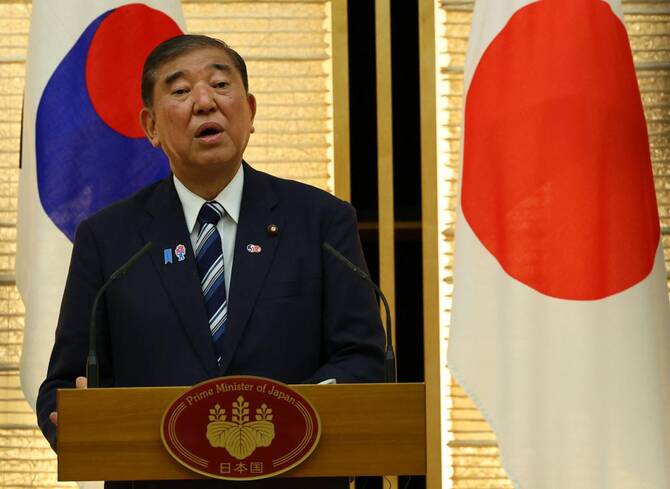
TOKYO: Japanese Prime Minister Shigeru Ishiba’s poll ratings have rebounded a month after disastrous election results left his premiership hanging by a thread, a clutch of surveys showed Monday.
Ishiba took the helm of the long-dominant Liberal Democratic Party (LDP) last year and has since lost his majority in both houses of parliament, most recently in upper chamber elections in July.
But the self-confessed defense policy “geek” and maker of model ships has defied calls to resign from within the party, which has governed Japan almost non-stop since the 1950s.
According to one poll by the Yomiuri Shimbun daily published Monday, the approval rating for Ishiba’s cabinet was 39 percent, a record 17 points higher than after the July 20 vote.
More respondents (50 percent) now think Ishiba should remain than resign (42 percent), the questionnaire showed, a reversal from July, when 54 percent said he should go and 35 percent stay.
Another poll conducted by Kyodo News put support at 35.4 percent, up 12.5 points from last month after the upper house election, while the disapproval rating stood at 49.8 percent.
A third survey by the Mainichi Shimbun put backing for the prime minister at 33 percent, a rise of four points, the first time it has been over 30 percent since February.
The Yomiuri put the recovery down to the recent trade deal with the United States and efforts by Ishiba’s government to curb the recent meteoric rise in rice prices.
US President Donald Trump announced a “massive” trade deal with Japan only two days after the upper house election, cutting threatened US tariffs to 15 percent from 25 percent, while lowering those on cars to the same level.
Voter backing of Ishiba’s handling of US trade negotiations rose to 42 percent from 29 percent in June.
An overwhelming 86 percent said they approved of the government’s decision to shift policy toward increasing rice production.
Rice prices have skyrocketed due to supply problems linked to a very hot summer in 2023 and panic-buying after a “megaquake” warning last year, among other factors.
Ishiba has appointed a new farm minister – the popular Shinjiro Koizumi, 44, a potential challenger – and his government has released emergency stocks in an effort to bring down prices.
According to media reports, the LDP plans to conduct a review of last month’s election, to be followed by a decision on whether to hold a party leadership election.
Ishiba, 68, said after a recent LDP plenary meeting, where some lawmakers reportedly urged him to step down, that he would “consider appropriately” the results of this investigation.
“I’d like to deepen my thinking as various things are going on simultaneously,” he said.
“Even within the LDP, passion for holding a party leadership election... has been diminishing,” said Mikitaka Masuyama, politics professor at the National Graduate Institute for Policy Studies.
“They may face criticism that instead of doing their jobs and addressing everyday life struggles like inflation, the LDP is holding a party leadership election,” Masuyama said.

Japan PM Ishiba bounces back in polls after election debacle
https://arab.news/8kcvc
Japan PM Ishiba bounces back in polls after election debacle
- Approval rating for Ishiba’s cabinet was 39 percent, a record 17 points higher than after the July 20 vote
- Another poll conducted by Kyodo News put support at 35.4 percent, up 12.5 points from last month after the upper house election
Russia has thrust world into new ‘age of uncertainty’: UK spy chief
- In her maiden speech, Blaise Metreweli highlighted the “threat” posed by an “aggressive, expansionist and revisionist” Russia
- “We are now operating in a space between peace and war,” added the new head of Britain’s MI6 foreign intelligence service
LONDON: Russia has propelled the world into an “age of uncertainty” and the UK is now operating in “a space between peace and war,” Britain’s new MI6 spy chief said Monday.
“Let’s be in no doubt. Our world is more dangerous and contested now than it has been for decades,” Blaise Metreweli, the first woman to lead the MI6 Secret Intelligence Service (SIS), warned.
“Conflict is evolving and trust eroding, just as new technologies spur both competition and dependence,” she said.
In her maiden speech, the new head of Britain’s MI6 foreign intelligence service highlighted the “threat” posed by an “aggressive, expansionist and revisionist” Russia.
In its war against Ukraine, Russian President Vladimir Putin “is dragging out negotiations and shifting the cost of war onto his own population,” she said.
“Russia is testing us in the grey zone with tactics that are just below the threshold of war,” she added.
Metreweli highlighted tactics by Moscow to “bully, fearmonger and manipulate” through cyberattacks on critical infrastructure, drones buzzing around European airports, aggressive activity on the seas and state-sponsored arson.
“Across the globe, we are now confronting not one single danger, but an interlocking web of security challenges — military, technological, social, ethical even — each shaping the other in complex ways,” she said.
“We are now operating in a space between peace and war.”
And Metreweli warned that “our world is being actively remade, with profound implications for national and international security.
“Institutions which were designed in the ashes of the Second World War are being challenged.”
Metreweli was appointed in June as the 18th head of the service. The MI6 chief is the only publicly named member of the organization and reports directly to the foreign minister.
She warned of the increasingly complex nature of global threats, adding the “front line is everywhere” as a result of cyber disruption, hybrid warfare, “terrorism and information manipulation.”
- ‘National resilience’ -
The new head of Britain’s armed forces, Richard Knighton, meanwhile was Monday to call for “national resilience” in another speech at the Royal United Services Institute (RUSI), a think tank specializing in defense.
“The situation is more dangerous than I have known during my career and the response requires more than simply strengthening our armed forces,” the chief of defense staff will say, according to a Ministry of Defense (MoD) statement.
“A new era for defense doesn’t just mean our military and government stepping up — as we are — it means our whole nation stepping up.”
Knighton will announce £50 million ($67 million) in funding for new “Defense Technical Excellence Colleges” to help defense employers train up staff.
The speeches come as Prime Minister Keir Starmer was due in Berlin later Monday for talks with Ukrainian President Volodymyr Zelensky and European leaders on how to end Moscow’s nearly four-year invasion.
Britain has repeatedly warned of the threat from Russia, recently raising the alarm after the government said a Russian military ship was sighted near British waters.
The MoD has just launched a new organization — the Military Intelligence Services — to unify intelligence gathering and sharing efforts undertaken by the army, navy and air force.
“The announcement comes amid escalating threats to the UK, as adversaries intensify cyber-attacks, disrupt satellites, threaten global shipping lanes, and spread disinformation,” the MoD said on Friday.


