

Pakistan joins Muslim nations in Jeddah for OIC talks on Gaza

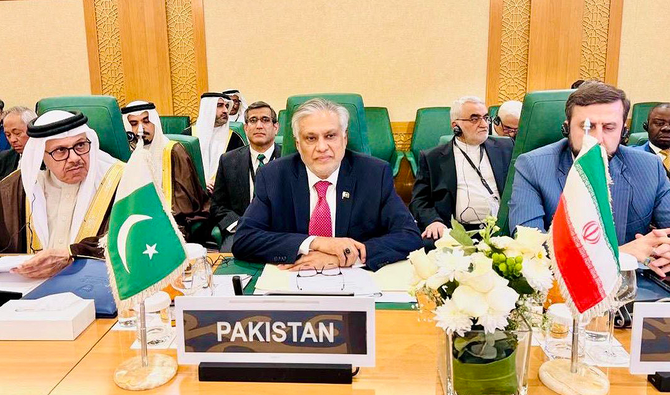
Pakistan's Deputy Prime Minister and Foreign Minister, Ishaq Dar (center), attending a meeting of Organization of Islamic Cooperation’s (OIC) Council of Foreign Ministers in Jeddah, Saudi Arabia, on March 8, 2025.(@MIshaqDar50-X/File)
Short Url
Updated 25 August 2025
Follow

Pakistan joins Muslim nations in Jeddah for OIC talks on Gaza

  • Pakistan Deputy PM Ishaq Dar to reject Israel’s plan to occupy Gaza with military force during Aug. 25-26 OIC meeting
  • Dar expected to hold meetings with representatives of key OIC member states at sidelines of summit, says foreign office

ISLAMABAD: Pakistan’s Deputy Prime Minister Ishaq Dar arrived in Saudi Arabia on Monday to take part in a meeting of the Organization of Islamic Cooperation’s (OIC) Council of Foreign Ministers being held to discuss the situation in Palestine amid Israel’s looming takeover of Gaza, the foreign office said. 

The OIC CFM from Aug. 25-26 takes place in Jeddah as Israel forces ramp up operations in Gaza, after its security cabinet this month approved a plan by Benjamin Netanyahu for Gaza’s military occupation. The move drew sharp condemnation and protests from several countries around the world, who urged the international community to rein in Israel from occupying Gaza by force. 

Dar, who is also Pakistan’s foreign minister, was received at the King Abdulaziz International Airport Jeddah by Pakistan’s Permanent Representative to OIC Ambassador Fawad Sher, Pakistan’s Ambassador to Saudi Arabia Ahmad Farooq and Pakistan’s Consul General in Jeddah Khalid Majid. 

“The Extraordinary Session will bring together foreign ministers and senior officials from the OIC member states to deliberate on coordinated responses to the escalating developments in Palestine, arising from the ongoing Israeli military aggression, proposed plans for full military control over Gaza, and the continuing egregious violations of Palestinian rights,” the foreign office said. 

In an earlier statement on Sunday, the foreign office said Dar would advocate for Israel’s total withdrawal from all Palestinian territories; reject the “outrageous” Israeli plan for extending full military control over Gaza and further displacement of Palestinians at the OIC meeting. 

It added that Dar would also emphasize on the urgent need of” unhindered humanitarian assistance” for the people of Palestine, and push for the establishment of an independent, contiguous, and sovereign Palestinian state based on pre-June 1967 borders, with Al-Quds Al-Sharif as its capital.

The foreign office said Dar was expected to hold bilateral meetings with his counterparts from OIC member states at the sidelines of the summit. 

Headquartered in Jeddah, the OIC is the second-largest inter-governmental organization after the United Nations, with a membership of 57 states across four continents. It serves as a collective voice of the Muslim world to ensure and safeguard their interests in economic, social, and political spheres.

Pakistan, which does not have diplomatic ties with Israel, has consistently condemned Israel’s war on Gaza that has killed at least 62,000 Palestinians since Oct. 7, 2023, left much of the territory in ruins and internally displaced nearly its entire population.


Pakistan, global crypto exchange discuss modernizing digital payments, creating job prospects 

Updated 8 sec ago
Follow

Pakistan, global crypto exchange discuss modernizing digital payments, creating job prospects 

  • Pakistani officials, Binance team discuss coordination between Islamabad, local banks and global exchanges
  • Pakistan has attempted to tap into growing crypto market to curb illicit transactions, improve oversight

ISLAMABAD: Pakistan’s finance officials and the team of a global cryptocurrency exchange on Friday held discussions aimed at modernizing the country’s digital payments system and building local talent pipelines to meet rising demand for blockchain and Web3 skills, the finance ministry said.

The development took place during a high-level meeting between Finance Minister Muhammad Aurangzeb, Pakistan Virtual Assets Regulatory Authority (PVARA) Chairman Bilal bin Saqib, domestic bank presidents and a Binance team led by Global CEO Richard Teng. The meeting was held to advance work on Pakistan’s National Digital Asset Framework, a regulatory setup to govern Pakistan’s digital assets.

Pakistan has been moving to regulate its fast-growing crypto and digital assets market by bringing virtual asset service providers (VASPs) under a formal licensing regime. Officials say the push is aimed at curbing illicit transactions, improving oversight, and encouraging innovation in blockchain-based financial services.

“Participants reviewed opportunities to modernize Pakistan’s digital payments landscape, noting that blockchain-based systems could significantly reduce costs from the country’s $38 billion annual remittance flows,” the finance ministry said in a statement. 

“Discussions also emphasized building local talent pipelines to meet rising global demand for blockchain and Web3 skills, creating high-value employment prospects for Pakistani youth.”

Blockchain is a type of digital database that is shared, transparent and tamper-resistant. Instead of being stored on one computer, the data is kept on a distributed network of computers, making it very hard to alter or hack.

Web3 refers to the next generation of the Internet built using blockchain, focusing on giving users more control over their data, identity and digital assets rather than big tech companies controlling it.

Participants of the meeting also discussed sovereign debt tokenization, which is the process of converting a country’s debt such as government bonds, into digital tokens on a blockchain, the ministry said. 

Aurangzeb called for close coordination between the government, domestic banks and global exchanges to modernize Pakistan’s payment landscape.

Participants of the meeting also discussed considering a “time-bound amnesty” to encourage users to move assets onto regulated platforms, stressing the need for stronger verifications and a risk-mitigation system.

Pakistan has attempted in recent months to tap into the country’s growing crypto market, crack down on money laundering and terror financing, and promote responsible innovation — a move analysts say could bring an estimated $25 billion in virtual assets into the tax net.

In September, Islamabad invited international crypto exchanges and other VASPs to apply for licenses to operate in the country, a step aimed at formalizing and regulating its fast-growing digital market.