Mexican drug lord Ismael ‘El Mayo’ Zambada to plead guilty to federal charges
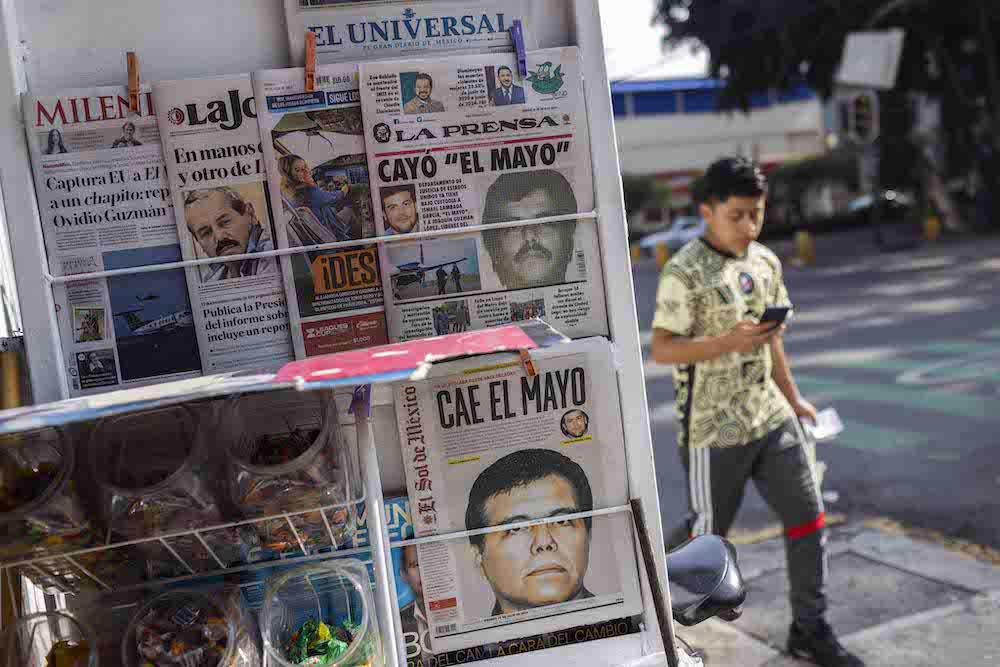
Mexican newspapers headline the capture of Ismael ‘El Mayo’ Zambada in Mexico City on July 26, 2024. The Sinaloa cartel leader is expected to plead guilty to one count of racketeering conspiracy and one count of running a continuing criminal enterprise. (AFP)
Short Url
Updated 25 August 2025
Follow

Mexican drug lord Ismael ‘El Mayo’ Zambada to plead guilty to federal charges
  • Longtime leader of the Sinaloa cartel is scheduled to appear before a federal judge in Brooklyn for a change of plea hearing
  • Appearance comes after federal prosecutors said two weeks ago that they wouldn’t seek the death penalty against Zambada

NEW YORK: Former Mexican cartel kingpin Ismael “El Mayo” Zambada is expected to plead guilty Monday to federal charges related to his role in the violent drug trade that for years flooded the US with cocaine, heroin and other illicit substances.
The longtime leader of the Sinaloa cartel is scheduled to appear before a federal judge in Brooklyn for a change of plea hearing.
The appearance comes after federal prosecutors said two weeks ago that they wouldn’t seek the death penalty against Zambada, who was arrested in Texas last year.
Prosecutors, in a court filing ahead of Monday’s hearing, said they expect the 77-year-old to plead guilty to one count of racketeering conspiracy and one count of running a continuing criminal enterprise.
Zambada pleaded not guilty last year to a range of drug trafficking and related charges, including gun and money laundering offenses.
Lawyers for Zambada didn’t immediately respond to an email seeking comment Friday.
Prosecutors say the Sinaloa cartel evolved from a regional player into the largest drug trafficking organization in the world under the leadership of Zambada and co-founder Joaquín “El Chapo” Guzman.
They say Zambada presided over a violent, highly militarized cartel with a private security force armed with powerful weapons and a cadre of “sicarios,” or hitmen, that carried out assassinations, kidnappings and torture.
Guzman was sentenced to life behind bars following his conviction in the same federal court in Brooklyn in 2019. His two sons, who ran a cartel faction, also face federal charges.


Hungary to release 1.8 million barrels of crude oil from strategic reserves

Updated 5 sec ago
Follow

Hungary to release 1.8 million barrels of crude oil from strategic reserves

  • Croatia’s JANAF pipeline operator, however, said there was no need for Budapest to tap its reserves
  • Hungary and Slovakia have been trying to secure supply since flows were halted on January 27

BUDAPEST: Hungary’s government will release about 1.8 million barrels of crude oil from its strategic reserves after a drone attack on the Druzhba pipeline late last month stopped oil flow, according to a government decree published late on Thursday.
Croatia’s JANAF pipeline operator, however, said there was no need for Budapest to tap its reserves after Hungary’s oil company MOL said on Friday JANAF must allow transit of Russian seaborne oil to Hungary and Slovakia during the Druzhba outage.
“At this ⁠moment, a significant ⁠quantity of non-Russian crude oil is being transported via JANAF’s pipeline for MOL Group, while three additional tankers carrying non-Russian oil, also for MOL Group, are on their way to the Omisalj Terminal,” JANAF said in a statement.
“There was no need to tap into (their) reserves since oil transport via the JANAF pipeline toward MOL’s refineries is being carried out continuously and without ⁠delays.”
Hungary and Slovakia, which have the only remaining refineries in the EU using Russian oil through Druzhba, have been trying to secure supply since flows were halted on January 27 following what Ukraine said was a Russian drone attack that damaged pipeline infrastructure.
Both countries have blamed Ukraine for the delay in restarting the flows for political reasons.

SCRAMBLE FOR CRUDE SUPPLIES
MOL is entitled to priority access to released crude oil reserves, and it will have access to the freed reserves until April 15 and has to return them by August 24, the Hungarian government decree said.
At the end of January, ⁠Hungary had ⁠enough crude oil and petroleum product reserves to cover 96 days, according to data on the Hungarian Hydrocarbon Stockpiling Association’s website.
As the two countries scramble to ensure supplies, MOL ordered tankers delivering Saudi, Norwegian, Kazakh, Libyan and Russian oil to supply its Hungarian and Slovak refineries and halted diesel deliveries to Ukraine earlier this week.
MOL said that first shipments were expected to arrive at the port of Omisalj in Croatia in early March. After that, it will take a further 5-12 days for the crude oil to reach its refineries.
The Slovak government has also declared an oil emergency situation and has pledged to release 1.825 million barrels of oil following a request from Slovakia’s Slovnaft refinery, which is owned by MOL.