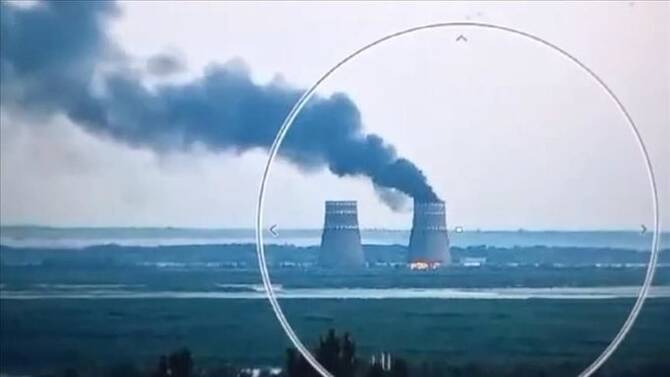
A Ukrainian drone attack sparked a short-lived fire at the Kursk Nuclear Power Plant, damaged an auxiliary transformer and led to reduction in the operating capacity at one of the plant’s units, the plant’s press service reported early on Sunday.
“A combat unmanned aerial vehicle (UAV) belonging to the Armed Forces of Ukraine was shot down by air defense systems near the Kursk Nuclear Power Plant,” the press service said in a statement on the Telegram messaging app.
“Upon impact, the drone detonated, resulting in damage to an auxiliary transformer.”
The press service added that there were no injuries, but as a result of the denotation, unit three of the plant was reduced to 50 percent capacity. The destroyed drone also sparked a fire that has since been extinguished, the press service said.
Radiation levels at the site and in the surrounding area have not exceeded normal limits, the press service added.
There was no immediate comment from Ukraine. Kyiv has said its strikes inside Russia are in response to Russia’s continued attacks on Ukraine and are aimed at destroying infrastructure deemed crucial to Moscow’s overall military efforts.
Reuters could not independently verify the report. It was not immediately clear at what part of the plant the fire occurred.
Earlier, Russia’s federal free-to-air television network REN TV reported, citing the plant’s press service, that the transformer is not a part of the nuclear section of the plant.

Ukraine drone attack causes fire, capacity reduction at Russia’s Kursk nuclear power plant
Short Url
https://arab.news/wqxk6
Ukraine drone attack causes fire, capacity reduction at Russia’s Kursk nuclear power plant
- Fire caused by falling drone that was shot down by Russian air defense systems, said the plant’s press service in a statement
- There were no injuries, but as a result of the denotation, one unit of the plant was reduced to 50 percent capacity, the statement added
UN seeks emergency funding to support cyclone-hit Sri Lanka
COLOMBO: The United Nations called on international donors on Thursday to help provide crucial assistance to Sri Lanka, grappling with the aftermath of deadly Cyclone Ditwah.
The devastating storm, which hit the island nation late last month, killed at least 639 people and affected more than 2 million others — about 10 percent of the population — causing extensive damage to homes, roads, bridges, industries and agriculture.
Some 200 people are still missing.
The UN’s top envoy to the country, Marc-Andre Franche, announced plans for a $35.3-million emergency fund which he said was needed to feed and cater to the basic needs of 658,000 people who have been worst affected.
The fund excludes reconstruction of damaged infrastructure or personal property and focuses solely on immediate basic needs.
Franche said $9.5 million had already been secured, with the European Union, Switzerland, Britain and the United States among the donors pledging funds.
The United Nations urged member states and other donors to help raise the remaining $25.8 million for the daunting recovery and reconstruction effort.
The natural disaster, which President Anura Kumara Dissanayake has described as the most challenging for his country, struck as Sri Lanka was emerging from its worst economic crisis.
It defaulted on its $46-billion external debt in April 2022, and secured a $2.9-billion bailout from the International Monetary Fund in early 2023, having only stabilized the economy earlier this year.
“The disaster is hitting the country at a moment when around 25 percent of Sri Lankans still live in poverty,” Franche told reporters in Colombo.
Ongoing monsoon rains continue to pose a hazard with continued landslide warnings, the UN said.
The devastating storm, which hit the island nation late last month, killed at least 639 people and affected more than 2 million others — about 10 percent of the population — causing extensive damage to homes, roads, bridges, industries and agriculture.
Some 200 people are still missing.
The UN’s top envoy to the country, Marc-Andre Franche, announced plans for a $35.3-million emergency fund which he said was needed to feed and cater to the basic needs of 658,000 people who have been worst affected.
The fund excludes reconstruction of damaged infrastructure or personal property and focuses solely on immediate basic needs.
Franche said $9.5 million had already been secured, with the European Union, Switzerland, Britain and the United States among the donors pledging funds.
The United Nations urged member states and other donors to help raise the remaining $25.8 million for the daunting recovery and reconstruction effort.
The natural disaster, which President Anura Kumara Dissanayake has described as the most challenging for his country, struck as Sri Lanka was emerging from its worst economic crisis.
It defaulted on its $46-billion external debt in April 2022, and secured a $2.9-billion bailout from the International Monetary Fund in early 2023, having only stabilized the economy earlier this year.
“The disaster is hitting the country at a moment when around 25 percent of Sri Lankans still live in poverty,” Franche told reporters in Colombo.
Ongoing monsoon rains continue to pose a hazard with continued landslide warnings, the UN said.
© 2025 SAUDI RESEARCH & PUBLISHING COMPANY, All Rights Reserved And subject to Terms of Use Agreement.


