

Pakistan probe panel declares journalist Khawar Hussain’s death ‘suicide’

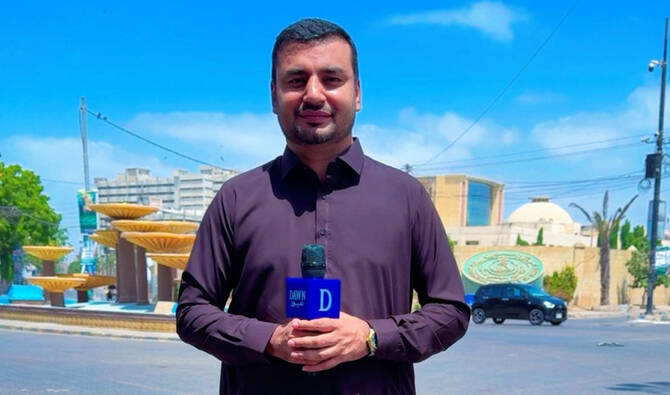
File photo of late journalist Khawar Hussain, posted by him on social media on June 7, 2025. (Facebook/@k.hussains/File)
Short Url
Updated 23 August 2025
Follow

Pakistan probe panel declares journalist Khawar Hussain’s death ‘suicide’

  • Hussain, a Karachi-based correspondent for Dawn News, was found dead inside his vehicle in Sanghar, with a gunshot wound to his head
  • His death prompted calls from senior journalists for a thorough probe, given a history of violence against journalists in the country

KARACHI: A three-member investigation committee has concluded its investigation into the death of Pakistani journalist Khawar Hussain and declared it a “suicide,” it emerged on Friday.

The body of Hussain, a Karachi-based correspondent for Dawn News, was recovered from his car parked outside a local restaurant in Sanghar district of SIndh province on Aug. 16, with a gunshot wound to his head. Police also found a pistol clutched in Hussain’s hand.

The probe committee, led by Additional Inspector General Azad Khan, said Hussain had traveled alone to Sanghar from Karachi on Aug. 16 and did not meet anyone. The journalist also removed SIM card from his phone and reset it prior to committing suicide.

The panel said it was clear from the firearm forensic examination that the lone bullet that caused the death of the deceased had been fired from the handgun recovered from his right hand.

“The committee after a thorough probe, based on detailed visit of the crime scene, interview of the witnesses, examination of post-mortem reports, forensic reports, and analysis of CCTV footage, concludes suicide as the only probable cause of death,” the probe committee report said.

Hussain’s death had shocked the media fraternity in Pakistan and prompted calls from senior journalists for a thorough probe into it, given a history of violence against journalists in the South Asian country

As per a report released by the Pakistan-based media and development sector watchdog Freedom Network last year, 184 incidents of violence against journalists took place in Sindh between 2018 and 2023. These included the killings of 10 journalists in the province.


Pakistan says defense pact with Saudi Arabia elevated brotherly ties to ‘new heights’

Updated 25 February 2026
Follow

Pakistan says defense pact with Saudi Arabia elevated brotherly ties to ‘new heights’

  • Pakistan, Saudi Arabia signed strategic defense pact last year pledging aggression against one will be treated as attack on both
  • Deputy PM Ishaq Dar says enduring bonds with Islamic and Arab nations form vital pillar of Pakistan’s foreign policy 

ISLAMABAD: Deputy Prime Minister Ishaq Dar said on Wednesday that Pakistan’s defense pact with Saudi Arabia elevated its brotherly ties with the Kingdom to “new heights,” stressing that close ties with Arab and Islamic nations form a key pillar of Islamabad’s foreign policy. 

Pakistan and Saudi Arabia signed a Strategic Mutual Defense Agreement on Sept. 17 last year, pledging that aggression against one country would be treated as an attack on both, enhancing joint deterrence and formalizing decades of military and security cooperation.

Both nations agreed in October 2025 to launch an economic cooperation framework to strengthen trade and investment ties. 

“In the Middle East, our landmark Strategic Mutual Defense Agreement with Saudi Arabia has elevated our brotherly ties to new heights,” Dar said while speaking at the Pakistan Governance Forum 2026 event in Islamabad. 

The Pakistani deputy prime minister was speaking on the topic “Navigating International Relations Amidst Changing Geo-Politics.”

Dar noted that Pakistan has reinforced partnerships with other Middle Eastern nations such as the UAE, Qatar, Jordan, Oman, Egypt and Bahrain. He said these partnerships have yielded “concrete agreements” in investment, agriculture, infrastructure, and energy sectors. 

“Our enduring bonds with Islamic and Arab nations form a vital pillar of our foreign policy, and we will continue to expand our partnerships across Asia, Latin America, and Africa,” he said. 

Dar pointed out that the presidents of Kazakhstan, Uzbekistan and Kyrgyzstan have undertaken visits to Pakistan in recent months, reflecting Central Asian nations’ desire to boost cooperation with Islamabad.

On South Asia, the Pakistani deputy PM said Pakistan has successfully transformed its fraternal ties with Bangladesh into “a substantive partnership.”

“Similarly, the trilateral mechanism involving China, Pakistan, and Bangladesh has been launched with a view to expanding and deepening regional cooperation and synergy,” the Pakistani minister said. 

He said Islamabad has strengthened its “all-weather” partnership with China via the second phase of the multi-billion-dollar China-Pakistan Economic Corridor agreement and “unwavering support” from both sides for each other’s core interests. 

Dar said Pakistan had also reinvigorated its partnership with the US, advancing cooperation in trade, technology, investment, and regional stability. 

“This calibrated approach has enhanced our ability to navigate complexity with skill and confidence, ensuring that our national interests are served without compromising our core foreign policy principles,” he said.