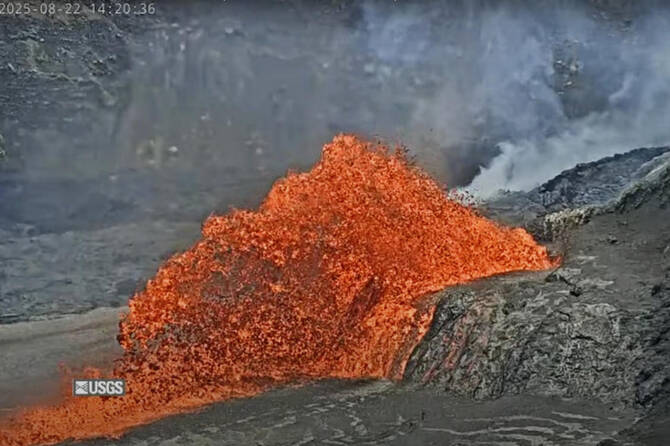
HONOLULU: Hawaii’s Kilauea volcano resumed erupting Friday by shooting an arc of lava 30 meters into the air and across a section of its summit crater floor.
It was Kilauea’s 31st display of molten rock since December, an appropriately high frequency for one of the world’s most active volcanoes.
The north vent at the summit crater began continuously spattering in the morning, and then lava overflowed a few hours later. The vent started shooting lava fountains in the afternoon.
The eruption was contained within the summit crater, and no homes were threatened.
A few lucky residents and visitors will have a front-row view at Hawaii Volcanoes National Park. If the past is a guide, hundreds of thousands more will be watching popular livestreams made possible by three camera angles set up by the US Geological Survey.
Whenever she gets word the lava is back, Park Service volunteer Janice Wei hustles to shoot photos and videos of Halemaumau Crater – which Native Hawaiian tradition says is the home to the volcano goddess Pele. She said that when the molten rock shoots high like a fountain, it sounds like a roaring jet engine or crashing ocean waves. She can feel its heat from over a mile away.
“Every eruption feels like I am sitting in the front row at nature’s most extraordinary show,” Wei said in an email.
Kilauea is on Hawaii Island, the largest of the Hawaiian archipelago. It’s about 200 miles (320 kilometers) south of the state’s largest city, Honolulu, which is on Oahu.
Here’s what to know about Kilauea’s latest eruption:
Towering fountains of molten rock
A lower magma chamber under Halemaumau Crater is receiving magma directly from the earth’s interior at about 5 cubic yards (3.8 cubic meters) per second, said Ken Hon, scientist-in-charge at the Hawaiian Volcano Observatory. This blows the chamber up like a balloon and forces magma into an upper chamber. From there it gets pushed above ground through cracks.
Magma has been using the same pathway to rise to the surface since December, making the initial release and subsequent episodes all part of the same eruption, Hon said.
Many have featured lava soaring into the air, in some cases more than 1,000 feet (300 meters). The fountains are generated in part because magma – which holds gases that are released as it rises – has been traveling to the surface through narrow, pipelike vents.
The expanding magma supply is capped by heavier magma that had expelled its gas at the end of the prior episode. Eventually enough new magma accumulates to force the degassed magma off, and the magma shoots out like a Champagne bottle that was shaken before the cork was popped.
This is the fourth time in 200 years that Kilauea has shot lava fountains into the air in repeated episodes. There were more episodes the last time Kilauea followed this pattern: The eruption that began in 1983 started with 44 sessions of shooting fountains. Those were spread out over three years, however. And the fountains emerged in a remote area, so few got to watch.
The other two occurred in 1959 and 1969.
Predicting Kilauea’s future
Scientists don’t know how the current eruption will end or how it may change. In 1983 magma built enough pressure that Kilauea opened a vent at a lower elevation and started continuously leaking lava from there rather than periodically shooting out of a higher elevation. The eruption continued in various forms for three decades and ended in 2018.
Something similar could happen again. Or the current eruption could instead stop at the summit if its magma supply peters out.
Scientists can estimate a few days or even a week ahead of time when lava is likely to emerge with the help of sensors around the volcano that detect earthquakes and minuscule changes in the angle of the ground, which indicate when magma is inflating or deflating.
“Our job is like being a bunch of ants crawling on an elephant trying to figure out how the elephant works,” Hon said.
The lava fountains have been shorter lately. Steve Lundblad, a University of Hawaii at Hilo geology professor, said the vent may have gotten wider, leaving molten rock less pressurized.
“We’re still gonna have spectacular eruptions,” he said. “They’re just going to be wider and not as high.”
Carrying stories of Pele
Some people may see lava flows as destructive. But Huihui Kanahele-Mossman, the executive director of the Edith Kanakaʻole Foundation, said lava is a natural resource that hardens into land and forms the foundation for everything on Hawaii Island.
Kanahele-Mossman’s nonprofit is named after her grandmother – the esteemed practitioner of Hawaiian language and culture and founder of a noted hula halau, or school. Hālau o Kekuhi is celebrated for its mastery of a style of hula rooted in the stories of Pele and her sister, Hiʻiaka.
Kanahele-Mossman has visited the crater a few times since the eruption began. She initially watches in awe and reverence. But then she observes more details so she can go home and compare it to the lava in the centuries-old tales that her school performs. While at the crater, she also delivers a chant prepared in advance and places offerings. Recently she presented awa, a drink made with kava, and a fern lei.
“You as the dancer, you are the storyteller and you carry that history that was written in those mele forward,” she said, using the Hawaiian word for song. “To be able to actually see that eruption that’s described in the mele, that’s always exciting to us and drives us and motivates us to stay in this tradition.”
Visiting the volcano
Park visitation has risen all eight months of the year so far, in part because of the eruption. In April there were 49 percent more visitors than the same month of 2024.
Park spokesperson Jessica Ferracane noted that the last several episodes have only lasted about 10 to 12 hours. Those wanting to go should sign up for US Geological Survey alert notifications because the eruption could be over before you know it, she said.
She cautioned that visitors should stay on marked trails and overlooks because unstable cliff edges and cracks in the earth may not be immediately apparent, and falling could lead to serious injury or death. Young children should be kept close.
Volcanic gas, glass and ash can also be dangerous. Nighttime visitors should bring a flashlight.


![]()

Hawaii’s Kilauea volcano erupts for the 31st time since December
Short Url
https://arab.news/vntev
Hawaii’s Kilauea volcano erupts for the 31st time since December
- A few lucky residents and visitors will have a front-row view at Hawaii Volcanoes National Park


Latest updates




© 2026 SAUDI RESEARCH & PUBLISHING COMPANY, All Rights Reserved And subject to Terms of Use Agreement.