

Pakistan urges immediate action on UN humanitarian plan for Syria

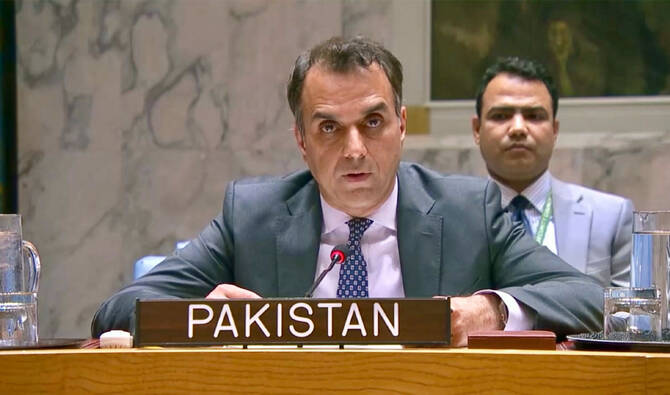
Pakistan’s Deputy Permanent Representative to the UN Ambassador, Usman Jadoon, speaks at the Security Council Briefing on UN Support Mission in Libya (UNSMIL) in New York on August 21, 2025. (@PakistanUN_NY)
Short Url
Updated 22 August 2025
Follow

Pakistan urges immediate action on UN humanitarian plan for Syria

  • Syria has been grappling with deep ethnic and religious divisions following the ouster of President Bashar Assad in December
  • Islamabad says over 16 million Syrians remain in need of assistance, deploring children continuing to face hunger, malnutrition

ISLAMABAD: Pakistan’s envoy to the United Nations (UN) has stressed urgent action to ensure adequate resources for the UN response plan to meet humanitarian needs in Syria, Pakistani state media reported on Friday.

UN humanitarian chief Tom Fletcher this week called the humanitarian situation in Syria “dire” and said aid workers need protection and safety, noting that humanitarian convoys came under fire this month.

He said money for food and other assistance is desperately needed, pointing to the UN humanitarian appeal for $3.19 billion for 2025 being only 14 percent funded.

Speaking at a UN Security Council briefing on Syria, Pakistan’s Deputy Permanent Representative to the UN Ambassador, Usman Jadoon, called for immediate humanitarian support, political inclusivity and respect for the sovereignty of Syria, the Radio Pakistan broadcaster reported.

“Over 16 million Syrians remain in need of humanitarian assistance,” he was quoted as saying. “It is deplorable that children continue to face hunger and malnutrition on a staggering scale, with access to safe water, health care and education collapsing.”

Syria is also grappling with deep ethnic and religious divisions following the ouster of President Bashar Assad in December, which brought an end to decades of Assad family rule. The transition has proven fragile, with renewed violence erupting in March along the coast and in July in Sweida, a city with a significant Druze population, highlighting the continued threat to peace after years of civil war.

Clashes erupted in Sweida on July 13 between Druze militias and local Bedouin tribes, and government forces intervened, nominally to restore order. Israel intervened in defense of the Druze, launching dozens of airstrikes on convoys of government fighters.

UN envoy for Syria Geir Pedersen warned on Thursday that while violence in Sweida has largely subsided following a ceasefire, “the threat of renewed conflict is ever-present — as are the political centrifugal forces that threaten Syria’s sovereignty, unity, independence and territorial integrity.”

“We are still seeing dangerous hostilities and skirmishes on the margins of Sweida. And violence could resume at any moment,” he said, expressing concern that “a month of relative military calm belies a worsening political climate, with escalatory and zero-sum rhetoric hardening among many.”

Pakistan’s Ambassador Jadoon strongly condemned repeated Israeli violations of Syrian sovereignty in Sweida, Daraa, Damascus and the occupied Syrian Golan.

“Such acts are in clear violation of international law, the UN Charter and Security Council’s resolutions,” he added.


OIC’s COMSTECH stresses academic collaborations across Muslim world in Islamabad meeting

Updated 4 sec ago
Follow

OIC’s COMSTECH stresses academic collaborations across Muslim world in Islamabad meeting

  • COMSTECH holds annual meeting in Islamabad featuring 30 delegates from Iran, Somalia, Palestine, Indonesia and other OIC states
  • Limited pool of skilled professionals one of the foremost challenges facing Muslim world, notes COMSTECH secretary general 

ISLAMABAD: The OIC Standing Committee on Scientific and Technological Cooperation (COMSTECH) called for stronger academic collaboration across Islamic states to secure the future of higher education in the Muslim world, state-run media reported on Saturday. 

COMSTECH’s Coordinator General Prof. Dr. Muhammad Iqbal Choudhary was speaking at the Annual Meeting of the COMSTECH Consortium of Excellence at the organization’s Secretariat in Islamabad. The event brought together vice chancellors, rectors, and senior representatives from leading universities across OIC member and observer states. 

Nearly 30 international delegates representing universities from Iran, Somalia, Palestine, Indonesia, Malaysia, Thailand, Uganda, Bangladesh, Benin, Cameroon, Gabon, Côte d’Ivoire, and Senegal joined their counterparts from several Pakistani institutions at the meeting. Participants attempted to chart a collective path forward for tertiary education in OIC countries.

“Collaborations, knowledge sharing, best practices, exchange of scholars, technology transfer and joint academic programs are vital for overcoming the educational challenges faced across the OIC region,” Choudhary said, according to the state-run Associated Press of Pakistan (APP).

The COMSTECH secretary general noted that one of the foremost developmental challenges facing OIC nations remains the limited pool of skilled professionals and workforce. 

He said this gap can only be bridged through strengthened tertiary education systems and expanded opportunities for knowledge transfer.

Discussions at the event highlighted the urgent need for competency-driven education, modern pedagogical tools, university–industry partnerships and collaborative training programs designed to equip graduates with the skills necessary to address emerging global challenges.

“The Annual Meeting served as a vital platform for reviewing progress achieved over the past year, identifying future priorities, and deepening academic cooperation to promote scientific excellence and sustainable development across the OIC region,” the APP said.