


MADRID: After surviving the perilous trek through the jungle of Panama’s Darien Gap with his wife and three daughters to reach the United States, Venezuelan policeman Alberto Peña thought he had found a haven from the persecution he says he fled from back home.
But two years later, President Donald Trump’s drive to end temporary protected status for hundreds of thousands of Venezuelans in the US forced Peña and his family to move once again — this time to Spain.
“Migrating twice is difficult, both for oneself and for one’s children,” Peña said from Madrid. “But peace of mind is priceless.”
He is among a growing number of Venezuelans who have become the new drivers of migration to Europe.
Venezuelans were for the first time the largest group applying for asylum in the EU in the first quarter after Germany received fewer Syrians following the toppling of Bashar Assad last year and migration controls in the Mediterranean reduced arrivals via Tunisia and Libya.
For years, the US was a haven for Venezuelans fleeing President Nicolas Maduro’s leftist government, but in Trump’s second term many are being branded criminals and forced to seek refuge elsewhere.
Spain, which has pursued a more flexible migration policy to address labor shortages even as European peers take a tougher approach, also shares language and cultural values that make it the natural alternative for many of the 1 million Venezuelans living in the US who fear deportation, said Tomás Paez, head of the Venezuelan Diaspora Observatory.
Fear of being sent to prisons such as the notorious Alligator Alcatraz in Florida is driving many Venezuelans to “self-deport,” said Paez.
“People are even afraid to go to school or work for fear of being raided and arrested,” he said. “They don’t know what to do, so there’s an exodus.”
Spanish NGOs have observed an increase in Venezuelans arriving or seeking guidance on how to relocate to Spain.
At least three of every 10 appointments are with Venezuelans living in the US, said Jesús Alemán, leader of the Madrid-based NGO Talento 58, which advises Venezuelan migrants such as Meliana Bruguera.
RESIDENCE PERMIT
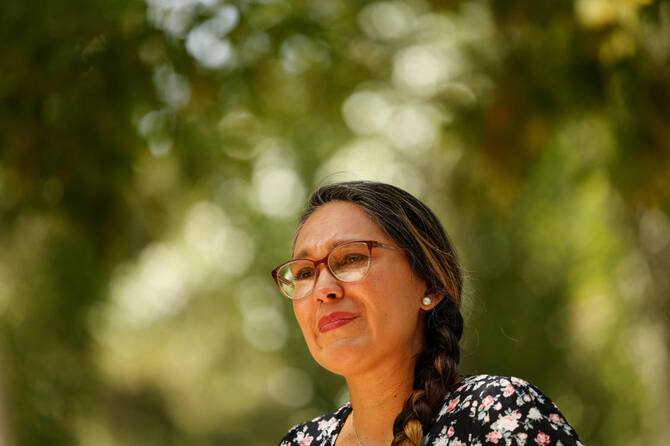
Bruguera, 41, arrived in the US saying she was fleeing threats back in Venezuela. She was pregnant and carrying her five-year-old daughter and a temporary humanitarian visa that Trump canceled for nearly 350,000 Venezuelans when she was in the process of renewing it.
Fearing deportation, she chose to leave her job as a kindergarten teacher to migrate again, this time to Spain.
“I couldn’t stop crying at work. I kept saying: ‘This is inhumane. Why are they kicking me out of the United States too?’,” she said in Madrid.
Spanish official data shows Venezuelan arrivals overall are accelerating. About 59 percent of all 77,251 asylum applications received in the first half of 2025 were by Venezuelans compared with 38 percent of all applications a year ago.
An unknown number of Venezuelans also have EU passports through family links and are applying for residency in Spain via that route.
Overall, there has been a 14 percent drop in asylum applications to Spain in the first half of the year compared with the same period last year. Total asylum applications to the EU are also down in the first quarter this year, compared with the same period in 2024, with fewer Syrians and Afghans arriving, while applications from Venezuelans are up.
According to an internal European Commission report seen by Reuters, 52,943 Venezuelans had applied for asylum in the EU to July 27 this year.
Venezuela’s economy has experienced a prolonged crisis marked by triple-digit inflation and the exodus of more than 9 million migrants seeking better opportunities abroad, according to the Venezuelan Diaspora Observatory. The government has blamed the economic collapse on sanctions by the United States and others, which it brands an “economic war.”
Most Venezuelan migrants have stayed in Latin America, overburdening already struggling public services in places like Colombia, where they get 10-year visas and access to public education and health care.
But Spain offers Venezuelans a relatively easy migration path, since they receive an automatic residence permit for humanitarian reasons if their asylum request is rejected.
That is better treatment than that received by thousands of migrants from West Africa to Spain each year, said Juan Carlos Lorenzo, a coordinator at the Spanish Commission for Refugee Aid in the Canary Islands.
“It is a privileged treatment that is almost only applied to Venezuelans,” he said.
But resettling is not easy. At least four Venezuelans who had moved from the US to Spain told Reuters it was harder to find a house to rent and a job than in the US
Bruguera and her children are staying in a Red Cross refuge while they wait for their application to be approved. Her husband, who joined them in Madrid from Venezuela, has found it difficult to rent an apartment and is living in a garage.
“Migrating a second time is doubly devastating, because you achieve stability ... and then you find that dream vanishing,” she said.
(Reporting by Corina Pons and Charlie Devereux in Madrid and Layli Foroudi in Paris; Additional reporting by Joan Faus in Barcelona; Editing by Alison Williams)


