



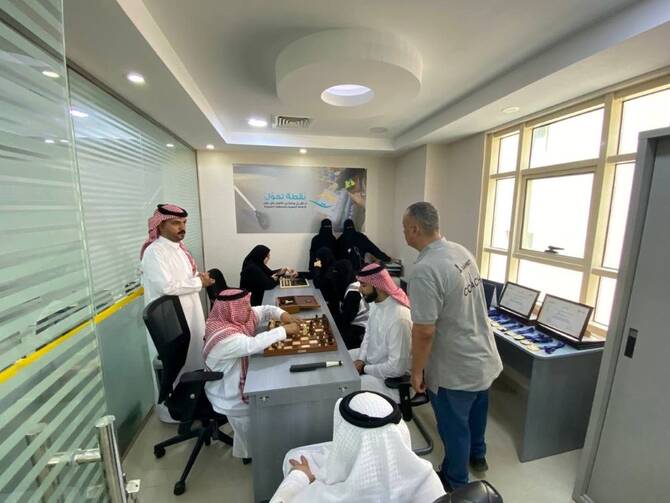


DHAHRAN: A first-of-its-kind initiative in the Kingdom has helped to introduce visually impaired players to the game of chess.
The Turning Point Association for the Rehabilitation and Empowerment of the Visually Impaired partnered with Gambit Chess Club to deliver a month-long training program in Alkhobar, which concluded on Aug. 19.
Held at the association’s headquarters, the program brought together six enthusiasts who completed 46 hours of training.
The trainees learned the fundamentals of chess, the rules of the game, and the movement of the pieces before taking part in practice matches against one another.
The closing ceremony celebrated their achievements, with certificates and medals given in the presence of representatives from the association and the club.
The popularity of chess has been steadily growing in the country, with the Saudi Chess Federation taking charge of local tournaments and training programs to encourage participation across different age groups.
The Kingdom has also hosted international chess events to bring together players from all over the world.
These efforts support cultural and recreational initiatives under Vision 2030, which aims to create opportunities and activities for people in the Kingdom.
Ali Al-Ayash, a founding member and vice president of Gambit Chess Club, said the project marked an important step for Saudi inclusivity.
“We believe that chess is not just a game, but a powerful educational and developmental tool,” he told Arab News.
He added that dedicating the program to the visually impaired was about opening doors.
Al-Ayash said: “This is a pioneering step toward integrating everyone into intellectual and cultural activities, and reflects our commitment to providing equal opportunities for all members of Saudi society.
“We’ve seen stories of individuals who have challenged disability and proved that intelligence is not measured by sight.”
He added that chess can be a platform for self-expression and empowerment, and said: “It gives participants the chance to showcase their abilities, strengthen their confidence, and compete in a fair environment. At its core this program was about breaking (down) barriers and redefining inclusivity in mind sports.”
Al-Ayash believes that chess fits naturally into the Kingdom’s goals to evolve and transform. He said: “Training in chess supports Vision 2030 by empowering individuals, especially youth, women, and people with disabilities.
“It enhances quality of life through cultural and recreational activities; strengthens education by improving logical thinking and patience; and fosters social innovation with technology and online tournaments.”
Following the achievements of the first group of trainees, Gambit Chess Club is now looking to further enhance its impact.
Al-Ayash said: “The next step is expanding the program in cooperation with local associations and schools.
“We have previously collaborated with the hearing impaired, and now we plan to involve other groups, alongside those (people) with hearing and visual disabilities.
“We want to train specialized coaches so that the program remains sustainable, and our goal is simple: to make chess accessible to everyone.”
The initiative is part of the association’s broader efforts to empower and develop skills for its beneficiaries while promoting new models of community engagement in the Kingdom.
The program represents more than just an achievement for Gambit Chess Club: The initiative is a symbol of how sports can evolve to embrace everyone, while proving that disability is no barrier to achievement.
“Chess is a universal language, and with the right support it’s a language that anyone can learn to speak,” Al-Ayash said.


