

Pakistan slams Muslim-only UN terror list, flags global rise of right-wing extremism

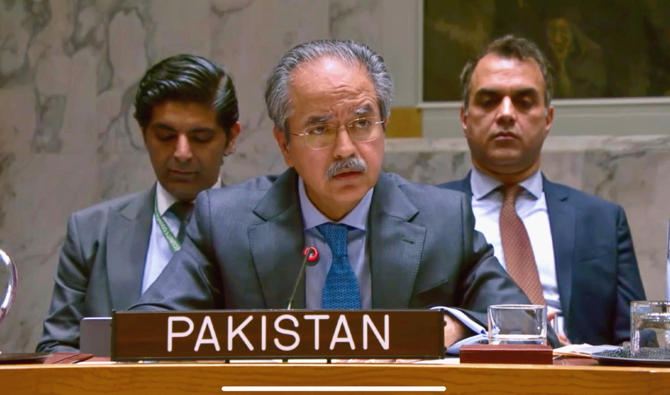
Pakistan's Ambassador to the United Nations, Asim Iftikhar Ahmad, speaking during a UN Security Council's session in New York, US, on August 20, 2025. (@PakistanUN_NY/X)
Short Url
Updated 21 August 2025
Follow

Pakistan slams Muslim-only UN terror list, flags global rise of right-wing extremism

  • Pakistan says UN terror list contradicts the world body’s own stance that terrorism is not tied to any religion
  • Its envoy maintains TTP, BLA and Majeed Brigade are collaborating in cross-border attacks against Pakistan

ISLAMABAD: Pakistan on Wednesday highlighted a global policy blindspot at the United Nations Security Council that was allowing right-wing and fascist movements to fuel extremist violence without attracting the same level of scrutiny as Muslim groups, despite posing serious threats in various parts of the world.

In remarks at a high-level Security Council briefing on threats to international peace, Pakistan’s UN envoy Asim Iftikhar Ahmad said his country had suffered deeply from militancy and condemned terrorism in all its forms. However, he urged the international community to revisit the global counterterrorism discourse, calling for a uniform application of the term “terrorism.”

“There has been a surge in the emergence of right-wing, extremist and fascist movements in several countries and regions of the world leading to terrorist violence,” he told the Council. “Yet, we see a strong inclination to see acts by non-Muslims not as terrorism, but often described just as violent crime.”

“It is not understandable, and is indeed unacceptable, that every name on the Security Council’s terrorism lists is Muslim, while terrorists and violent extremists elsewhere escape scrutiny,” he said. “There is no non-Muslim in the lists. This must change.”

Ahmad pointed out this approach ran counter to the UN’s own position that terrorism should not be associated with any religion, nationality, civilization or ethnic group.

The Pakistani envoy also reiterated his country’s concern over the challenge of militant violence emanating from Afghanistan, calling it “the single most potent threat” to the region and the world.

He cited the Tehreek-e-Taliban Pakistan (TTP) as the largest UN-designated militant outfit operating from Afghan soil, with nearly 6,000 fighters posing a direct threat to Pakistan’s national security.

“With safe havens close to our borders, it directly threatens our national security,” Ahmad continued, adding there was “credible evidence of collaboration” between the TTP and the separatist Balochistan Liberation Army (BLA) and Majeed Brigade.

These groups, he noted, had jointly targeted Pakistan’s strategic infrastructure, economic projects and civilians.

He recounted recent attacks including the hijacking of a passenger train in Balochistan earlier this year in March and a school bus attack in Khuzdar in May that left 10 people dead, eight of them children, pointing out that these acts were carried out by the same groups.

Ahmad accused Pakistan’s “principal adversary in the region” of sponsoring militant violence on its soil without naming India, saying it was also carrying out “extra-territorial assassinations that have gone global.”

He also condemned a cross-border strike by New Delhi in May that killed 54 Pakistani civilians, including 15 children, and led to an intense four-day war between the two nuclear-armed neighbors.


Pakistan, global crypto exchange discuss modernizing digital payments, creating job prospects 

Updated 05 December 2025
Follow

Pakistan, global crypto exchange discuss modernizing digital payments, creating job prospects 

  • Pakistani officials, Binance team discuss coordination between Islamabad, local banks and global exchanges
  • Pakistan has attempted to tap into growing crypto market to curb illicit transactions, improve oversight

ISLAMABAD: Pakistan’s finance officials and the team of a global cryptocurrency exchange on Friday held discussions aimed at modernizing the country’s digital payments system and building local talent pipelines to meet rising demand for blockchain and Web3 skills, the finance ministry said.

The development took place during a high-level meeting between Finance Minister Muhammad Aurangzeb, Pakistan Virtual Assets Regulatory Authority (PVARA) Chairman Bilal bin Saqib, domestic bank presidents and a Binance team led by Global CEO Richard Teng. The meeting was held to advance work on Pakistan’s National Digital Asset Framework, a regulatory setup to govern Pakistan’s digital assets.

Pakistan has been moving to regulate its fast-growing crypto and digital assets market by bringing virtual asset service providers (VASPs) under a formal licensing regime. Officials say the push is aimed at curbing illicit transactions, improving oversight, and encouraging innovation in blockchain-based financial services.

“Participants reviewed opportunities to modernize Pakistan’s digital payments landscape, noting that blockchain-based systems could significantly reduce costs from the country’s $38 billion annual remittance flows,” the finance ministry said in a statement. 

“Discussions also emphasized building local talent pipelines to meet rising global demand for blockchain and Web3 skills, creating high-value employment prospects for Pakistani youth.”

Blockchain is a type of digital database that is shared, transparent and tamper-resistant. Instead of being stored on one computer, the data is kept on a distributed network of computers, making it very hard to alter or hack.

Web3 refers to the next generation of the Internet built using blockchain, focusing on giving users more control over their data, identity and digital assets rather than big tech companies controlling it.

Participants of the meeting also discussed sovereign debt tokenization, which is the process of converting a country’s debt such as government bonds, into digital tokens on a blockchain, the ministry said. 

Aurangzeb called for close coordination between the government, domestic banks and global exchanges to modernize Pakistan’s payment landscape.

Participants of the meeting also discussed considering a “time-bound amnesty” to encourage users to move assets onto regulated platforms, stressing the need for stronger verifications and a risk-mitigation system.

Pakistan has attempted in recent months to tap into the country’s growing crypto market, crack down on money laundering and terror financing, and promote responsible innovation — a move analysts say could bring an estimated $25 billion in virtual assets into the tax net.

In September, Islamabad invited international crypto exchanges and other VASPs to apply for licenses to operate in the country, a step aimed at formalizing and regulating its fast-growing digital market.