

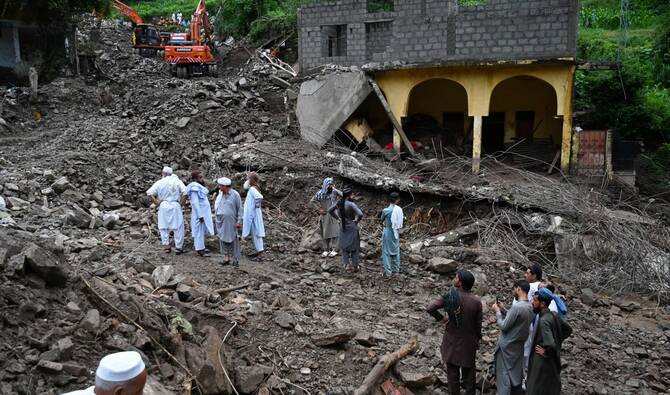

ISLAMABAD: Heavy rains, flash floods, landslides and house collapses have killed at least 385 people across Pakistan’s northwestern Khyber Pakhtunkhwa (KP) province since Aug. 15, with Buner district alone accounting for 228 deaths, according to disaster management officials.
Flash floods triggered by cloudbursts in the mountainous northwest have brought destruction since Friday in the worst spell of this year’s monsoon season, which began in late June.
Nationwide, monsoon rains and floods have killed at least 707 people and injured 967 since Jun. 26, according to the National Disaster Management Authority (NDMA). Most of the deaths have been caused by flash floods, house collapses, landslides, and electrocutions triggered by heavy rains.
“Administrations of affected districts [in KP] have been directed to accelerate relief activities and provide immediate assistance to victims,” the latest report by the Provincial Disaster Management Authority (PDMA) for KP said.
The report added that out of the 385 people killed in the province, 299 were men, 52 women, and 34 children, while 182 people had been injured.
A total of 1,398 houses had been damaged due to rains and flash floods since last week, with 1,030 houses partially damaged and 368 completely destroyed.
Buner, to the north, received more than 150 mm of rain within an hour triggered by a cloudburst on Friday morning, killing close to 230 people, the single most destructive event in this monsoon season.
“The most affected district is Buner, where the death toll has reached 228, followed by Swabi with 41 fatalities,” the report said.
Flood relief operations in places like Khyber Pakhtunkhwa are notoriously difficult because of the province’s mountainous terrain, scattered valleys, and fragile road networks that are often the first to be washed away by landslides and flash floods. Many affected villages are accessible only by narrow link roads, suspension bridges, or dirt tracks that become impassable after heavy rain. Limited air support, damaged communications, and the sheer distance between communities slow down rescue efforts, while cultural and security sensitivities in some districts further complicate the ability of aid agencies to respond quickly.
Separately, the NDMA issued a travel advisory for northern Pakistan, particularly Gilgit-Baltistan, warning that landslides and flash floods had damaged or blocked several key roads and bridges.
Routes between Skardu, Shigar, Kharmang, and Kargil were reported cut off, while access to parts of Hunza, Gilgit, and Astore was disrupted. Authorities said limited traffic was moving on the Jaglot–Skardu road after damage to the Astak Bridge, while other roads including those linking Ghizer, Shandur, Khalkti, Dain, and Ishkoman remained closed.
Some access points, including the Sarmo Bridge in Ghanche and Bagheecha Road in Skardu, have since been restored, but NDMA urged travelers to avoid damaged or unsafe routes and follow instructions from local authorities.
On Wednesday afternoon, Prime Minister Shehbaz Sharif, accompanied by federal ministers and Army Chief Field Marshal Syed Asim Muneer, visited Swat, Buner, Shangla, and Swabi districts to review the flood situation.
According to a report in state-run Associated Press of Pakistan (APP), Sharif said illegal encroachments, the timber mafia, and mining and crushing activities, especially in waterways, had contributed greatly to the loss of lives and damages.
Environmental experts have long warned that riverbed mining, unregulated logging, and construction in natural flood channels weaken ecosystems, block drainage routes, and intensify the impact of heavy rains. Since Friday, experts have widely said poor regulation and corruption, as much as extreme weather, were aggravating Pakistan’s vulnerability to climate disasters.
Annual monsoon rains are vital for agriculture, food security, and the livelihoods of millions of farmers in Pakistan. However, in recent years they have caused intense flooding and landslides amid shifting weather patterns that scientists attribute to global climate change.
Pakistan is among the world’s most climate-vulnerable nations, despite contributing less than 1 percent to global greenhouse gas emissions. Devastating floods in 2022, triggered by unusually heavy rains and the melting of glaciers, killed over 1,700 people and inflicted losses exceeding $30 billion, according to estimates.


