

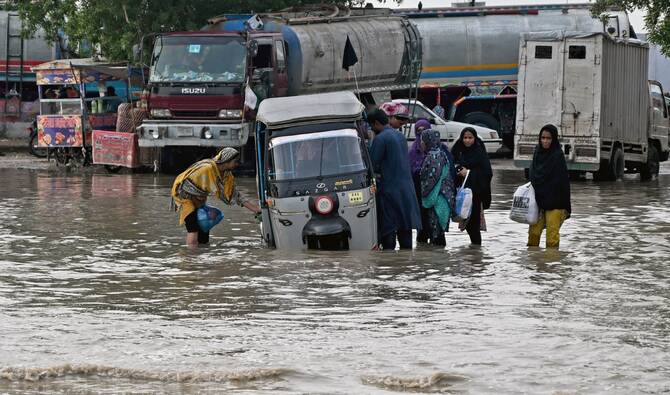

KARACHI: Pakistan’s commercial capital Karachi is bracing for another spell of heavy rain today, according to a meteorological official on Wednesday, as the city is still reeling from downpour a day earlier that killed eight people and submerged major thoroughfares, leaving citizens stranded for hours.
The downpour in Karachi occurred at a time when Pakistan is witnessing an intense monsoon season that has already ravaged several areas, particularly in the country’s north, where cloudburst-triggered deluges have killed nearly 400 people since August 15.
In total, over 700 Pakistanis, including 175 children, have died in this year’s monsoon season, which began on June 26, according to the National Disaster Management Authority (NDMA).
The situation has raised fears of a repeat of the catastrophic 2022 floods that submerged a third of Pakistan and killed more than 1,700 people, as well as causing $30 billion in economic losses.
“Heavy rainfall is expected in Karachi during the first half of the day, which could trigger flooding similar to yesterday,” Ameer Hyder, Director of the Met Office Karachi, told Arab News.
He added the city recorded up to 163.4 millimeters (mm) of rain on Tuesday.
“If today’s downpour reaches the same intensity or goes above it, it may again lead to flood-like conditions,” he said.
The situation has prompted the local administration to declare a public holiday on Wednesday due to the threat of urban flooding.
Dr. Summayia Syed, a police surgeon in the city, said eight bodies were brought to different hospitals in Karachi after yesterday’s downpour, adding that a large number of citizens also were injured in rain-related incidents.
“Eight bodies have been brought to Jinnah Post Graduate Medical Center, Abbasi Shaheed Hospital, and Civil Hospital Karachi since the rain started yesterday,” she told Arab News, adding most deaths were caused by wall collapses and electrocution.
CITY PARALYZED
On Wednesday morning, water remained in several parts of the city, with vehicles still stranded along roadside stretches.
However, Karachi Mayor Murtaza Wahab said most major roads had been cleared by morning.
“Although there is still water near the airport, which was the worst affected area yesterday, the road is now motorable,” Wahab told Arab News, urging residents to stay indoors.
He cautioned that roads could be submerged again if heavy rain returned.
“We have been clearing the roads and will continue efforts today,” he said, attributing the flooding to unusually heavy downpours in a city where the drainage system can handle only 40mm of water.
Karachi, a city of more than 20 million with dilapidated infrastructure, has often seen even moderate rains trigger flooding in parts of the city, threatening residents’ lives and causing hours-long power outages.
Wahab said there were several civic agencies that collected revenue but were not seen on the ground.
Karachi has faced repeated bouts of urban flooding in recent years.
In July-August 2009, the heaviest rains in three decades killed at least 26 people and damaged infrastructure. Torrential downpours in August 2017 left 23 dead and large parts of the city paralyzed, while heavy rains in
2019 killed 11, mostly from electrocution and collapsing structures.
The following year brought the worst flooding in nearly a century, with record-breaking rainfall in August 2020 killing more than 40 and cutting power to many neighborhoods for days.
In July 2022, intense monsoon showers again submerged parts of the city, killing at least 14 in early July and several more later that month.


