Protest-hit UK town wins bid to empty asylum-seeker hotel

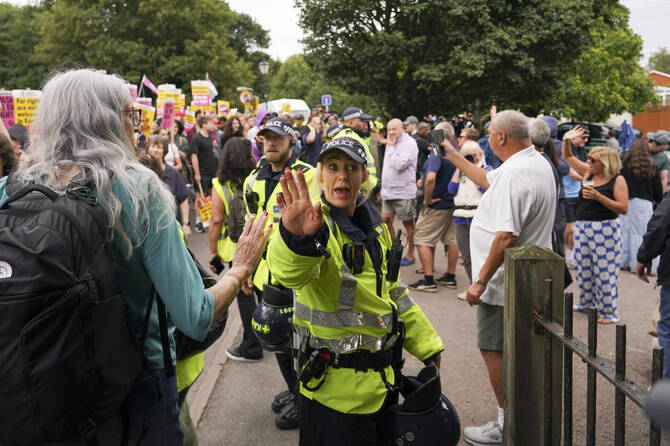
A police officer reacts as demonstrators hold placards and banners as they leave a protest outside the Bell Hotel in Epping, near London, Sunday, July 27, 2025. (AP)
Short Url
Updated 19 August 2025
Follow

Protest-hit UK town wins bid to empty asylum-seeker hotel

LONDON: A UK judge on Tuesday blocked asylum seekers from being housed at a hotel in a town which has witnessed violent protests, dealing a blow to the government.
The high court judge approved a request by the local authority in Epping, northeast of London, for a temporary injunction to stop migrants from being housed at the Bell Hotel.
The ruling, which came after the interior ministry was unsuccessful in trying to dismiss the case, raises questions about the government’s ability to provide accommodation for asylum seekers and refugees.
It also comes as Labour Prime Minister Keir Starmer faces serious political heat from the hard-right Reform UK party for failing to stop irregular migrants crossing the Channel to England on small boats.
Protests broke out in Epping in July after an asylum seeker was charged with sexually assaulting a 14-year-old girl, which he denies.
Since then hundreds of people have taken part in protests and counter-protests outside the Bell Hotel. Further anti-immigration demonstrations also spread to London and around England.
The council argued that putting the migrants in the Bell Hotel presented a “clear risk of further escalating community tensions.”
It sought an injunction that would mean the hotel’s owners, Somani Hotels Limited, must remove asylum seekers from the property within 14 days.
Judge Stephen Eyre granted the interim order, but gave the owners until September 12 to stop housing the migrants.
He issued his judgment after lawyers for the Home Office claimed that approving the request would “substantially impact” its ability to provide accommodation for asylum seekers across the UK.
Police say there have been at least six protests in Epping since July 17, with officers and vehicles attacked during some of the demonstrations.
Several men appeared in court on Monday charged with violent disorder over the protests.
Starmer has vowed to slash the number of migrants and asylum seekers in Britain, as well as reduce legal migration, to stave off pressure from the far-right Reform party, led by Brexit-leader Nigel Farage and riding high in polls.
More than 50,000 people have made the dangerous crossing from northern France in rudimentary vessels since Starmer became UK leader last July.
Labour has pledged to end the use of hotels for asylum seekers before the next election, likely in 2029, in a bid to save billions of pounds.


France moves to bar US Ambassador Charles Kushner from direct government access

Updated 5 sec ago
Follow

France moves to bar US Ambassador Charles Kushner from direct government access

  • French authorities had summoned Kushner to the Quai d’Orsay, which houses the Foreign Affairs Ministry, on Monday evening but he did not show up
  • Jean-Noel Barrot: ‘We reject any instrumentalization of this tragedy (killing of Quentin Deranque), which has plunged a French family into mourning, for political ends’
PARIS: France’s top diplomat Monday requested that US Ambassador Charles Kushner no longer be allowed direct access to members of the French government after he skipped a meeting to discuss comments by the Trump administration over the beating death of a far-right activist.
French authorities had summoned Kushner to the Quai d’Orsay, which houses the Foreign Affairs Ministry, on Monday evening but he did not show up, according to diplomatic sources.
Jean-Noel Barrot, the foreign affairs minister, moved to restrict Kushner’s access “in light of this apparent misunderstanding of the basic expectations of the mission of an ambassador, who has the honor of representing his country.”
The ministry, however, left the door open for reconciliation.
“It remains, of course, possible for Ambassador Charles Kushner to carry out his duties and present himself at the Quai d’Orsay, so that we may hold the diplomatic discussions needed to smooth over the irritants that can inevitably arise in a friendship spanning 250 years,” it said.
Kushner had been summoned following a statement by the State Department’s Counterterrorism Bureau, which posted on X that “reports, corroborated by the French Minister of the Interior, that Quentin Deranque was killed by left-wing militants, should concern us all.” The US Embassy had posted that statement on social media.
Deranque, a far-right activist, died of brain injuries this month from a beating in the French city of Lyon. He was attacked during a fight on the margins of a student meeting where a far-left lawmaker was a keynote speaker.
His killing highlighted a climate of deep political tension ahead of next year’s presidential vote.
“We reject any instrumentalization of this tragedy, which has plunged a French family into mourning, for political ends,” Barrot said over the weekend. “We have no lessons to learn, particularly on the issue of violence, from the international reactionary movement.”
The State Department said in its post that “violent radical leftism is on the rise and its role in Quentin Deranque’s death demonstrates the threat it poses to public safety. We will continue to monitor the situation and expect to see the perpetrators of violence brought to justice.”
Kushner was summoned in August over his letter to French President Emmanuel Macron alleging the country did not do enough to combat antisemitism. France’s foreign officials met with a representative of the US ambassador since the diplomat did not show up.