

Pakistan completes clearance of 585 companies under new Iraq-Iran pilgrim travel regime

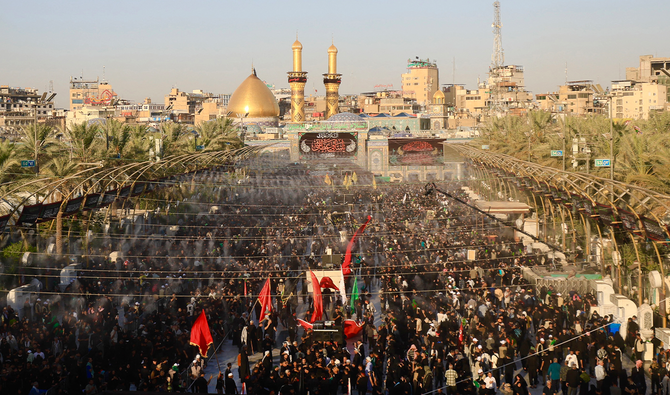
Shiite Muslim devotees attend mourning rituals next to the shrine of Imam Abu al-Fadl al-Abbas in Iraq's central holy shrine city of Karbala on August 13, 2025. (AFP)
Short Url
Updated 19 August 2025
Follow

Pakistan completes clearance of 585 companies under new Iraq-Iran pilgrim travel regime

  • Religious affairs ministry says scrutiny of Ziyarat Group Organizers underway, certificates to be issued soon
  • New centralized system replaces decades-old “Salar” model after 40,000 Pakistani pilgrims went missing abroad

ISLAMABAD: Pakistan’s ministry of religious affairs has completed security clearance of 585 companies seeking to organize pilgrimages to holy sites in Iran and Iraq, as authorities move to operationalize a new, tightly regulated travel regime, the ministry said on Tuesday.

According to a spokesperson, the ministry has begun scrutinizing applications for registration as Ziyarat Group Organizers (ZGOs), the only entities that will now be authorized to arrange pilgrimages under the restructured system.

“Security clearance of 585 companies has been completed,” the religious affairs ministry spokesman said in a statement. 

“Registration certificates for pilgrimage companies that complete the required documentation are expected to be issued soon.” 

The ministry said 95 new companies had submitted documents during the most recent extension period. Document submission from existing companies will continue until Aug. 31, while new firms can apply until Sept. 10.

The overhaul follows Islamabad’s decision last month to abolish the decades-old Salar system, in which private caravan leaders managed pilgrim travel. The move came after officials confirmed that around 40,000 Pakistani citizens had overstayed or gone missing in Iran, Iraq, and Syria over the past decade.

The government has also barred overland travel for this year’s Arbaeen pilgrimage, citing militant threats in the restive Balochistan province bordering Iran, meaning all journeys to Iraq and Iran will be arranged through registered tour operators and air travel only.

Under the new Ziyarat Management Policy, all pilgrimages must be organized through licensed groups, with operators directly responsible for ensuring that all travelers return on time. Companies that fail to meet requirements face license cancelation, the ministry has said.

Authorities say the policy aims to address long-standing security and migration concerns flagged by host governments, while restoring credibility to Pakistan’s management of religious tourism.


Pakistan says defense pact with Saudi Arabia elevated brotherly ties to ‘new heights’

Updated 25 February 2026
Follow

Pakistan says defense pact with Saudi Arabia elevated brotherly ties to ‘new heights’

  • Pakistan, Saudi Arabia signed strategic defense pact last year pledging aggression against one will be treated as attack on both
  • Deputy PM Ishaq Dar says enduring bonds with Islamic and Arab nations form vital pillar of Pakistan’s foreign policy 

ISLAMABAD: Deputy Prime Minister Ishaq Dar said on Wednesday that Pakistan’s defense pact with Saudi Arabia elevated its brotherly ties with the Kingdom to “new heights,” stressing that close ties with Arab and Islamic nations form a key pillar of Islamabad’s foreign policy. 

Pakistan and Saudi Arabia signed a Strategic Mutual Defense Agreement on Sept. 17 last year, pledging that aggression against one country would be treated as an attack on both, enhancing joint deterrence and formalizing decades of military and security cooperation.

Both nations agreed in October 2025 to launch an economic cooperation framework to strengthen trade and investment ties. 

“In the Middle East, our landmark Strategic Mutual Defense Agreement with Saudi Arabia has elevated our brotherly ties to new heights,” Dar said while speaking at the Pakistan Governance Forum 2026 event in Islamabad. 

The Pakistani deputy prime minister was speaking on the topic “Navigating International Relations Amidst Changing Geo-Politics.”

Dar noted that Pakistan has reinforced partnerships with other Middle Eastern nations such as the UAE, Qatar, Jordan, Oman, Egypt and Bahrain. He said these partnerships have yielded “concrete agreements” in investment, agriculture, infrastructure, and energy sectors. 

“Our enduring bonds with Islamic and Arab nations form a vital pillar of our foreign policy, and we will continue to expand our partnerships across Asia, Latin America, and Africa,” he said. 

Dar pointed out that the presidents of Kazakhstan, Uzbekistan and Kyrgyzstan have undertaken visits to Pakistan in recent months, reflecting Central Asian nations’ desire to boost cooperation with Islamabad.

On South Asia, the Pakistani deputy PM said Pakistan has successfully transformed its fraternal ties with Bangladesh into “a substantive partnership.”

“Similarly, the trilateral mechanism involving China, Pakistan, and Bangladesh has been launched with a view to expanding and deepening regional cooperation and synergy,” the Pakistani minister said. 

He said Islamabad has strengthened its “all-weather” partnership with China via the second phase of the multi-billion-dollar China-Pakistan Economic Corridor agreement and “unwavering support” from both sides for each other’s core interests. 

Dar said Pakistan had also reinvigorated its partnership with the US, advancing cooperation in trade, technology, investment, and regional stability. 

“This calibrated approach has enhanced our ability to navigate complexity with skill and confidence, ensuring that our national interests are served without compromising our core foreign policy principles,” he said.