

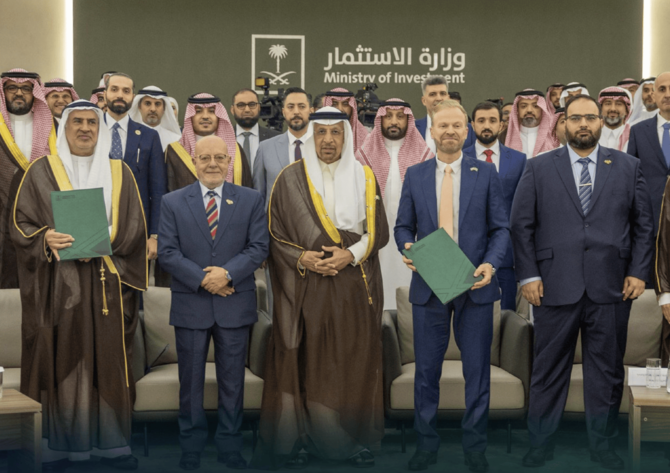

RIYADH: Saudi Arabia and Syria have signed an agreement to protect and promote mutual investments between both countries.
The deal was signed on the sidelines of a roundtable in Riyadh, following the arrival of a Syrian delegation of government officials and private sector leaders, led by the country’s Economy and Industry Minister Mohammad Nidal Al-Shaar.
The event builds on last month’s Syrian-Saudi Investment Forum in Damascus, where over 100 firms from the Kingdom, alongside 20 government agencies, signed 47 deals worth $6.4 billion across sectors including real estate, infrastructure, and finance, as well as telecom, energy, and industry.
In a post on its official X account, the Saudi Ministry of Investment described the latest deal as “a step that reflects the depth of investment ties and paves the way for distinctive cooperation between the two nations.”
The ministry added that the scope includes safeguarding investors and investments, accelerating integration, ensuring a secure environment backed by favorable laws, and boosting the flow of capital into key sectors.
The deal also addresses challenges facing investors, aims to boost the flow of mutual investments across various sectors, and seeks to create new job opportunities.
“The agreement underscores the depth of historical and economic ties between Saudi Arabia and the Syrian Arab Republic,” the ministry added in its post on X.
Speaking at the Riyadh roundtable, Saudi Minister of Investment Khalid Al-Falih said the Kingdom supports the private sector’s proposal to establish a “Fund of Funds” to facilitate and manage Saudi investments in Syria.
“In the field of infrastructure, an agreement was reached last week between Saudi-based Khashoggi Holding Co. and Syria’s Radiant Structures to enter into a strategic partnership with Sinoma to implement a joint project that includes establishing a cement plant with a daily capacity of 6,000 tonnes,” Al-Falih said during his opening remarks.
He also revealed that 80 Saudi companies have registered to participate in the Damascus International Fair, which will be held after a six-year pause from Aug. 27 to Sept. 5.
“We aim to overcome the economic challenges in Syria and support the establishment of a Saudi investment fund in Damascus,” Al-Falih said, as reported by Al-Ekhbariya.
He further emphasized that Syria’s new investment law reflects the country’s commitment to building an investment-driven future.
The deal follows Al-Shaar’s earlier meeting with Saudi Minister of Commerce Majid Al-Qasabi in Riyadh, where the two sides discussed ways to strengthen cooperation and expand investment opportunities, according to the Syrian Arab News Agency.
Both officials emphasized the importance of strengthening fraternal ties between the two nations and highlighted the need for coordinated efforts to address global economic challenges.
Talks also focused on expanding cooperation in industry and trade, with the aim of attracting more joint investments and enhancing the growth prospects of both the Saudi and Syrian economies.
Studies are underway for a partnership to establish Tadawul Co. in Damascus for securities trading.
In addition, rapid progress has been made in implementing agreements and memoranda of understanding within three weeks.
This includes an agreement between Al-Makan Real Estate Development Co. and the Syrian Ministry of Tourism to manage and operate several historic hotels in Damascus.
A deal was signed between the Saudi Co. for Trade and Construction, known as Cotroc, and the Syrian General Organization for Sugar to establish a factory in Hama.
Ghreiwal International Group has started construction work on a $2 billion real estate project named “Falak City” in Damascus.
Jawharat Al-Sharq Co. and the Syrian Investment Authority reached an agreement to launch joint projects. Al-Asas Co. has begun a feasibility study on rights to exploit phosphate reserves in Syria. Nayifat Finance Co. received approval to open offices in Damascus.
Al-Bassam Group announced plans to invest in a residential-commercial complex in Homs.
Key figures highlight the growing scale of economic ties. Syrian investments in Saudi Arabia reached SR8.4 billion ($2.24 billion) in 2023 while more than 3,000 licenses were issued to Syrian companies in the Kingdom by 2024.
Al-Shaar’s visit forms part of ongoing efforts to strengthen economic relations and expand trade between the two countries.


