



ISLAMABAD: Torrential monsoon rains and subsequent floods have killed almost 670 people in Pakistan since late June, with the disaster management authority warning on Monday that at least two more heavy spells are expected before the season tapers off in September.
Heavy rain in Pakistan’s northwestern Khyber Pakhtunkhwa province halted rescue and relief operations for several hours on Monday before resuming in a region where flash floods have killed over 300 people since Friday. Officials fear the toll, already among the deadliest in recent years, could rise further as dozens remain missing.
“We are going through the seventh spell of monsoon of 2025,” National Disaster Management Authority (NDMA) Chairman Lt. Gen. Inam Haider Malik told a press briefing.
“The predictions that we made about the monsoon from June to September, there will be at least 9 to 10 spells, which will impact different areas of Pakistan.”
He said approximately 670 people had died and about 1,000 had been injured since the monsoons began in the last week of June. Up to 90 people were also still missing.
Malik cautioned that the situation could intensify, with cloudbursts and localized rains forecast from Aug. 23 through early September.
“If horizontal flows mix with vertical flows, this can be a more dangerous situation, which we have seen in 2022,” he said, referring to devastating rains and floods that killed over 1,700 people and caused over $30 billion in losses three years ago.
The NDMA chief explained that “horizontal flows” caused by rapidly melting glaciers in the northern Gilgit-Baltistan, Khyber Pakhtunkhwa and Azad Jammu and Kashmir regions had already destroyed bridges and other infrastructure. Vertical flows, he said, came in the form of cloudbursts and prolonged rains.
“When these flows converge, they trigger serious emergencies,” Malik said.
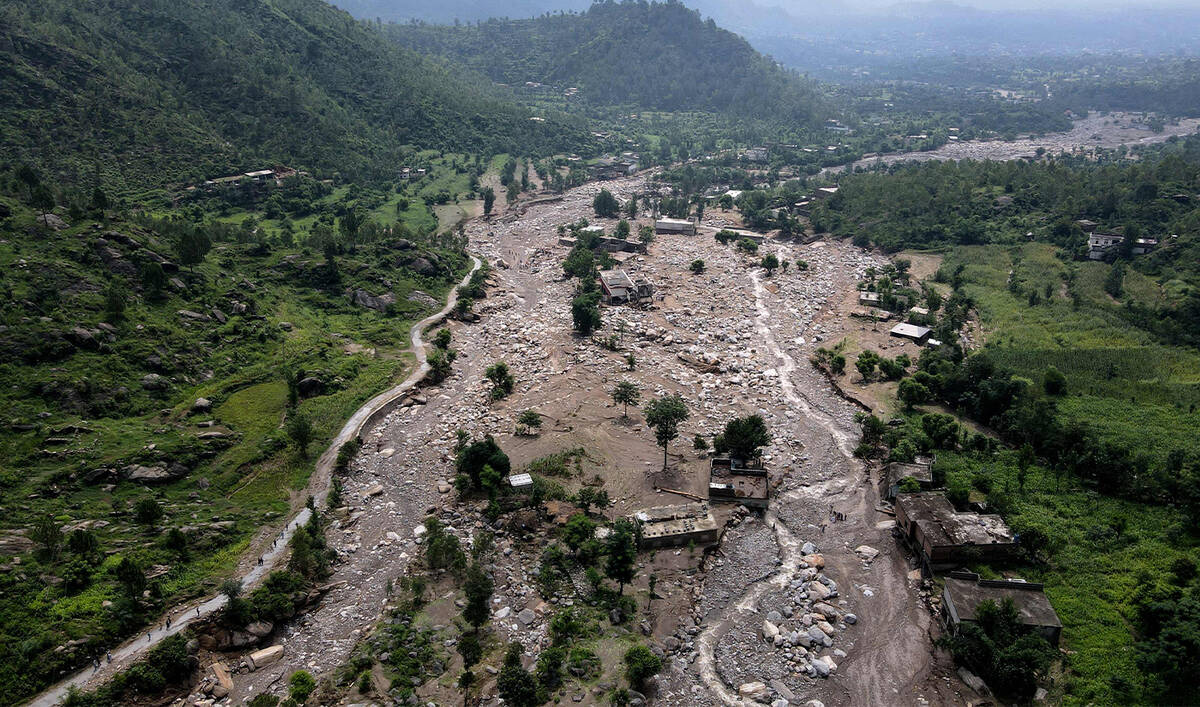
An aerial view shows houses partially submerged in sludge along a riverbed in the aftermath of flash floods at the Buner district of mountainous Khyber Pakhtunkhwa province on August 17, 2025. (AFP)
He said 425 relief camps had been activated and convoys of trucks carrying food were being dispatched to badly hit districts in Khyber Pakhtunkhwa, including Buner.
The Pakistan Army had deployed engineers and special units for search and rescue, while field hospitals and Combined Military Hospitals were on alert to treat the injured.
“By September 10, we will have comprehensive national data on casualties and damages,” Malik said.
Separately, Prime Minister Shehbaz Sharif, who chaired a high-level meeting in Islamabad, announced that the federal cabinet would donate one month’s salary to flood victims in Khyber Pakhtunkhwa.
“This is not the time for politics, it is the time for service and to heal people’s wounds,” Sharif said, according to an official statement.
He directed federal ministers to personally oversee the restoration of electricity, roads, water and other infrastructure in the affected regions. The Minister for Kashmir Affairs was tasked to supervise distribution of relief goods, while the finance ministry was instructed to provide NDMA with additional resources.
“Until the last affected person is helped and basic infrastructure is restored, the relevant federal ministers will remain in the field,” the statement quoted Sharif as saying.
The PMO said 456 relief camps had been set up nationwide and more than 400 rescue operations conducted so far, with losses to public and private property estimated at Rs126 million ($455,000). Aid distribution under the Prime Minister’s relief package, alongside medical teams and medicines, was ongoing, it added.
BUNER
Buner district in KP province has been the worst hit in the latest rains that began on Friday, with over 200 deaths.
Heavy rain in the flood-hit areas, including Buner, forced rescue teams to halt relief efforts for several hours on Monday, a regional government officer, Abid Wazir, told Reuters.
“Our priority is now to clear the roads, set up bridges and bring relief to the affected people,” he said.

Villagers look on as floodwater levels rise in the Buner district of Pakistan's Khyber Pakhtunkhwa province on August 18, 2025. (AFP)
Residents in Buner’s Bayshonai Kalay village panicked and ran to higher ground after a water channel that had earlier overflowed and caused major devastation started swelling with the fresh rain on Monday, according to Reuters witnesses.
Rescuers from local government, the disaster management authority and the army used excavator machines to clear the roads and streets from mud, fallen trees and electric poles.
Relief goods have been sent to the affected areas, Information Minister Attaullah Tarar said in a recorded video statement on Monday.
Food, medicine, blankets, camps, an electric generator and de-watering pumps are included in the relief goods, the authority said in a statement.
Buner, a three-and-a-half-hour drive from the capital Islamabad, was hit by a cloudburst, a rare phenomenon in which more than 100 mm (4 inches) of rain falls within an hour in a small area, officials said.
In Buner, there was more than 150 mm of rain within an hour on Friday morning, they said.
More heavy rain was expected across Pakistan until early September, officials said.
“The current weather system is active over the Pakistan region and may cause heavy to very heavy rainfall during the next 24 hours,” the disaster management authority said on Sunday.
With inputs from Reuters


