

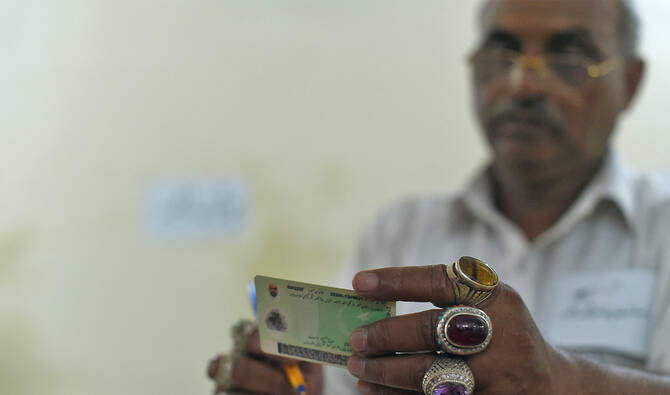

ISLAMABAD: Pakistan will develop digital identities of all its citizens to enable secure and efficient payments, Pakistani state media reported on Sunday, amid the Islamabad’s push for economic transformation.
The report comes weeks after Prime Minister Shehbaz Sharif directed provincial governments to fully cooperate with the center to move the country toward a “cashless” system as the central government aims to digitize the economy for greater transparency. Pakistan is a cash-dominated market where a significant portion of transactions, particularly in the informal sector, are conducted in cash.
In recent years, the country’s central bank has taken steps to ensure a transition toward a more cashless economy so that transactions are more traceable, reducing chances of tax evasion and corruption. Pakistan’s digital payments have also been on the rise. Since its 2021 launch, the central bank’s Raast system has processed over 892 million transactions worth Rs20 trillion ($72 billion) as of July 2025.
On Sunday, PM Sharif presided over a review meeting in Islamabad on cashless economy, at which he directed provincial chief secretaries to fully cooperate with the federal government in expanding the Raast digital payment system to the district level.
“The meeting was briefed that Pakistan will develop digital public infrastructure to create digital IDs for every citizen, integrating national Identity Cards, biometrics, and mobile numbers,” the Radio Pakistan broadcaster reported.
“These digital IDs will enable secure and efficient payments. It was further said that the provincial governments have shown significant progress in linking government-to-public and public-to-government payments with the Raast system.”
Pakistan, a country of over 240 million people, has a vast informal economy and low tax compliance. The government has long identified digitization as a key tool to improve governance, reduce corruption and expand the country’s narrow tax base.
The government has set an ambitious tax collection target of Rs14,131 billion ($49.46 billion) for the fiscal year 2025-26 (FY26), reflecting a nine-percent increase over last year’s goal.
Last month, Pakistan launched the Merchant Onboarding Framework that requires banks and payment providers to equip all merchants with Raast-enabled digital payment tools such as QR codes and POS [Point of Sale] systems. In May, the government also approved setting up the Pakistan Digital Assets Authority to regulate blockchain-based financial infrastructure.
Speaking at Sunday’s meeting, Sharif said his government was working on a priority basis to digitize the economy and transform financial transactions to cashless and digital system.
“Federal development agencies have granted Right of Way for fiber connectivity, while discussions are ongoing with Pakistan Railways and the National Highway Authority to expand digital infrastructure,” the report said, citing officials at the meeting.


